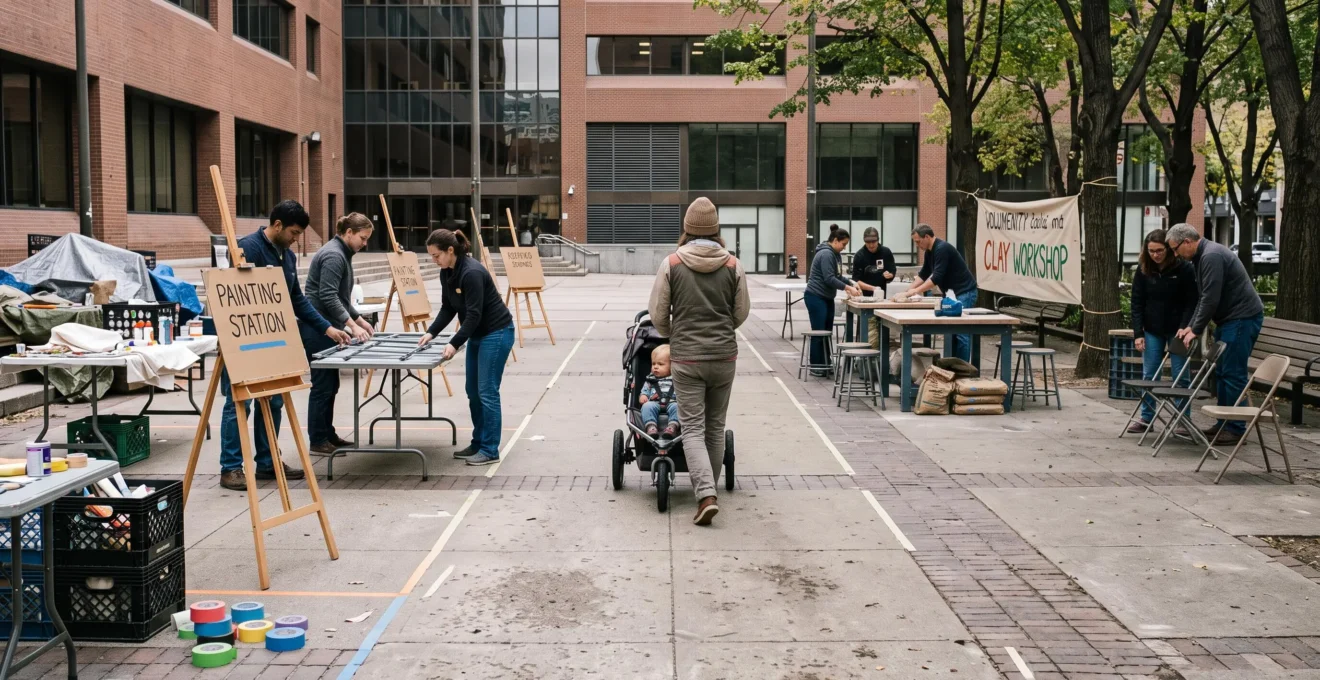
Planning a public art event in a shared outdoor space means creating opportunities for participation without preventing other people from using the location. A successful programme must accommodate artists, visitors, pedestrians, neighbouring businesses and existing recreational activities while maintaining safe, accessible circulation.
Start by observing how the site functions at the intended event time. Identify usable space, pedestrian routes, facilities and natural gathering points before selecting activities. Then establish permissions, choose participation formats that fit the available capacity, prepare weather alternatives and involve local communities in decisions that affect them.
These steps are particularly important for community arts organisers working with limited budgets, volunteer teams and mixed audiences. A public plaza, park or shared courtyard may be freely accessible in everyday use, but that does not automatically make it suitable for organised workshops, temporary installations or amplified performances. The aim is to design an event that welcomes participation while respecting the people who already depend on the space.
Outdoor public art event planning essentials
- Choose a location based on accessibility, usable gathering space and visitor behaviour, not pedestrian numbers alone.
- Protect circulation routes, confirm applicable permissions and match activity formats to available staffing and space.
- Prepare weather alternatives and involve local communities early so participation remains practical, welcoming and responsive.
- Why Does the Location of an Outdoor Art Event Affect Turnout?
- How to Set Up Outdoor Art Stations Without Blocking Pedestrians?
- Drop-In Art Activities or Booked Sessions for a Community Festival?
- Why Public Art Events Need Permission Checks Before Promotion
- When to Move an Outdoor Art Event Indoors Because of Weather?
- How to Run a Community Listening Session Before an Art Initiative?
- How to Make Exhibition Activities Welcoming to Art Beginners?
- How Can Public Engagement Make Art Programmes More Inclusive?
Why Does the Location of an Outdoor Art Event Affect Turnout?
The location of an outdoor art event affects turnout because visibility, pedestrian behaviour, accessibility and nearby activities determine whether people can discover, approach and comfortably participate. A busy walkway may attract attention without encouraging visitors to stop, while a quieter gathering area can offer better opportunities for sustained engagement. The right location supports both discovery and participation.
Foot traffic and relevant foot traffic are different. A commuter route might carry many pedestrians who are focused on reaching their destinations. By contrast, people already spending time near a community garden, playground or weekend market may be more willing to explore a creative activity.
Before choosing a location, visit the site at the same day and time proposed for the event. Observe whether people walk straight through, pause near seating or gather around existing attractions. Record where they naturally stop and whether those areas have enough additional space for art activities without obstructing others.
Visibility also matters. Check whether visitors can see the activities from main entrances, accessible paths and established gathering points. An attractive courtyard hidden behind buildings may need additional wayfinding, while a station positioned beside a busy entrance may create congestion.
Nearby programmes can either support or compete with attendance. A family art table near a playground may attract adults accompanying children, provided the station does not interfere with play. A loud demonstration beside a quiet garden, however, could conflict with the space’s existing purpose.
Use a simple pre-event site audit to record:
- Pedestrian movement, stopping patterns and likely queue locations.
- Shade, seating, natural gathering points and weather exposure.
- Step-free approaches from public transport, parking and surrounding paths.
- Accessible toilets, drinking water and available resting areas.
- Nearby activities, delivery routes and competing demands for space.
Translate these observations into a marked site sketch. Distinguish fixed features from proposed activity areas, and verify that visitors using mobility devices can reach the stations and facilities. A location may be easy to find but still unsuitable for people who cannot comfortably navigate or remain there.
Once the location is selected, its circulation patterns should determine where stations can safely operate. Designing the layout around existing movement is more reliable than arranging activities first and attempting to recover walking space afterwards.
How to Set Up Outdoor Art Stations Without Blocking Pedestrians?
Set up outdoor art stations by establishing protected pedestrian routes before allocating space to tables, easels, demonstrations or queues. Confirm the applicable accessibility and site requirements, mark the necessary circulation areas, and place activities only within the remaining usable space. Test the finished arrangement from a visitor’s perspective before opening, including access for wheelchairs and strollers.
A circulation-first layout begins with entrances, exits, accessible connections, emergency access and established pedestrian routes. Mark these on a site plan before deciding how many activity stations the location can support.
Accessibility requirements vary by jurisdiction and setting. The U.S. Access Board guidance on accessible routes explains that ADA accessible walking surfaces generally require at least 36 inches (915 mm) of clear width, subject to specified exceptions and additional requirements for passing and turning.
That minimum is not a universal event walkway standard and should not be treated as sufficient for queues or busy two-way movement. Public rights-of-way, temporary events and other jurisdictions may require different clearances. Confirm the applicable rules with the site manager and relevant authority, then provide more room where pedestrian demand requires it.
Divide the available activity space into functional zones:
- Messy activities: Put paint, clay and other wet or dusty materials away from high-traffic edges, with suitable spill management and waste collection.
- Quiet participation: Position drawing, viewing and reflection areas near seating where visitors can remain without obstructing routes.
- Demonstrations: Allow room for audiences to gather without spilling into walking paths, cycle lanes or neighbouring activities.
Account for how people will behave around each station, not just the dimensions of its equipment. A table may fit on the plan, but participants standing behind chairs or spectators gathering around an easel can significantly change its usable footprint.
Inspect practical hazards such as trailing electrical cords, unstable displays, projecting easel legs and unsecured ground coverings. Keep equipment clear of cycle lanes, loading areas and vehicle access points. Directional signs should help visitors identify entrances and activities without concentrating them into narrow passageways.
Before opening, ask someone unfamiliar with the plan to navigate the site using a stroller or mobility aid where practical, and include disabled participants or accessibility advisers in reviewing the arrangement. Check turning areas, visibility, surface changes and station reachability. A walkthrough supplements, but does not replace, applicable accessibility and safety assessments.
Circulation planning also establishes realistic activity capacity. Once the available footprint is known, organisers can choose participation formats that suit the space instead of creating queues that the site cannot accommodate.
Drop-In Art Activities or Booked Sessions for a Community Festival?
Drop-in art activities suit festivals seeking spontaneous participation, while booked sessions work better when activities require predictable capacity, dedicated instruction or specialised equipment. Neither format is universally more inclusive or efficient. The strongest choice depends on available space, volunteer capacity, material costs and participant needs. A hybrid programme can combine flexible access with controlled workshops.
Drop-in activities let passersby join without arranging their schedules in advance. However, organisers must manage uncertain demand, replenish supplies and prevent queues from spreading into shared circulation areas.
Booked sessions offer a clearer estimate of expected participation and allow facilitators to prepare specific materials. Their disadvantages include registration barriers, unused places caused by no-shows and reduced flexibility for visitors who discover the event spontaneously.
The following comparison helps identify operational trade-offs.
| Planning factor | Drop-in activities | Booked sessions |
|---|---|---|
| Attendance predictability | Variable throughout the event | Known reservations, with possible no-shows |
| Materials | Flexible supplies and replenishment needed | Prepared for reserved places and reasonable contingencies |
| Staffing | Facilitators manage changing demand | Staff can be assigned to scheduled groups |
| Visitor access | Supports spontaneous and unregistered participation | May require advance planning or registration support |
| Space management | Needs queue and crowd monitoring | Allows defined session capacities |
| Best suited to | Short, flexible, low-barrier activities | Guided workshops and capacity-sensitive activities |
The hidden costs are different. Drop-in formats transfer attendance uncertainty to organisers, who need sufficient consumables and facilitators during peak demand. Booked sessions transfer some uncertainty to participants and programme capacity: reserved places may remain unused even when other visitors would have joined.
Estimate supplies using the activity’s actual material requirements, expected participation range and opportunities to reuse equipment. For booked sessions, plan around reservations while considering possible additional participants or unused places. For drop-in stations, establish a manageable participation capacity and a clear process for temporarily pausing admissions.
A hybrid programme often offers useful flexibility. Keep simple collaborative art, drawing or printmaking available throughout the event, while scheduling a limited number of guided workshops that require controlled group sizes.
Stagger booked workshops so they do not all begin simultaneously or remove every facilitator from open stations. Offer registration alternatives for visitors with limited digital access, and consider reserving places or arranging suitable sessions for school groups, disabled participants or visitors who benefit from predictable, quieter environments.
Once the programme format is defined, the proposed activities, audience size and equipment can be checked against the permissions governing the location.
Why Public Art Events Need Permission Checks Before Promotion
Public art events need permission checks before definitive promotion because access to a shared outdoor space does not automatically authorise organised activities, installations or large gatherings. Landowner approval, permits, insurance conditions and activity-specific permissions may all apply. Confirming these requirements before announcing a fixed programme reduces the risk of cancellation, relocation and damaged community trust.
Start by identifying who owns or manages the space. A publicly accessible plaza may belong to a municipality, private property owner, development partnership or another organisation. The authority controlling the site may impose conditions beyond those required by local event regulations.
Permissions should be checked in separate layers:
- Site authorisation: Written agreement from the landowner or responsible manager.
- Event permissions: Applicable park, public-space, gathering or temporary-event approvals.
- Insurance: Any public liability coverage required by an authority, landowner, contract or risk assessment.
- Activity approvals: Conditions affecting amplified sound, food provision, temporary structures, electricity or installations.
- Third-party arrangements: Coordination with existing site users, local associations and artists whose work may be reproduced or displayed.
The UK Cabinet Office guidance on voluntary and community events recommends establishing an event’s scale, expected attendance, necessary permissions and practical requirements during planning. It also highlights the importance of considering neighbouring residents and businesses.
Insurance obligations should not be generalised across countries. For example, public liability insurance is not automatically a legal requirement for every voluntary community event in the UK, although a venue or landowner may make it a condition of using the space.
Approval processing times vary between authorities and event types. Obtain current requirements directly from the relevant organisations and record any restrictions on capacity, noise, opening hours, equipment, cleanup or public access.
Early community discussions and provisional announcements may be appropriate, but definitive promotion should be aligned with confirmed approvals. If a decision remains pending, communicate that uncertainty explicitly rather than advertising an unconfirmed venue or programme as final.
Five permission checks to complete before final promotion
- Identify the landowner and site manager; produce a contact record showing who can authorise the event.
- Describe the planned activities, equipment and expected attendance; produce an event specification for approval enquiries.
- Contact the relevant authorities about permits, insurance and additional licences; produce a requirements register with confirmed processing information.
- Consult affected site users, neighbours and relevant rights holders; produce a record of agreements and unresolved concerns.
- Collect written approvals and attached conditions; produce a final permission checklist identifying any remaining restrictions before confirming publicity.
Permission conditions can also influence contingency planning. A weather-related move to another venue may require its own access agreement, insurance review or activity restrictions, even when the original outdoor event has already been approved.
When to Move an Outdoor Art Event Indoors Because of Weather?
Move an outdoor art event indoors when forecast or observed conditions make the planned activities unsafe, inaccessible or impractical, and an appropriate indoor venue can accommodate them. Establish decision criteria before the event, considering wind, rain, heat and thunderstorms. Relocation should occur early enough to notify participants and adapt the programme, rather than becoming an improvised response.
Different activities have different weather tolerances. Lightweight easels, paper displays and temporary structures may be vulnerable to wind. Rain can damage materials, make surfaces slippery and complicate electrical equipment use. Heat may particularly affect older visitors, young children and participants with additional support needs.
Weather thresholds must be activity-specific. Organisers should determine acceptable conditions through equipment guidance, site rules, forecasts and risk assessments. A single wind-speed or temperature threshold cannot responsibly be applied to every type of outdoor art installation.
Thunderstorms require particular caution. The National Weather Service guidance on lightning safety for outdoor activities recommends advance lightning safety plans that identify who monitors weather, when activities stop and where people can seek appropriate shelter.
Small outdoor shelters and ordinary tents are not safe lightning refuges. The National Weather Service recommends waiting at least 30 minutes after the last thunder before resuming outdoor activities. Organisers must also allow sufficient time for everyone to reach safety.
A practical decision process distinguishes several responses:
- Continue with adjustments: Use suitable shade, reposition approved equipment or reduce weather-sensitive activities where conditions remain safe.
- Shorten or modify programming: Remove vulnerable activities while maintaining safe and accessible options.
- Relocate indoors: Transfer programming to an approved venue when the original activities cannot safely continue outdoors.
- Postpone or cancel: Choose this option when no safe, suitable or accessible alternative is available.
Confirm any indoor backup before advertising it as an option. Check permitted occupancy, step-free access, accessible toilets, ventilation, floor protection for paint or clay, equipment access and whether the alternative location can support the planned activities.
Set a decision schedule that accounts for venue booking deadlines and participants’ travel arrangements. Some visitors require advance certainty to organise accessible transport, childcare or assistance. Identify a responsible decision-maker and use consistent communication channels for location updates.
Assess forecast confidence alongside actual risk. Uncertain light rain may justify a modified programme, while a credible thunderstorm threat may require stopping outdoor activities even if conditions initially appear favourable.
Weather preparation is partly a communication challenge. Community members can help identify which alternative arrangements are practical, making early consultation valuable beyond the artistic programme itself.
How to Run a Community Listening Session Before an Art Initiative?
Run a community listening session by inviting people who use or are affected by the proposed location, asking about their priorities and concerns, and translating feedback into planning decisions. Separate open discussion from prioritisation, record practical constraints and report back on the outcome. Effective listening establishes what can change, not simply what participants would like to see.
Shared outdoor spaces have existing communities of use. Residents, dog walkers, sports clubs, market traders, local businesses and regular visitors may know about congestion, seasonal problems or informal routines that do not appear in official site documents.
Invite these groups early, while decisions about timing, station placement and participation formats remain open. Clarify which matters can be influenced and which are already constrained by budgets, accessibility requirements or site permissions.
A useful listening session can follow four stages:
- Set the context: Explain the proposed art initiative, its location, objectives and non-negotiable constraints.
- Gather experiences: Ask participants how they currently use the space, what activities interest them and what could cause difficulties.
- Prioritise: Use small-group discussion, sticky notes or dot voting to identify common preferences while separately recording concerns that cannot be resolved through majority preference alone.
- Confirm next steps: Summarise proposed decisions, identify unresolved questions and explain when participants will receive an update.
Do not treat the most frequently expressed preference as automatically representative. Record who attended and which groups were missing. A meeting dominated by people available on weekday evenings may overlook people working shifts, parents managing care responsibilities or visitors who avoid formal meetings.
Offer alternative feedback methods, such as brief on-site conversations, accessible online contributions or written responses. Provide language and communication support appropriate to the local community, and avoid collecting unnecessary personal information.
Closing the feedback loop is essential for trust. Publish a concise summary of what participants suggested, what the organisers changed and what could not be accommodated. Explain the reasons for rejected proposals rather than allowing them to disappear without acknowledgement.
Consultation can reveal practical barriers, but the activities themselves must also feel approachable. The next step is to turn those findings into creative experiences that welcome visitors regardless of artistic confidence.
How to Make Exhibition Activities Welcoming to Art Beginners?
Make exhibition activities welcoming to art beginners by removing unexplained jargon, offering simple ways to participate and ensuring that creative work does not feel like a test of artistic skill. Provide visible examples, supportive facilitators and activities with different levels of involvement. Visitors should be able to observe, contribute briefly or explore more deeply without pressure.
Public art events often reach people who would not normally attend a workshop or exhibition. Some may be curious but unsure what they are expected to do. Others may worry about making mistakes in front of experienced artists or strangers.
Replace specialist instructions with plain-language invitations. Rather than asking participants to explore a complex artistic technique without explanation, demonstrate an approachable action and describe what materials are available.
A graduated participation model can offer three entry points:
- Immediate participation: add a mark, colour or shape to a collective artwork without requiring prior experience.
- Guided exploration: complete a short creative task with optional facilitator support.
- Independent creation: use available materials to develop an individual response or experiment more freely.
Facilitators can demonstrate ordinary creative experimentation, including corrections and unexpected results, rather than displaying only polished examples. This helps communicate that participation is not reserved for people with technical expertise.
The social environment matters as well. Provide seating for companions, opportunities for families or friends to collaborate, and space for visitors who prefer to watch before joining. Avoid requiring everyone to speak publicly about their work.
Make physical participation practical by considering table height, reachability, seating, grip-friendly tools and alternatives for people unable or unwilling to handle particular materials. Clear visual instructions and optional spoken guidance can support visitors with different communication preferences.
Evaluate whether the approach works rather than assuming that welcoming language guarantees inclusion. Observe whether newcomers engage, ask casual questions about their experience and invite optional feedback about returning. Participation duration, repeat attendance and invitations to friends can offer useful indicators, but none alone proves that visitors felt comfortable.
Accessible entry points can help people participate on the day. Lasting inclusion, however, also depends on whether communities have genuine influence over what the programme offers in the first place.
Key takeaways for inclusive public art planning
- Ask whose needs and perspectives shaped the programme before assessing who attends it.
- Turn accessibility and community feedback into changes to activities, scheduling and space allocation.
- Evaluate the event with community partners and document improvements for future editions.
How Can Public Engagement Make Art Programmes More Inclusive?
Public engagement can make art programmes more inclusive when communities help shape decisions rather than only receive invitations to attend. Involving residents, local groups and potential participants in choosing themes, formats and practical arrangements can expose barriers that organisers might otherwise overlook. Inclusion becomes more meaningful when feedback influences decisions and its effects are reviewed over time.
Consultation and co-creation serve different purposes. Consultation collects perspectives that organisers can consider. Co-creation gives community members a defined role in developing aspects of the programme, such as selecting themes, proposing activities or collaborating with artists.
Neither approach automatically guarantees representative participation. What matters is whether the process gives affected people appropriate influence, recognises different needs and produces accountable decisions.
The National Endowment for the Arts describes community planning, public-space design, arts workshops and public art as activities within its creative placemaking framework. Its emphasis on place-specific priorities and partnerships provides a useful basis for developing programmes with communities rather than treating them solely as audiences.
Inclusion is shaped long before opening day. Organisers should consider who is invited into planning discussions, whether activities have financial or registration barriers, and how timing affects people with employment, education or caring responsibilities.
Communication formats also influence participation. Plain-language descriptions, relevant translations, accessible registration alternatives and advance information about noise, materials and sensory conditions can help visitors make informed choices.
The physical environment must support those invitations. Publicity describing an event as accessible should reflect the actual conditions on site, including routes, facilities, station arrangements and any limitations. Claims about inclusion should be specific enough for potential visitors to judge whether the experience suits their needs.
After the event, combine short participant feedback with a structured debrief involving facilitators, artists and community partners. Discuss which activities were used, where visitors encountered barriers, whose participation was limited and which decisions should change next time.
Record proposed changes, assign responsibility and report progress back to contributors. This creates an iterative improvement process instead of treating accessibility or public engagement as a one-time checklist.
Avoid symbolic participation, such as displaying cultural contributions from a community without inviting its members to influence the programme. Where participation involves cultural representation, clarify permissions, attribution, decision-making roles and appropriate recognition.
For the next public art initiative, begin with a joint site visit involving the organiser, site manager and community representatives. Agree on the most important access and participation requirements, identify the permissions to confirm, and develop a programme that can be improved through direct feedback rather than assumptions about who will attend.
How far in advance should an outdoor public art event be planned?
Begin planning early enough to complete site assessments, obtain applicable permissions, arrange suitable equipment and staffing, and communicate confirmed details to participants. There is no universal lead time: permit processing, venue availability and the complexity of activities vary by location. Ask the relevant site manager and authorities about current approval timelines before setting a final public launch date.
Can a community art event operate in a public park without a permit?
Possibly, but public access does not establish permission for an organised event. Requirements depend on the jurisdiction, managing authority, expected attendance, equipment and planned activities. Contact the park manager or relevant local authority to determine whether approval, insurance or separate activity permissions are required. Obtain written confirmation of applicable conditions.
What should volunteers know before helping at outdoor art stations?
Volunteers should understand their assigned tasks, station capacity, pedestrian circulation arrangements, accessibility procedures, material handling, emergency contacts and weather response plan. They should also know who can authorise changes to the setup and how to report a safety concern. A short pre-opening briefing and an accessible written station plan can reinforce these responsibilities.
How can organisers estimate attendance for a free public art event?
Combine observations of the site’s usual activity with information from comparable local events, where reliable records exist. Optional free reservations can indicate interest, but registrations do not guarantee attendance. Establish minimum and maximum planning scenarios, review the capacity of each station and prepare a way to manage unexpected demand without obstructing shared paths.
What should be measured after a community art event?
Record participation by activity where feasible, material usage, queue issues, accessibility concerns, incidents, volunteer observations and feedback from participants and neighbouring site users. Evaluate whether people could participate comfortably, not just how many attended. Avoid collecting unnecessary personal data, and convert findings into specific actions for the next programme.