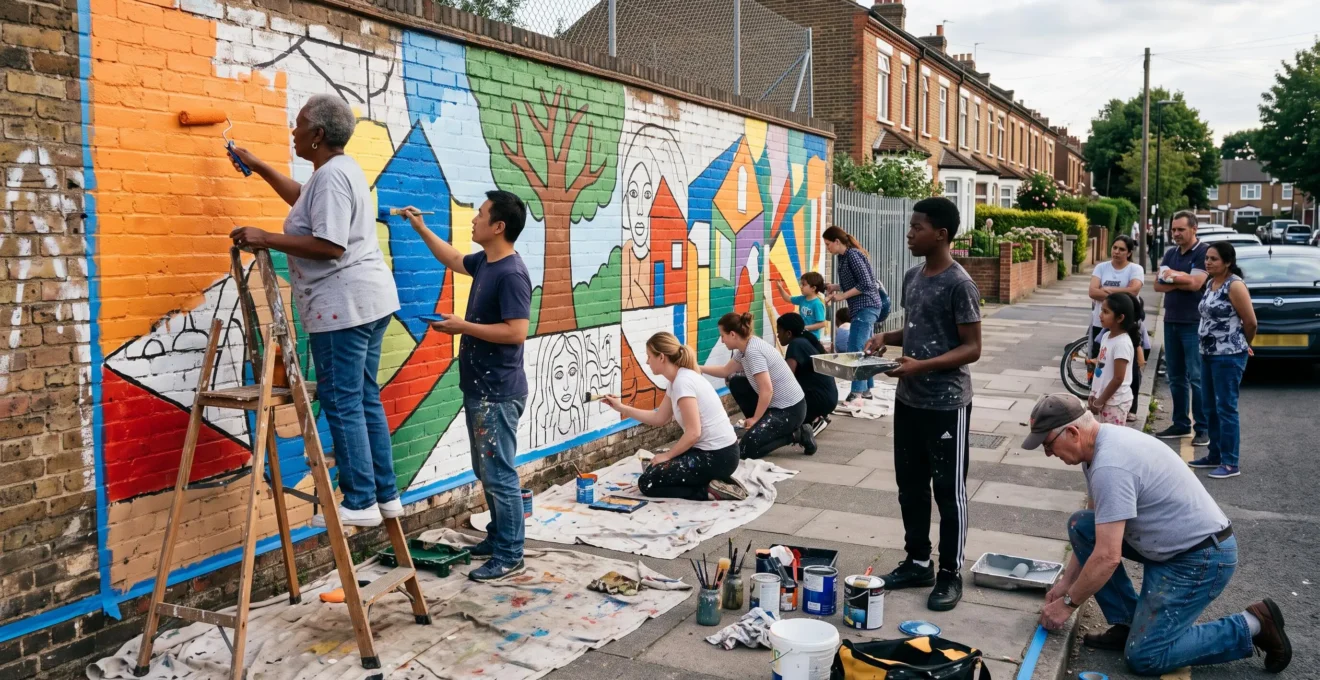
Two neighbours may live on the same street for years without exchanging more than a brief greeting. Yet give them a shared wall to paint, a sculpture to assemble or a collection of local stories to illustrate, and they have a practical reason to work together.
Community interaction through art brings neighbours together by creating shared tasks, opportunities for informal conversation and visible achievements that residents can recognise as their own. The creative process matters as much as the finished artwork: people negotiate choices, exchange knowledge and begin recognising one another outside the activity.
Research provides useful context, although it does not establish that every art project strengthens neighbourhood relationships. The National Endowment for the Arts reported an association between art-making and social participation among US adults in 2024. Whether an individual community initiative produces similar benefits depends on who can participate, whose decisions matter and what happens when the workshop ends.
For local cultural associations, the practical challenge is therefore not simply to organise an enjoyable creative event. It is to design an activity in which different residents can contribute meaningfully and have reasons to reconnect afterwards.
How community art creates stronger neighbourhood connections
- Shared creative tasks allow neighbours to cooperate naturally, including people who are uncomfortable with formal introductions or group discussions.
- Inclusive facilitation gives different generations and cultural communities genuine influence over the artwork, rather than merely inviting them to attend.
- Follow-up gatherings, shared maintenance and simple relationship measures help cultural associations sustain and assess connections beyond the original workshop.
- Why Do Collaborative Murals Help Strangers Work Together?
- How to Run an Intergenerational Art Workshop in a Community Centre?
- Group Painting or Shared Sculpture for a Small Community Project?
- Why Some Voices Disappear During Collaborative Art Activities
- How to Keep Neighbours Connected After a Community Art Workshop?
- How to Share Curatorial Decisions Across Different Cultural Communities?
- How to Measure Community Trust After a Participatory Art Programme?
- How Can Public Engagement Make Art Programmes More Inclusive?
Why Do Collaborative Murals Help Strangers Work Together?
Collaborative murals can help strangers work together because painting provides an immediate shared purpose without requiring personal conversation. Neighbours can contribute side by side, coordinate colours and solve practical problems at their own pace. When participation is genuinely shared, the activity creates opportunities for familiarity, mutual recognition and cooperation that may continue after the painting session.
One useful mechanism is parallel participation. A resident can begin by preparing a surface while someone nearby fills an outlined section. Neither person needs to introduce themselves formally. Questions emerge naturally: which colour belongs here, who needs another brush, or how can two sections meet cleanly?
This approach may feel more accessible to people who dislike speaking in front of groups. However, it should be understood as a practical facilitation principle, not a scientifically established effect specific to mural painting.
The design determines whether the mural encourages cooperation or simply places people beside one another. A single-author composition in which residents fill predetermined shapes offers participation but limited creative influence. A genuinely shared canvas allows neighbours to shape imagery, negotiate boundaries and make decisions together.
- Grid sections: Give participants identifiable areas while encouraging pairs to agree on transitions between sections.
- Layered stencils: Allow different residents to add complementary shapes and colours to the same composition.
- Free-expression zones: Create space for personal contributions within an agreed overall theme.
- Rotating tasks: Invite participants to switch between painting, colour mixing, surface preparation and finishing.
Rotation also addresses a familiar problem: experienced or confident painters can take control while newcomers become spectators. Pairing participants and recognising preparation tasks as genuine contributions makes involvement more accessible, although organisers should still offer opportunities to influence the creative result.
28.2% versus 19.3%
In the April–July 2024 US survey, 28.2% of adults who created art reported attending group or club meetings at least 12 times annually, compared with 19.3% of adults who did not create art. This is an association, not evidence that community murals caused greater social participation.
National Endowment for the Arts research announcement on arts engagement and social connectedness.
A mural displayed in a shared public space also creates a possible point of contact after completion. Residents might pause to discuss a detail, show visitors their contribution or recognise someone who worked alongside them. These interactions are opportunities rather than guaranteed outcomes, and the effect depends on the artwork remaining accessible and relevant to local people.
Once residents have a practical reason to collaborate, the next challenge is to ensure that age differences do not quietly divide the workshop into separate groups.
How to Run an Intergenerational Art Workshop in a Community Centre?
Run an intergenerational art workshop by deliberately pairing participants from different age groups, giving each person a meaningful role and building opportunities to exchange skills throughout the session. An accessible venue, flexible materials and recruitment through existing community relationships are essential. Without active facilitation, participants may naturally gravitate towards people of similar ages.
A community centre offers an advantage: staff and regular visitors may already know residents who would welcome an invitation. Rather than relying on a social media announcement, organisers can invite people through coffee mornings, existing activity groups, notice boards, schools and local community partners.
The invitation should describe a shared creative activity, not position older residents as people who need help from younger volunteers. A two-way skill exchange gives every generation something valuable to contribute.
For example, longtime residents might share memories of local landmarks, changing streets or neighbourhood celebrations. Younger participants might contribute digital design skills, contemporary imagery or ways to document the finished piece. These roles are suggestions, not assumptions about individual abilities.
A practical two-hour workshop could follow this structure:
- Welcome and orientation — 15 minutes: Introduce the shared theme and offer several ways to participate, including drawing, storytelling and arranging materials.
- Mixed-age pairing — 20 minutes: Seat participants with someone from a different generation and invite each pair to exchange a local memory or creative idea.
- First creative round — 30 minutes: Ask pairs to produce a collaborative sketch, collage element or painted panel.
- Break and partner rotation — 15 minutes: Allow time for rest, refreshments and informal conversation before changing working partners.
- Shared composition — 30 minutes: Combine contributions and discuss where different ideas belong.
- Reflection and next steps — 10 minutes: Invite feedback and agree on how residents can view, complete or revisit the work.
This timetable is an illustrative facilitation proposal, not a validated intervention. Group size, individual needs and available support should determine the actual pace.
Physical accessibility deserves the same attention as the programme. Check whether tables accommodate seated participants, provide supportive chairs, limit periods of standing and avoid requiring everyone to use fine brushes or scissors. Clear spoken instructions, written prompts and good lighting can help participants with different hearing, visual and communication needs.
Offer activities with varied physical demands: storytelling, selecting colours, arranging shapes, holding templates, documenting contributions or painting larger surfaces. Participants should be able to choose and change roles without being treated as less capable.
A successful mixed-age activity creates the conditions for new conversations, but its format must also fit the available budget, space and responsibility for the resulting artwork.
Group Painting or Shared Sculpture for a Small Community Project?
Group painting is often a practical starting point for a small community project because materials can be simple, tasks are easily divided and participants can see progress quickly. Shared sculpture offers different opportunities for three-dimensional collaboration but may involve additional structural, safety and maintenance considerations. The right choice depends on the site, participants, resources and long-term care arrangements.
Rather than selecting a format solely because it looks appealing, local associations should first establish what residents want to make, where it will be displayed and who will look after it.
The following comparison describes typical planning considerations, not fixed costs or universal differences between artistic formats.
| Criterion | Group painting or mural | Shared sculpture |
|---|---|---|
| Budget | Can use relatively inexpensive paints and prepared panels; large outdoor surfaces may increase costs. | Costs vary with materials, fabrication, supports and specialist assistance. |
| Available space | Suitable for walls, boards or flat indoor surfaces. | Requires space for three-dimensional construction, display and safe movement. |
| Permanence | Can be temporary, portable or long-lasting, depending on surface and materials. | Can be temporary or permanent, depending on design and installation. |
| Weather exposure | Outdoor paint may fade, peel or require protective treatment. | Outdoor materials and fixings must withstand the intended conditions. |
| Maintenance | May require cleaning, repainting or touch-ups. | May require cleaning, inspection and repair of components or supports. |
| Skill threshold | Broad brushwork and stencils can accommodate beginners. | Modular assembly can be accessible, but structural work may need specialist supervision. |
| Individual contributions | Visible in separate panels or sections; less distinct when overpainted. | Can remain identifiable through individual tiles, objects or assembled components. |
Maintenance responsibility should strongly influence the final decision. A painted panel that can be stored indoors may be more realistic than a permanent installation when an association has limited capacity. Conversely, a well-planned sculpture assembled from individual modules may offer a meaningful long-term project where suitable expertise and care are available.
Hybrid formats offer further flexibility. Residents could paint separate wooden panels that form a shallow relief, decorate tiles attached to a shared sculptural base or add approved components over several sessions. This reduces the pressure to complete everything during one gathering and makes room for people with different schedules.
Permissions and ownership must be addressed before materials are purchased. Warwick District Council‘s Public Art Toolkit highlights the importance of site approval, ownership, funding, insurance, risk management and long-term maintenance when planning public art.
The applicable requirements vary between locations and jurisdictions. An association should establish who owns the wall or land, who can authorise the installation, whether additional approvals are needed, who owns or controls the finished work and who is responsible for damage or deterioration.
Five practical checks before committing to a community artwork
- Ask residents to identify their preferred format, location and intended audience; produce a one-page project brief recording their choices.
- Inspect the proposed site for accessibility, working space and environmental exposure; produce a site assessment with photographs and identified constraints.
- Compare materials, tools, accessibility adaptations and specialist support; produce an itemised draft budget.
- Contact the relevant site owner and authorities about permissions, insurance and responsibilities; produce a written approvals and ownership record.
- Agree who will inspect, maintain and document the artwork after completion; produce a named maintenance plan with review dates.
Choosing a manageable format is important, but even a technically successful artwork can fail as a community project when its creative decisions remain concentrated in a few hands.
Why Some Voices Disappear During Collaborative Art Activities
Some voices disappear during collaborative art activities because participation does not automatically create equal influence. Confident speakers may dominate decisions, language differences can restrict discussion, and people without artistic experience may hesitate to offer ideas. Residents excluded from planning channels can be overlooked altogether, even when they would willingly contribute to the creative work.
Quiet exclusion is often difficult to notice. A participant may attend every session, complete assigned painting tasks and appear satisfied while none of their suggestions influence the final design.
The crucial distinction is between being present and having influence. Attendance records indicate who entered the room. They do not reveal whose preferences shaped the theme, imagery, materials or installation.
Several facilitation methods can help redistribute opportunities to contribute:
- Silent idea generation: Invite participants to sketch or write suggestions individually before discussion begins, reducing the influence of whoever speaks first.
- One-contribution rounds: Give each person an initial opportunity to offer an idea before opening general discussion, while allowing people to pass.
- Anonymous sketching: Display unlabelled proposals so ideas can be considered without assumptions about the contributor.
- Local decision roles: Give residents directly affected by a proposed installation meaningful input into specific design choices.
- Multiple feedback channels: Accept spoken, written, translated, visual and in-person responses instead of relying on one meeting or messaging group.
Facilitators should also examine what happens after suggestions are collected. A simple decision log can record proposed ideas, whether each was adopted, combined, modified or rejected, and the reason. Personal identities need not be published, but organisers should be able to check whether particular groups consistently see their contributions disregarded.
Consider a hypothetical neighbourhood collage workshop in which residents submit drawings about local life. If only the most polished drawings are selected, participants with less artistic confidence may see their experiences excluded. Selection based on relevance, diversity of perspectives and opportunities for adaptation can support broader representation without requiring every proposal to be used unchanged.
How decisions are communicated matters. A rejected idea may be understood as a personal dismissal, especially when no explanation is given. Repeated experiences of being ignored could discourage future participation, although such outcomes should not be assumed for every resident.
A constructive response is to explain constraints openly, recognise the contribution and provide another route to influence the project. Facilitators can also check privately whether quieter participants felt heard rather than interpreting silence as consent.
Protecting participants’ influence helps preserve the relationships developed during the creative process. Those relationships then need opportunities to continue after the project ends.
How to Keep Neighbours Connected After a Community Art Workshop?
Keep neighbours connected after an art workshop by establishing simple opportunities for continued contact before the final session. A participant-led communication channel, a scheduled celebration and shared responsibility for the artwork can provide reasons to meet again. Ongoing relationships need not become close friendships: familiarity, casual greetings and willingness to cooperate are valuable neighbourhood outcomes.
Workshop momentum often comes from the shared task. Once the painting, collage or installation is finished, the reason to gather disappears unless participants establish another one.
The most practical approach is to design a continuation plan while people are still involved. Ask which activities residents would genuinely like to repeat and whether anyone wants to help coordinate them.
A messaging group such as WhatsApp can support informal communication where participants choose to use it. However, digital access and preferences vary. A community-centre notice board, printed announcements or an agreed telephone contact may be better for some residents. Contact details should be shared only with permission, and participation in any group should remain optional.
A planned reveal or celebration creates a second gathering point. Rather than treating it as a ceremonial ending, organisers can invite residents to bring neighbours, exchange stories about the artwork and discuss possible future activities.
An unfinished corner of a shared display or a rotating community sketchbook can also encourage return visits. These approaches are especially useful when people were unable to attend the original sessions and want a low-pressure way to contribute later.
Where suitable, residents can take part in caring for their artwork through supervised touch-up days, cleaning, seasonal additions or photographic documentation. These activities transform a finished object into an ongoing shared responsibility. Any physical maintenance should follow the site’s safety and permission arrangements; volunteers should not undertake hazardous repairs or work at height without appropriate safeguards.
Continuity also needs realistic expectations. Some workshop partners may become friends, while others will simply recognise one another at the market or exchange greetings outside the community centre. These weaker connections still matter because they can make future encounters feel more familiar and approachable.
Organisers should avoid turning relationship-building into an obligation. Occasional, voluntary gatherings are preferable to expecting every participant to remain constantly active.
Once opportunities for continued contact exist, the next responsibility is to make sure the shared artwork represents the different communities involved in its creation.
How to Share Curatorial Decisions Across Different Cultural Communities?
Share curatorial decisions across cultural communities by involving residents in choosing themes, imagery, locations and boundaries from the beginning. A representative decision-making group, clear procedures for disagreement and transparent records of accepted or rejected proposals can support meaningful participation. Consultation becomes tokenistic when organisers request opinions but retain exclusive control over decisions that have already been made.
There is a practical difference between asking people to react to a finished artistic concept and allowing them to shape the concept itself. The first offers feedback within predetermined limits. The second gives residents influence over the questions the artwork addresses and the way their communities are represented.
A cultural association could establish a shared curatorial group with residents nominated through participating community organisations and open invitations to people outside established networks. Membership should not be based solely on who is most visible or confident.
For a small project, responsibilities might include proposing themes, evaluating sketches, discussing culturally sensitive imagery and reviewing the final design before installation. Chairing and presentation roles can rotate, while decision rules should be agreed before disagreements arise.
Possible rules include requiring proposals to be considered against published criteria, allowing additional consultation when concerns are raised and recording unresolved objections without automatically overriding minority perspectives.
Symbols, religious imagery and cultural motifs need particular care. A visual element may have meanings that are not immediately apparent to someone outside the community concerned. Seeking context and appropriate permission from knowledgeable participants can reduce the risk of insensitive representation.
No single representative should automatically be treated as speaking for an entire cultural group. When a symbol is contested, it may be more appropriate to adapt the imagery, invite alternative interpretations or exclude the element than to force agreement.
Transparency is equally important. UK government guidance on community participation in design processes emphasises allowing people to understand how their input affects subsequent decisions. The UK government guidance on community engagement in design codes offers relevant principles, although it was developed for planning and design rather than specifically for collaborative art.
A useful curatorial decision record can identify each proposal, the reasons for selecting or setting it aside, the people or groups involved in reviewing it and any agreed amendments. Sensitive personal information should be protected, and public summaries should be approved for sharing.
This record helps residents assess whether participation was meaningful, including when their preferred option was not selected. It also gives future organisers a clearer understanding of how cultural differences were addressed.
Fair decision-making is an important part of a trustworthy process, but organisers still need a way to learn whether participants’ relationships and perceptions change over time.
How to Measure Community Trust After a Participatory Art Programme?
Measure community trust after a participatory art programme by examining relationships and behaviour, not attendance alone. Short perception surveys, voluntary follow-up interviews and observations of later cooperation can show whether residents feel more familiar with one another. Because trust develops through repeated experiences, evaluation should extend beyond the final workshop and avoid claiming that art caused changes without stronger evidence.
Start by distinguishing participation measures from relationship measures. Both have value, but they answer different questions.
| What to assess | Suggested indicator | What it can reveal |
|---|---|---|
| Participation | Attendance across sessions and voluntarily reported participant characteristics. | Who attended and which groups may have been underrepresented. |
| Neighbour familiarity | Whether participants recognise or know more local residents than before. | Potential growth in local social connections. |
| Perceived support | Whether participants feel comfortable asking a neighbour for minor help. | Self-reported confidence in neighbourly support. |
| Collaboration | Whether participants voluntarily work together on subsequent activities. | Evidence of continued cooperation. |
| Community initiative | Resident-led proposals, volunteering or involvement in other neighbourhood events. | Possible continuation of engagement beyond the original programme. |
A short questionnaire before the first session and after the final session might ask residents how many neighbours they know well enough to greet, whether they feel listened to in local activities and how comfortable they would be joining another community project.
Use consistent questions at both points, make answers voluntary and avoid collecting more identifying information than necessary. With small groups, even apparently anonymous answers may identify individuals, so results should be reported cautiously.
For longer-term observation, organisers could plan optional follow-ups around three and six months after the programme. These intervals are practical suggestions, not scientifically established thresholds for measuring trust.
Follow-up questions might explore whether participants have met again, attended unrelated neighbourhood activities or initiated a new creative collaboration. A simple relationship map can also help if participants consent to describing their connections.
Interpret the results carefully. People who participate in art may already be more socially active than those who do not. The 2024 National Endowment for the Arts findings show why this distinction matters: associations between arts participation and social connectedness should not be confused with proof of causation.
Organisers should also look beyond enthusiastic testimonials. Residents who participated quietly, attended only once or chose not to attend may identify scheduling problems, cultural barriers or uncomfortable group dynamics that the most engaged participants never experienced.
A credible evaluation should acknowledge missing responses, other local initiatives and the possibility that relationships changed for reasons unrelated to the artwork.
Measurement becomes most useful when findings guide the next programme, particularly by identifying residents who were not reached or who had little influence over its design.
Key takeaways before planning your next community art initiative
- Invite residents to influence the project’s purpose, location and creative format before those choices become difficult to change.
- Assess practical access and cultural comfort alongside attendance, so underrepresentation is treated as a design issue rather than a lack of interest.
- Use what residents say about participation and decision-making to improve future activities, rather than relying only on positive feedback from regular participants.
How Can Public Engagement Make Art Programmes More Inclusive?
Public engagement makes art programmes more inclusive when residents can shape activities before they are designed, influence decisions throughout delivery and participate without unnecessary practical or cultural barriers. Outreach through trusted local relationships can reach people who would not respond to conventional publicity. Inclusion becomes meaningful when participants have both access to the activity and influence over its outcomes.
A programme advertised as open to everyone may still mainly attract people who already feel comfortable in cultural settings. If organisers choose the theme, venue, timetable and artistic approach before speaking with residents, important barriers can become embedded in the project.
Co-design should begin before recruitment for the workshop itself. Early conversations can establish what local people would like to create, which places matter to them and what kinds of participation feel welcoming.
Homes England‘s guidance on early community engagement recommends collaboration, accessible communication, attention to underrepresented groups and working through trusted local partners. Although written for planning and regeneration in England, Homes England’s community engagement advice note provides principles that cultural associations can adapt to participatory art.
In practice, inclusion requires specific responses to different barriers:
- Material costs: Provide essential supplies without requiring residents to purchase equipment or contribute financially.
- Scheduling conflicts: Consult shift workers, carers and other residents before selecting session times, and consider alternative opportunities to contribute.
- Physical accessibility: Check step-free access, seating, toilets, lighting and the suitability of workstations and materials.
- Cultural expectations: Explain activities clearly, avoid assuming prior artistic knowledge and invite residents to identify imagery or practices they would find inappropriate.
- Communication barriers: Offer understandable information through suitable languages, visual explanations and both digital and non-digital channels.
- Limited confidence: Provide low-pressure introductory tasks and opportunities to contribute without speaking in a large group.
Outreach should be treated as relationship-building rather than advertising. A poster in a gallery may reach residents already interested in art. An invitation shared through a school, community centre, faith group or trusted local organiser may reach people who would never think to look for a cultural programme.
These relationships should not be used merely to recruit participants. Community partners and residents need opportunities to shape the activity, challenge assumptions and receive an explanation of how their contributions influenced the final decisions.
Engagement should continue throughout the programme. A brief feedback conversation after each session can reveal practical problems early enough to change the next one. Residents might suggest a quieter workspace, different materials, another meeting time or a new way to display their contributions.
Public engagement cannot guarantee that everyone will participate or that all preferences will be compatible. Its value lies in making decisions more responsive, reducing avoidable exclusions and creating opportunities for residents to recognise the project as something they helped develop.
For a practical next step, invite a small, varied group of local residents and community partners to discuss one possible artwork before deciding its format or location. Ask what they would like to make, what might prevent their participation and what could bring them back afterwards. Record their suggestions, explain the resulting decisions and use that conversation to build a community art programme that belongs to its participants.
Can a community art project work without a permanent public artwork?
Yes. Portable collages, temporary installations, community sketchbooks and shared exhibitions can provide meaningful opportunities to cooperate. A permanent installation is not necessary for residents to exchange ideas or develop familiarity. Choose a format that matches participants’ interests, available resources and realistic maintenance capacity.
How can organisers involve neighbours who say they are not artistic?
Describe the activity as a shared community project rather than an art competition. Offer accessible roles such as choosing colours, sharing local stories, preparing materials, arranging shapes or documenting the process. Make it clear that participants do not need previous experience and can try different tasks without their work being judged.
What should organisers do if residents disagree about a proposed design?
Give each perspective a fair opportunity to be explained, identify any safety or cultural concerns and revisit the decision criteria agreed at the start. Consider adapting the proposal, combining compatible ideas or seeking further consultation. Record the decision and its reasoning rather than allowing the loudest participant to settle the disagreement.
How can a small cultural association keep a community art project affordable?
Start with a manageable format, such as a shared paper installation or individual painted panels assembled into one composition. Use an itemised budget, seek permission before committing to a site and account for accessibility, safe materials, storage and future care. Donations or partnerships may help, but should not be assumed until confirmed.
How can organisers protect participants’ privacy when documenting community connections?
Explain what information will be collected and why, make surveys and photographs optional, and seek appropriate permission before sharing identifiable material. Avoid publishing individual relationship maps or sensitive comments. Store information securely, limit access and follow the data protection requirements applicable in the project’s jurisdiction.