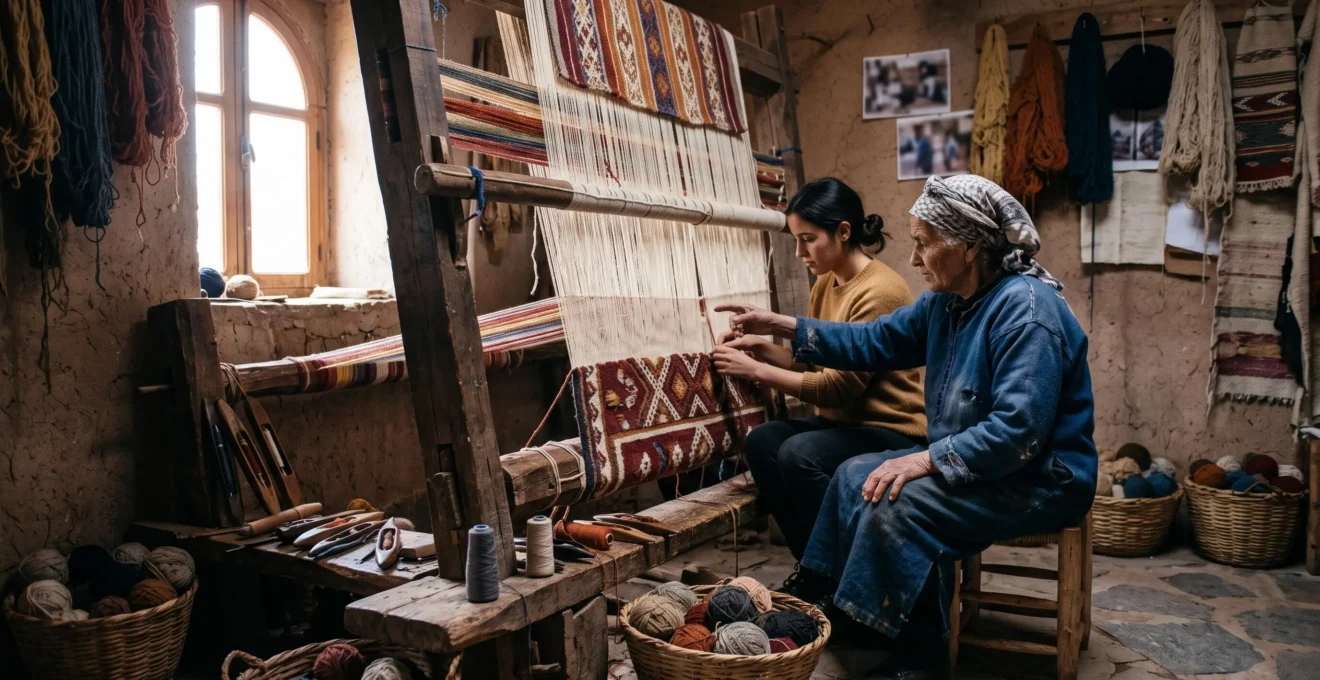
Artistic traditions survive not by remaining unchanged, but by allowing successive generations to reinterpret inherited skills while maintaining meaningful connections to their origins. A weaving technique may incorporate modern tools, a ceramic form may acquire a contemporary purpose, and a traditional motif may appear in an unfamiliar artistic medium. Each development raises the same question: what must remain for a practice to retain its cultural character?
The answer lies partly in cultural transmission. Traditions endure through practitioners who learn established methods, exercise judgment, respond to changing circumstances and pass their knowledge onwards. Materials and finished objects matter, but the decisions, relationships and meanings surrounding their production are equally significant.
Understanding this process requires distinguishing respectful innovation from misleading claims of authenticity, protecting knowledge alongside physical artefacts, and recognising the economic conditions that allow skilled practitioners to continue working. The survival of artistic heritage ultimately depends on whether inherited practices remain meaningful and practicable for living communities.
How Living Artistic Traditions Endure
- Traditional techniques evolve through apprenticeship, experimentation and changing social needs; continuity does not require exact repetition.
- Effective cultural transmission preserves practical judgment, technical knowledge and community relationships, not just finished objects.
- Responsible adaptation requires transparent provenance, respect for cultural custodians and viable opportunities for future practitioners.
- Why Do Traditional Craft Techniques Evolve Over Time?
- How to Record a Traditional Craft Process Before Skills Disappear?
- Apprenticeship or Formal Classes for Learning Traditional Crafts?
- Why Modern Reproductions Should Not Be Presented as Ancient Traditions
- How to Adapt a Traditional Craft Without Losing Its Character?
- How to Introduce New Techniques Without Losing Your Artistic Identity?
- Why Do Household Objects Symbolise Cultural Belonging in Contemporary Art?
- How Can Artistic Heritage Be Protected From Damage and Neglect?
Why Do Traditional Craft Techniques Evolve Over Time?
Traditional craft techniques evolve because practitioners continually adjust inherited knowledge to their materials, tools, working conditions and cultural expectations. Some changes originate within the craft itself, while others reflect economic or social pressures. A tradition remains recognisable when successive adaptations preserve meaningful relationships with its established skills, forms and cultural context.
Internal evolution occurs when craftspeople refine an existing process. A woodcarver may improve the angle of a cutting gesture, for example, or a weaver may adjust thread tension to reduce recurring defects. Such refinements need not alter the underlying identity of the practice. They can represent accumulated practical knowledge.
External evolution arises when circumstances change around the craft. New raw materials become available, established customers disappear, production costs shift, or patrons request unfamiliar designs. A basket once produced primarily for agricultural storage might acquire a decorative or ceremonial market. The technique can survive even when its original commercial function becomes less important.
These developments illustrate transmission with variation. Apprentices learn by observing and reproducing experienced practitioners’ actions, but differences in physique, dexterity, available equipment and individual judgment affect how those actions are performed. Each generation inherits a practice that has already undergone interpretation.
“This intangible cultural heritage, transmitted from generation to generation, is constantly recreated by communities and groups in response to their environment”
Changing tastes also influence what survives. Techniques associated with declining household uses may find new purposes in contemporary design, restoration or artistic production. However, adaptation does not automatically preserve every aspect of a tradition: commercial success can coexist with the loss of specialised meanings or skills.
A practical way to evaluate continuity is to examine whether experienced practitioners can still recognise the logic of the gestures, the functions of important motifs and the relationship between newer forms and inherited conventions. This is a contextual assessment, not a universal authenticity test.
Technical change is therefore neither proof of cultural decline nor evidence of successful preservation by itself. What matters is whether the knowledge behind the practice continues to circulate among people capable of interpreting and developing it.
How to Record a Traditional Craft Process Before Skills Disappear?
To record a traditional craft effectively, document the practitioner’s movements, technical vocabulary, cultural context and decisions when difficulties arise. Video alone rarely communicates the full knowledge involved. A useful archive combines demonstrations, guided interviews, written observations and agreed access conditions so future learners can understand both the procedure and its reasoning.
A practical documentation project can be organised into four complementary layers. This framework is a recommended working method rather than a universal archival standard.
- Record the physical gesture. Film important movements from angles that reveal tool position, material contact and body posture. Capture the complete process alongside close details of demanding stages.
- Preserve technical language. Transcribe local names for tools, materials, actions and defects. Where appropriate, retain terminology in its original language alongside explanations.
- Document social context. Explain who traditionally practised the craft, how skills were taught, what objects were used for and which cultural restrictions governed their production.
- Capture decisions and corrections. Ask practitioners to demonstrate how they identify mistakes, judge material readiness, adjust pressure and decide whether a piece can be repaired.
The fourth layer is particularly important. A recording of a potter forming a vessel may show the sequence of movements without revealing how the potter recognises excessive moisture or responds when a wall begins to collapse. Practical judgment often becomes visible only when the maker encounters uncertainty.
Guided commentary during a demonstration can help identify otherwise invisible considerations, such as pressure, rhythm and tactile resistance. Follow-up interviews remain useful because explaining complicated decisions while performing them may interrupt the work. The two approaches should complement rather than replace each other.
The American Folklife Center‘s Library of Congress cultural documentation guidebook provides a broader foundation covering research preparation, interviewing, recordings, fieldnotes and archival preservation.
Ethical safeguards must be established before recording. Copyright ownership depends on applicable law and agreements; consent to participate does not necessarily authorise unrestricted publication. Communities may also have customary rules limiting access to particular techniques or knowledge.
Five Actions for Building a Usable Craft Archive
- Identify the practitioner’s essential production stages and create a one-page process map.
- Record demonstrations showing tools, gestures and material changes; produce an indexed collection of video clips.
- Interview the practitioner about terminology and common mistakes; prepare a transcribed technical glossary.
- Document cultural uses, transmission relationships and any knowledge restrictions; produce a contextual record reviewed with the practitioner.
- Agree on access permissions and organise materials around practical decisions; deliver an archive index with named custodians and access conditions.
Where the community permits it, indexing recordings by decisions such as material selection, fault diagnosis and finishing choices can make them easier to use during training. Chronological footage should still be preserved as part of the original record.
Documentation creates a foundation for future teaching, but recordings cannot entirely replace sustained contact with experienced practitioners. Preserving knowledge ultimately requires opportunities to practise it.
Apprenticeship or Formal Classes for Learning Traditional Crafts?
Apprenticeship is generally better suited to developing sustained practical judgment within a particular craft tradition, while formal classes offer structured access to foundational procedures and techniques. Neither approach is universally superior. The appropriate choice depends on the learner’s intended level of mastery, available time, finances and access to experienced practitioners.
The decisive distinction concerns what happens after a familiar procedure fails. Short courses can efficiently introduce materials, safety requirements and repeatable production steps. Extended workshop practice creates more opportunities to encounter unusual problems, make corrections and understand why an experienced maker chooses one response over another.
For instance, learning the standard sequence for joining wooden components differs from developing the judgment needed to work with irregular grain, seasonal movement or an imperfectly prepared surface. These capabilities require exposure to varied working conditions rather than repetition of an ideal demonstration alone.
UNESCO‘s overview of traditional craftsmanship recognises the importance of apprenticeship and identifies economic conditions as a significant challenge for transmission. Opportunities to earn a livelihood, alongside incentives for teachers and learners, can help sustain traditional craft practices.
The financial implications deserve equal consideration. A lengthy apprenticeship can restrict other employment, although arrangements vary and some apprenticeships provide wages or financial support. Formal education usually involves identifiable tuition and equipment costs, but flexible schedules may allow learners to maintain existing work.
The following comparison helps clarify the practical trade-offs.
| Criterion | Apprenticeship | Formal Classes |
|---|---|---|
| Primary strength | Situated judgment and continuing mentorship | Structured introduction to methods and principles |
| Learning environment | Working workshop with variable production demands | Planned exercises and defined learning objectives |
| Time commitment | Often extended and dependent on the craft | Typically more clearly scheduled |
| Financial considerations | Income and working arrangements vary | Tuition, materials and equipment may be required |
| Best suited to | Deep specialisation and continuity within a practice | Exploration, foundational training or focused skills |
A reliable mentor allows learners to handle materials early under appropriate supervision, explains the reasoning behind rules and acknowledges mistakes rather than presenting every inherited practice as unquestionable. The ability to provide constructive feedback matters as much as technical reputation.
Hybrid programmes can offer an effective alternative, combining formal instruction with supervised periods in an active workshop. For adults entering a craft later in life, this arrangement may provide technical foundations without requiring an immediate departure from paid employment.
Regardless of the educational setting, the central objective should be competence rather than mechanical imitation. That distinction also matters when assessing whether objects marketed as traditional genuinely reflect inherited craftsmanship.
Why Modern Reproductions Should Not Be Presented as Ancient Traditions
Modern reproductions should not be presented as ancient traditions because misleading descriptions obscure an object’s actual origins, production methods and cultural significance. A contemporary copy can have artistic and commercial value, but claims about its age, provenance or inherited techniques must be accurate. Honest labelling protects both buyers and the practitioners maintaining established traditions.
The distinction is not simply between handmade and machine-made objects. A newly produced item can belong to a living tradition when its methods and meanings genuinely continue an inherited practice. Conversely, an object that imitates an old design may have no direct connection with the community or techniques from which that design originated.
Misrepresentation can undermine the ability of buyers to distinguish skilled work from industrial imitation. It can also disadvantage practitioners whose prices reflect time-intensive production and specialist knowledge. The exact consequences depend on the market and circumstances; not every reproduction displaces traditional production.
Three practical questions help evaluate an object’s description:
- Materials: Are the materials historically associated with the craft, modern substitutes or deliberately selected alternatives?
- Methods: Were the techniques learned through a living craft practice, reconstructed from historical evidence or replaced by industrial processes?
- Meaning: Do the motifs retain recognised cultural functions, or have they been borrowed primarily for decorative effect?
Physical characteristics can offer clues, but they are not definitive proof of provenance. Skilled contemporary makers may produce highly regular handwoven textiles, while industrial processes can deliberately introduce irregularities. Reliable assessment therefore requires information about the maker, production history and techniques, rather than visual inspection alone.
Museums, online catalogues and retail platforms share responsibility for accurate descriptions. A label such as « traditional design » should not be treated as equivalent to « historical artefact » or « made using inherited techniques ». Where evidence is incomplete, descriptions should acknowledge that uncertainty.
Contemporary reproductions can nevertheless support artistic education, broaden access to historical designs or contribute to workshop income. Their legitimacy does not depend on pretending to be older than they are. Descriptions such as « contemporary interpretation of a historical motif » communicate the relationship without falsely establishing an ancient provenance.
Transparent attribution enables historical works, living craft traditions and contemporary reinterpretations to coexist without being mistaken for one another. Once this distinction is established, adaptation becomes a creative choice rather than a question of disguising origins.
How to Adapt a Traditional Craft Without Losing Its Character?
Adapting a traditional craft without losing its character requires identifying the features that carry its cultural identity and distinguishing them from aspects that can change more freely. Practitioners should evaluate proposed modifications with knowledgeable community members, preserve the reasoning behind their choices and explain how new work relates to inherited methods.
The first task is to distinguish essential features from historically contingent ones. Depending on the craft, identity may be concentrated in a foundational gesture, a particular material, a motif’s cultural meaning or the relationship between an object and its customary use.
Other characteristics, such as production dimensions, workshop equipment or commercial presentation, may be more adaptable. These distinctions cannot be established through appearance alone. A material that seems interchangeable to an outside designer may possess ceremonial significance for its traditional practitioners.
Consider a hypothetical basket-making workshop developing smaller pieces for contemporary interiors. Changes in dimensions and intended use might allow an established weaving structure to survive in a different market. Yet replacing a culturally significant pattern with an arbitrary design could alter the work’s meaning more substantially than changing its size.
The central question is not whether the new object resembles an older example. It is whether the modification maintains an intelligible relationship with the tradition’s techniques, values and practitioners.
UNESCO’s ethical principles for intangible cultural heritage recognise that living heritage is dynamic. They emphasise community participation, informed consent, respect for customary access restrictions and attention to the interests of people whose cultural practices are documented, promoted or adapted.
Community recognition provides an important test, although communities are not necessarily unanimous. Different generations, workshops and practitioners may disagree about acceptable innovations. Meaningful consultation therefore involves listening to differing perspectives rather than obtaining approval from a single spokesperson and treating it as universal.
Refusing all adaptation can also endanger continuity. Where historical uses or livelihoods disappear, responsible changes in function and presentation may make it possible for skilled production to continue. The challenge is to maintain cultural substance without making economic survival dependent on increasingly superficial versions of the craft.
Every significant modification should leave a traceable record. A workshop might note the original technique, materials replaced, reasons for the change, participating practitioners and responses from relevant cultural custodians. This establishes a genealogy of innovation that future learners can examine rather than mistaking the latest version for the earliest one.
Responsible innovation preserves the possibility of understanding what changed and why. The same principle applies beyond collective craft traditions to individual artists incorporating unfamiliar methods into established creative practices.
How to Introduce New Techniques Without Losing Your Artistic Identity?
Artists can introduce new techniques without losing their identity by evaluating how those methods affect their established intentions, visual language and working principles. Rather than adopting every attractive innovation, they can test unfamiliar approaches in limited projects, compare the results with existing work and retain techniques that strengthen a coherent artistic direction.
Not all innovations influence an artistic practice equally. Their impact can be examined at three levels.
- Tools: Introducing a new cutting instrument, digital measuring device or finishing implement may change efficiency without substantially altering the work’s meaning.
- Production methods: Changing from hand-building to mould-based production, for example, can affect texture, repetition and the relationship between gesture and form.
- Visual and symbolic language: Adopting motifs, compositional conventions or culturally specific imagery may transform how audiences interpret the work and where its references appear to originate.
The third level often demands the greatest reflection because images and symbols can carry meanings beyond their visual qualities. A technique that appears technically useful may also introduce associations incompatible with an artist’s intentions or with the cultural permissions surrounding its use.
A useful approach is to treat innovation as translation. Before adopting a method, identify the precise effect it creates. Does it produce a texture unavailable through existing tools? Does it allow larger forms, alter the pace of production or change the relationship between the artist and the material?
The artist can then decide whether that effect serves an established purpose or simply introduces novelty. A ceramicist whose work depends on visible hand pressure might use digital tools for planning while retaining hand-building as a defining feature. Another artist might deliberately rethink the role of handwork, provided the change is conceptually justified.
Accumulating techniques without a governing intention risks producing work whose references compete rather than reinforce one another. Artistic identity does not require a single medium, but it benefits from a coherent hierarchy of choices.
A practical testing protocol is to develop a small secondary series using the proposed technique. Record how it changes surface qualities, production decisions, audience interpretation and the artist’s experience of making. Compare those results with the main body of work before deciding whether broader integration is appropriate.
Innovation becomes more convincing when viewers can recognise an underlying artistic intention across changing methods. This relationship between material form and enduring meaning also explains why ordinary objects can become powerful carriers of collective memory.
Why Do Household Objects Symbolise Cultural Belonging in Contemporary Art?
Household objects symbolise cultural belonging in contemporary art because they preserve associations with everyday practices, family relationships and inherited ways of making and using things. Through familiar materials, forms and signs of wear, artists can evoke collective memory. Their meaning, however, depends on cultural context, authorship and how the object is presented.
Unlike monumental heritage, domestic objects often enter daily life without attracting deliberate attention. A woven container, serving vessel or embroidered cloth may become meaningful through repeated handling, shared meals, family ceremonies or skills passed between generations.
Such objects can connect personal memory with wider cultural practices. Their materials may reflect local resources, while their form can reveal established production techniques. Patterns of repair or wear may suggest prolonged use, although these physical traces cannot establish a complete history without supporting evidence.
Contemporary artists can engage with this material inheritance in several distinct ways.
- Transmission: An object may document a continuing relationship with family makers, community workshops or inherited domestic practices.
- Cultural critique: Recontextualising a household object may question how institutions classify everyday heritage or whose histories receive recognition.
- Identity symbolism: An object may evoke a cultural association primarily through its appearance, without necessarily documenting a direct transmission relationship.
These uses should not be confused. Displaying a traditional vessel in a gallery does not automatically demonstrate that its associated knowledge remains alive. Equally, an artist’s personal connection to a cultural object does not eliminate the need to consider other community perspectives.
Questions of cultural appropriation become particularly relevant when artists draw on objects or motifs associated with communities to which they have no established relationship. Responsible interpretation considers who created the original forms, whether knowledge is restricted, how contributors are acknowledged and whether the representation changes culturally important meanings.
There is also a risk of museification. When familiar domestic objects are presented solely as relics of an idealised past, their continuing practical uses can disappear from view. An exhibition that documents current makers, repairs and changing household functions can convey a more complete picture of living cultural heritage.
For viewers, useful interpretation begins by asking whether an object represents a documented lineage, a critical artistic intervention or a generalised cultural image. The distinction affects what the work can reasonably tell audiences about belonging and transmission.
Domestic objects reveal how cultural heritage occupies ordinary life rather than existing only in institutions. Protecting that heritage consequently means caring for physical things while also supporting the people and practices that give them meaning.
Key Takeaways Before Planning Heritage Protection
- Assess physical deterioration and the disappearance of practical knowledge separately; each requires different protective measures.
- Include practitioners in decisions about safeguarding, particularly where access to materials, teaching opportunities or cultural permissions is at stake.
- Evaluate whether a preservation programme supports continuing cultural practice rather than only public visibility or visitor demand.
How Can Artistic Heritage Be Protected From Damage and Neglect?
Artistic heritage can be protected by combining preventive conservation of physical objects with the continued transmission of living skills. Collections require appropriate storage, monitoring and professional care, while traditional practices need active practitioners, educational opportunities and viable economic conditions. Effective safeguarding must also involve the communities whose heritage is being protected.
Physical and intangible heritage face different vulnerabilities. Textiles, paintings, sculptures and historic structures can deteriorate through inappropriate handling, environmental conditions, accidents or neglected maintenance. Preventive conservation aims to reduce such risks before extensive intervention becomes necessary.
Practical measures include documenting an object’s condition, using materials and storage environments suited to its conservation needs, establishing safe handling procedures and obtaining specialist advice when damage occurs. Conservation treatment should reflect the specific materials and significance of the object rather than follow an assumed universal remedy.
Living skills face another kind of loss. A perfectly preserved handwoven textile cannot independently teach a learner how to judge fibre tension, prepare the loom or correct a weaving fault. These abilities depend on people who can demonstrate, explain and practise them.
International safeguarding frameworks recognise this distinction. UNESCO’s 2003 Convention includes traditional craftsmanship within intangible cultural heritage and identifies documentation, research, education, transmission and revitalisation as safeguarding measures. Its provisions place responsibilities on States Parties, including the identification of heritage with community participation and the maintenance of inventories.
The Convention’s Representative List seeks to increase visibility and awareness of intangible cultural heritage. Inscription is not an automatic guarantee of workshop funding, individual legal protection or continued commercial demand. National obligations under the treaty also depend on whether a country is a party to it.
At the local level, a workable safeguarding strategy can bring together three priorities:
- Intergenerational transmission: Create sustained opportunities for experienced practitioners to teach through workshops, mentorship and supervised production.
- Economic viability: Consider remuneration, access to appropriate working spaces and routes to earning a livelihood without requiring practitioners to abandon defining features of their craft.
- Material continuity: Identify threatened supplies, specialist tools and production environments before shortages make established techniques impracticable.
Market demand can support these measures, but relying exclusively on tourism or collectors introduces additional risks. Producers may face pressure to simplify demanding methods, repeat commercially popular motifs or prioritise decorative products over culturally significant uses.
The aim should therefore be to develop opportunities that respect practitioner judgment and community priorities. Museums, educators, local organisations and craft businesses can contribute, but their programmes are stronger when practitioners participate in defining what should be maintained, shared or adapted.
For an immediate next step, select one craft practice or collection and prepare a brief safeguarding assessment covering its physical condition, active practitioners, routes of transmission and economic vulnerabilities. That assessment can reveal whether the most urgent need is conservation, documentation, teaching or support for continued production.
Can a traditional artwork remain authentic if it uses modern materials?
Yes, depending on the tradition and the significance of its materials. Some practices allow substitutions without changing their defining techniques or meanings, while others depend on culturally important materials. The relevant practitioners’ perspectives, production history and transparent description of modifications are more informative than a blanket rule against modern materials.
What is the difference between preserving an artistic tradition and reviving one?
Preservation supports the continuity of existing objects, knowledge and practices. Revival seeks to reactivate practices that have declined or ceased to be performed in a particular setting. Revival may draw on archival records, surviving artefacts and community knowledge, but reconstructed techniques should be distinguished from methods maintained through uninterrupted transmission.
Who should decide whether a cultural adaptation is respectful?
Practitioners and communities associated with the cultural heritage should play a central role. Their perspectives help establish which techniques, meanings and access restrictions matter. Because opinions can differ within communities, respectful decisions require meaningful consultation, attention to customary practices and transparent acknowledgment of the adaptation’s origins.
Can digital archives replace traditional craft teachers?
Digital archives can preserve demonstrations, terminology, interviews and contextual information, but they cannot fully replace the feedback and tactile experience available through guided practice. They are especially valuable as supporting teaching resources, provided recordings are maintained, appropriately described and accessed under agreed ethical conditions.
Does recognition as intangible cultural heritage guarantee a tradition’s survival?
No. Recognition can support awareness and safeguarding efforts, but long-term survival depends on factors such as practitioners’ participation, knowledge transmission, access to materials and viable working conditions. International heritage recognition does not by itself guarantee funding, legal protection for individual artisans or future generations of learners.