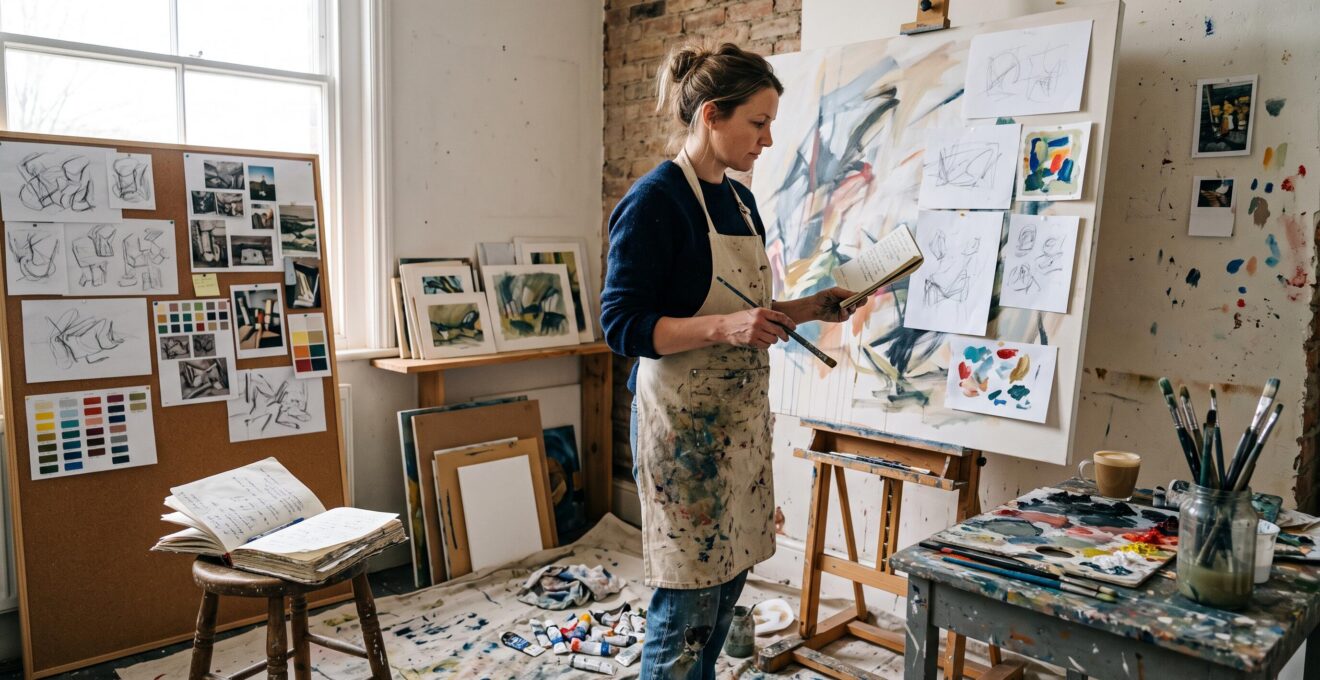
Building a repeatable creative process does not mean turning art into a mechanical sequence of instructions. It means creating a flexible structure that helps an idea survive the transition from initial inspiration to a developed, finished artwork. Independent artists often struggle not because they lack ideas, but because production introduces decisions, technical challenges and competing possibilities that gradually weaken their original direction.
A useful artistic workflow establishes reference points without dictating the final appearance. It gives experimentation room to reveal unexpected possibilities while providing practical criteria for deciding what to develop, what to change and when to stop. The distinction matters: structure should support artistic judgement, not replace it.
The most effective approach combines exploration, concept development, material testing, focused production and deliberate finishing. Each stage has a purpose, but movement between stages remains possible when new discoveries justify reconsidering an earlier decision. The objective is not to make every artwork predictable. It is to make creative progress more manageable, intentional and repeatable.
Creative Process: The Essential Principles
- Establish a flexible artistic direction through a short working concept rather than a rigid visual plan.
- Use experimentation, selected constraints and material tests to turn possibilities into informed creative decisions.
- Define practical completion criteria and project milestones to prevent endless research, reworking and unfinished artworks.
- Why Do Strong Art Ideas Lose Direction During Production?
- How to Turn Scattered Sketchbook Ideas Into a Focused Art Concept?
- Iterative Sketching or Detailed Planning for an Unfamiliar Medium?
- Why Constant Reworking Can Prevent an Artwork From Being Finished
- When Should an Artist Stop Researching and Begin Making?
- Free Experimentation or Creative Constraints for New Ideas?
- How to Turn a Personal Experience Into an Abstract Artwork?
- How to Manage an Artistic Project From First Sketch to Exhibition?
Why Do Strong Art Ideas Lose Direction During Production?
Strong art ideas often lose direction during production because the original concept must survive hundreds of small decisions that gradually change the work. An idea may initially feel coherent as a complete mental image, but translating it into physical or digital form introduces separate questions about composition, colour, texture, scale and technique. When these decisions are made independently, their cumulative effect can move the artwork away from its original intention without the artist consciously choosing a new direction.
This phenomenon is better understood as creative drift than as a lack of discipline. Each modification may appear reasonable in isolation. A new colour improves one area, an additional detail fills an empty space, and a compositional adjustment solves a local problem. Yet the combined result may express something different from the initial idea.
A simple diagnostic method is to write one sentence describing what the artwork is intended to express before beginning a session. At the end, write another sentence describing its current direction. Comparing these statements over several sessions can reveal whether the project is evolving deliberately or drifting through accumulated decisions. Three successive reformulations that move away from the original intention are a useful practical warning signal, not a scientifically established threshold.
Importantly, changing direction is not necessarily a problem. Sometimes experimentation reveals a stronger concept than the original one. The distinction is whether the artist consciously accepts the discovery and records the change. A deliberate creative pivot establishes a new reference point; an unnoticed departure leaves subsequent decisions without a clear criterion.
The gap between mental vision and material reality also deserves attention. An imagined artwork may contain a richness that its chosen medium cannot reproduce. Trying to compensate by adding more elements can dilute the central idea. Instead, identify which qualities of the original vision matter most and determine how the actual medium can communicate them.
The Design Council‘s Framework for Innovation offers a useful conceptual reference through its Double Diamond methodology. Its Discover, Define, Develop and Deliver stages distinguish broad exploration from more focused decision-making. The framework also recognises iteration: discoveries can justify returning to earlier stages rather than following a rigid linear sequence. Applying this approach to individual artistic production is an adaptation, not a directly validated method for preventing creative drift.
Creative direction should therefore function as a reference rather than a restriction. The artist remains free to discover something unexpected, provided that significant changes become conscious decisions instead of accidental consequences of endless adjustments.
How to Turn Scattered Sketchbook Ideas Into a Focused Art Concept?
Scattered sketchbook ideas become a focused art concept when they are grouped according to the questions, tensions or formal problems they explore rather than simply their visual subjects. A collection of unrelated-looking drawings may reveal a consistent artistic investigation when examined through recurring contrasts such as control and chance, fragmentation and continuity, or intimacy and distance. The objective is to identify a productive direction without forcing every sketch into the same predetermined category.
Start by reviewing the sketchbook and identifying recurring concerns. A landscape, an abstract composition and a figure drawing may share more conceptual territory than three visually similar landscapes. For example, they might all investigate how objects appear fragmented by changes in perspective. In that case, fragmentation becomes a more useful organising principle than subject matter.
Next, identify which sketches have the capacity to generate further possibilities. A promising idea should support development rather than exist only as an attractive isolated image. Try producing three quick variations of each candidate. Change the composition, scale, visual rhythm or relationship between positive and negative space while keeping the underlying question recognisable.
Ideas that naturally generate variations provide stronger foundations for sustained production. Those that quickly exhaust their possibilities may still be valuable as independent studies, but they do not necessarily need to become the central concept of a larger artwork.
Once a recurring direction becomes visible, translate it into a working statement using a simple structure:
« I explore [tension] through [formal means]. »
For example, an artist might write: « I explore the tension between order and instability through repeated geometric forms and irregular surface textures. » This statement does not prescribe the final composition, colours or materials. It simply establishes a question against which subsequent decisions can be evaluated.
There is, however, a risk in defining the concept too early. Selecting a single direction before generating enough variations can force independent sketches into an artificial framework. A more reliable approach allows contradictory experiments to exist temporarily. The concept becomes clearer after several alternatives have been attempted, not necessarily before the first drawing.
A focused concept is therefore not a final answer. It is a practical question that gives the artist enough consistency to develop an artwork while leaving its visual outcome open to discovery.
Iterative Sketching or Detailed Planning for an Unfamiliar Medium?
Iterative sketching is generally more useful when an artist is unfamiliar with a medium because the material’s behaviour cannot yet be predicted reliably. Detailed planning becomes more dependable when the artist already understands the techniques, limitations and likely results. For unfamiliar materials, a hybrid approach works best: plan technical necessities in advance, but use small experiments to discover the visual possibilities that cannot be anticipated.
The choice should depend on what the artist can reasonably predict. With a familiar painting technique, for example, an artist may understand how layers interact, how colours behave and how much time is required for particular operations. A detailed composition plan can therefore guide production with relatively little uncertainty.
Working with an unfamiliar medium changes that relationship. The material may respond differently to dilution, pressure, temperature, layering or surface preparation than expected. In such circumstances, repeated sketching and small-scale tests become methods of learning rather than simply preparing an already imagined result.
A useful distinction is between fixed technical constraints and discoverable creative decisions.
- Plan in advance: dimensions, structural requirements, equipment availability, material costs, safety considerations and technical processes that cannot easily be changed.
- Explore through iteration: surface effects, colour interactions, layering, texture, movement and other outcomes dependent on the medium’s behaviour.
This approach prevents an artist from spending excessive time detailing a plan built on assumptions. An unexpected result becomes useful information rather than evidence that the project has failed.
Material research can help establish realistic expectations. The Getty Conservation Institute‘s research on artistic paint properties explains how paint behaviour varies according to composition, environmental conditions and ageing. It also examines the changing mechanical properties of paint films. These findings are relevant when considering unfamiliar paint materials, although they should not be generalised to every artistic medium.
Before beginning the main artwork, conduct a separate calibration phase. Produce small, disposable studies that investigate the properties most relevant to the project. Record dilution, layering, handling behaviour and drying or curing observations where appropriate. Drying and curing are not interchangeable, and product-specific technical guidance remains essential.
The purpose of these preliminary studies is not to produce miniature masterpieces. It is to replace uncertain assumptions with observations that can inform the main project. There is no universal number of tests required; the necessary amount depends on the material, the consequences of failure and the complexity of the intended work.
The result is a more reliable workflow: enough preparation to avoid preventable technical problems, combined with enough flexibility to let the medium influence the final artistic direction.
Why Constant Reworking Can Prevent an Artwork From Being Finished
Constant reworking can prevent an artwork from being finished because every adjustment creates another opportunity to reconsider the entire composition. When artists have no predefined completion criteria, the standard for what counts as finished moves continuously. A modification solves one local dissatisfaction but changes the overall balance, making another modification appear necessary. The artwork remains in production because the artist has no stable basis for deciding when further intervention is no longer useful.
This cycle is particularly common when an artist evaluates each session independently. A colour adjustment may initially improve the composition, but the following day it appears too strong. The artist changes it again, only to discover that the original version had better visual balance. Repeatedly reversing previous decisions can produce an endless loop in which the artwork changes without making meaningful progress.
The solution is to define completion criteria before entering the final stages. These criteria should describe observable conditions rather than vague feelings of satisfaction.
Depending on the artwork, useful criteria might include:
- The central artistic intention remains recognisable.
- The composition and colour relationships work at the intended viewing distance.
- No unresolved technical issue compromises the intended presentation.
These are practical examples rather than universal standards. A deliberately unfinished or fragmented artwork may require very different criteria from a highly detailed figurative painting.
It is also important to distinguish productive refinement from destructive reworking. Productive refinement strengthens a decision that already serves the working concept. Destructive reworking changes direction without a clear reason connected to the artwork’s purpose.
A useful rule during the finishing phase is to justify each substantial modification against the written concept. If a change cannot be explained in terms of the work’s intention, composition or technical requirements, it may be responding primarily to temporary dissatisfaction.
Another warning sign is the repeated cancellation of previous decisions. If each new session reverses the improvements made during earlier sessions, the artist may no longer be developing the artwork. Instead, the work is oscillating between incompatible solutions.
Introducing a short review period before making another significant change can help. Step away from the artwork, examine it at its intended viewing distance and compare it with the completion criteria. This creates a more considered decision than immediately reacting to every perceived imperfection.
Finishing does not mean proving that no further improvement is possible. It means recognising that the artwork has fulfilled its intended purpose and that additional changes are no longer necessary to achieve it.
When Should an Artist Stop Researching and Begin Making?
An artist should stop researching and begin making when additional information no longer changes a concrete decision about the artwork. Research is valuable when it resolves genuine uncertainties about materials, techniques, references or context. It becomes counterproductive when collecting more information replaces the act of testing ideas. At that point, practical experimentation can answer questions that reading and observation alone cannot resolve.
Research can create a convincing feeling of progress. An artist collects reference images, watches demonstrations, reads technical guides and studies other practitioners’ work. Each activity expands knowledge, but none necessarily moves the artwork closer to completion.
A useful diagnostic test is to review the last two research sessions. Did any new information change a material choice, compositional decision, technical method or other concrete aspect of the project? If not, research may have stopped contributing meaningfully to production.
The type of research matters too. Exploratory research takes place while the artist is still discovering what the work might become. It can remain broad because the concept has not yet stabilised. Targeted research takes place after a direction has emerged and should focus on answering specific questions.
For example, an artist preparing a mixed-media installation might identify three questions:
- Which materials can support the intended structure?
- How will the selected surfaces respond to the planned application technique?
- What technical limitations could affect the final installation?
Once these questions have sufficiently reliable answers, the next step should be testing the material and making preliminary components rather than continuing to accumulate general references.
However, beginning without adequate research is not automatically a sign of creative freedom. Some techniques involve expensive, irreversible or technically demanding operations. Research into the requirements of photographic processing, casting, specialist equipment or costly materials can prevent avoidable failures.
The distinction is therefore not between research and action. It is between information that enables the next decision and information that no longer changes the project. When a question can only be answered through direct contact with the material, the studio becomes the most useful research environment.
Set a research boundary before beginning the next project phase. Decide which questions must be answered before production, what evidence will count as sufficient and which uncertainties can be resolved through small-scale experiments. This prevents the research stage from expanding indefinitely.
Beginning production does not eliminate research. It changes its role. Information gathering becomes more precise because it responds to actual problems encountered during the development of the artwork.
Free Experimentation or Creative Constraints for New Ideas?
Free experimentation and creative constraints serve different but complementary purposes. Experimentation generates possibilities, unexpected results and new visual material. Constraints help an artist select, develop and refine those discoveries. Neither approach needs to dominate the entire process. A productive creative workflow alternates between open exploration and focused decision-making, allowing originality to emerge without letting the project become directionless.
During an open experimentation session, the artist can explore gestures, combinations, textures, compositions and techniques without immediately evaluating every result. The purpose is to produce raw material that may later reveal a promising direction.
However, unrestricted experimentation does not always produce genuinely new possibilities. Artists naturally return to familiar techniques, preferred compositions and established visual habits. Without a reason to change these habits, repeated sessions can produce variations of the same solutions.
A carefully selected constraint can introduce a useful disturbance. Examples include:
- Working with a restricted colour palette.
- Using a single drawing or painting tool.
- Creating several compositions within one fixed format.
- Building an image from repeated shapes or gestures.
- Changing the relationship between foreground and background.
The value of a constraint is not simply that it makes the task harder. It changes the available decisions and can encourage solutions that would not emerge through habitual practice.
Experimental research offers a qualified perspective on this relationship. In their 2011 Journal of Marketing Research article, Sellier and Dahl reported two studies involving knitting and crafting. Their findings suggested that restricting creative input choices could improve expert-assessed creative output among experienced participants. The research also distinguished evaluated creativity from participants’ own perceptions of their creativity. These findings support the possibility that selected restrictions can help in certain creative contexts, but they do not establish that constraints always improve originality in professional fine-art practice.
Research Example: Restricted Creative Choice
In two experimental studies involving knitting and crafting, Anne-Laure Sellier and Darren W. Dahl investigated the relationship between creative input choices and creative output.
The authors reported that restricting available creative inputs could enhance expert-assessed creativity among experienced consumers. The findings concern specific crafting contexts and should not be interpreted as a universal rule for all artistic disciplines.
A particularly useful method is to derive the next constraint from the results of the previous experiment. Rather than imposing an arbitrary rule from the beginning, examine which accident, texture, gesture or compositional feature generated the most interesting possibilities. Turn that discovery into a working restriction for the next session.
For example, an artist experimenting freely with layered marks might discover that overlapping transparent shapes create an unexpected sense of depth. The next session could focus exclusively on variations of overlapping forms. The constraint emerges from an actual discovery, making it relevant to the artwork rather than an unrelated exercise.
Constraints should nevertheless remain limited. Combining too many restrictions can leave insufficient room for meaningful exploration. One or two carefully chosen conditions are often a more manageable starting point. If a constraint no longer produces discoveries, it can be relaxed or replaced.
Originality is not necessarily the product of unlimited choice. It can also emerge from the productive relationship between an open search for possibilities and the deliberate decisions that give those possibilities artistic direction.
How to Turn a Personal Experience Into an Abstract Artwork?
A personal experience can become an abstract artwork by translating its underlying emotional and structural qualities into visual relationships rather than illustrating the event directly. Instead of reproducing recognisable objects or telling a literal story, an artist can investigate the experience’s rhythm, intensity, duration, interruptions or contradictions. These qualities can then be expressed through colour, texture, repetition, scale, composition and material behaviour.
The first step is to describe the experience without using visual language. This prevents the artist from immediately reaching for obvious symbols. Consider what actually characterised the experience: was it repetitive, fragmented, overwhelming, unstable, gradual or interrupted?
Next, identify possible formal equivalents. A repeated gesture might communicate persistent thought. An abrupt change in material could suggest a rupture. Increasingly compressed spacing might express pressure, while irregular intervals could represent uncertainty or instability.
A two-column exercise makes this process easier to manage:
| Experience or quality | Possible formal equivalent |
|---|---|
| Repetition | Recurring shapes or gestures with subtle variations. |
| Emotional intensity | Increasing contrast, density or visual scale. |
| Sudden disruption | A break in composition, texture or material continuity. |
| Uncertainty | Ambiguous forms, unstable relationships or irregular spacing. |
| Gradual change | Progressive shifts in colour, transparency or surface treatment. |
These relationships are possibilities, not universal visual codes. A repeated pattern does not automatically communicate anxiety, and an abrupt change in colour does not have the same emotional meaning for every viewer. The artist must test whether the selected formal language supports the intended experience.
Two opposite problems can weaken the result. The first is excessive literalness: an artwork that depends on private symbols or identifiable personal references may become difficult for an unfamiliar viewer to interpret. The second is excessive abstraction: removing every trace of the original emotional experience can make the work feel disconnected from the reason it was created.
One solution is to preserve a single formal element directly connected to the experience. This might be a particular rhythm, an unusual material, a repeated gesture or a specific compositional relationship. The element acts as an anchor without forcing the artwork to become autobiographical illustration.
Finally, test the work with someone unfamiliar with the original experience. Ask what they perceive, describe or feel without explaining the personal story first. If their response approaches the emotional territory of the original experience, the formal translation may be working. If the response is exclusively decorative or merely narrative, consider whether the work has lost one of its essential dimensions.
The goal is not to make every viewer reconstruct the artist’s personal history. It is to create a visual experience that can communicate something meaningful beyond the circumstances that initially inspired it.
Key Takeaways Before Managing an Artistic Project
- A working concept should remain stable enough to guide decisions but flexible enough to accommodate deliberate creative discoveries.
- Production requires different planning strategies depending on material familiarity, technical uncertainty and the consequences of mistakes.
- Finishing and exhibition preparation need explicit criteria and deadlines so that creative development can lead to a completed, presentable artwork.
How to Manage an Artistic Project From First Sketch to Exhibition?
Managing an artistic project from the first sketch to exhibition requires dividing the process into practical phases with clear outputs and transition criteria. Exploration, concept development, production, finishing and exhibition logistics each involve different decisions. Organising them separately makes progress easier to evaluate without forcing the artistic process into an inflexible sequence. The most effective project structure combines flexible creative time with fixed external deadlines.
A useful starting point is to establish five working phases. Each should produce something tangible that helps the artist decide whether the project is ready to advance.
1. Exploration: Generate sketches, visual references, material experiments and preliminary questions. The main output is a collection of possibilities that reveals recurring interests or tensions.
2. Concept development: Select a promising direction and formulate a working statement. The output is a defined artistic intention, accompanied by preliminary visual studies and identified technical requirements.
3. Production: Develop the principal artwork through planned work sessions and controlled experimentation. The output is a substantially developed piece that communicates the intended concept.
4. Finishing: Resolve technical details, review the artwork against its completion criteria and prepare it for presentation. The output is an artwork that meets the requirements established for its intended exhibition context.
5. Exhibition logistics: Confirm presentation requirements, installation arrangements, transport, documentation and communication with the venue. The output is an artwork and supporting material ready for installation.
These phases should not be treated as a compulsory one-way sequence. New discoveries may require adjustments to the concept or production approach. The important point is to recognise when a return to an earlier phase is intentional and what needs to change before moving forward again.
Time management requires a distinction between creative work and external obligations. Creative sessions often benefit from flexible scheduling because experimentation can produce unpredictable results. Exhibition deadlines, however, are generally less flexible. An installation date, delivery requirement or venue access window may be fixed regardless of the artist’s progress.
For this reason, logistics should be planned backwards from the exhibition date. Confirm the relevant deadlines and identify the time required for preparation, transport, framing, documentation and installation. These requirements vary according to the artwork and venue, so they should be checked directly rather than assumed.
The Smithsonian American Art Museum provides a useful institutional reference through its Installation Planning Guide. The resource is intended to help exhibition staff and registrars anticipate the resources required to exhibit artworks. Independent artists can adapt this planning principle by checking the specific requirements of their own exhibition space.
Some logistical considerations should be identified much earlier than the final installation stage. Artwork dimensions, weight, mounting systems, access routes, lighting and equipment availability may influence decisions during production. Documentation requirements may also include artwork lists, descriptions, pricing information or insurance arrangements, depending on the venue and exhibition agreement.
To turn the overall framework into a repeatable workflow, use a short review at every phase transition. Check whether the working concept remains valid, update the remaining schedule and identify unresolved decisions. If the project has changed direction, record the new intention before continuing.
A Practical Five-Step Checklist for Managing an Artistic Project
- Define the artistic intention: Write a one-sentence working concept and save it in the project notebook as the reference for future decisions.
- Organise the exploratory material: Group sketches by recurring artistic tensions and produce three quick variations of the strongest candidate, retaining the resulting studies as evidence of exploration.
- Test the technical requirements: Create preliminary material studies and record relevant observations, including handling behaviour, layering and drying or curing requirements where applicable.
- Establish production and completion criteria: Create a working schedule, define two or three observable finishing conditions and record the intended review date for the completed artwork.
- Prepare the exhibition requirements: Confirm the venue’s installation specifications, delivery deadlines and documentation needs, then save a final checklist of outstanding logistical tasks.
A review ritual at each transition makes the workflow more reliable. Before moving into production, verify that the concept is sufficiently developed. Before finishing, check that the principal artistic decisions have been resolved. Before exhibition, confirm that the artwork and its documentation meet the venue’s actual requirements.
A repeatable creative workflow should ultimately make artistic independence easier, not reduce it. By separating exploration, decision-making, production and logistics, artists can protect the space needed for original ideas while building a practical route from inspiration to completion. The process remains adaptable, but each project gains clearer direction, more deliberate decisions and a realistic opportunity to reach its intended presentation.
How can artists stay organised without making their creative process rigid?
Artists can stay organised by establishing flexible phases, a short working concept and practical review points rather than prescribing every artistic decision in advance. A useful structure defines what each phase should achieve while allowing materials, experimentation and unexpected discoveries to influence the final outcome. The framework should guide progress, not determine the appearance of the artwork.
How often should an artist review the direction of an artwork?
A practical approach is to review the artwork at the end of each substantial working session and during transitions between project phases. A short written comparison between the original intention and the current direction can reveal gradual changes. More extensive reviews are useful when the artist is considering a significant compositional, conceptual or technical modification.
Can creative constraints improve originality?
Creative constraints can encourage artists to explore solutions outside their usual habits by reducing the number of available choices or changing the conditions of an experiment. Research by Sellier and Dahl found benefits from restricted creative input choices in particular knitting and crafting studies involving experienced consumers. However, the results do not establish that constraints improve originality in every artistic discipline. Their usefulness depends on how they are selected and applied.
What should an artist do when an artwork no longer matches the original concept?
First, determine whether the difference results from an intentional creative discovery or gradual, unintended changes. If the new direction offers a stronger artistic possibility, document the revised concept and use it to guide subsequent decisions. If the difference is accidental, identify which modifications weakened the original intention and decide whether they should be adjusted. The aim is conscious artistic development rather than automatic loyalty to the first idea.
How can independent artists finish more projects without sacrificing quality?
Independent artists can improve project completion by defining realistic milestones, limiting unnecessary research, testing unfamiliar materials before full production and establishing observable finishing criteria. Working backwards from external exhibition deadlines also helps protect time for final preparation. Quality does not require endless modification; it requires making informed decisions and recognising when the artwork has achieved its intended purpose.