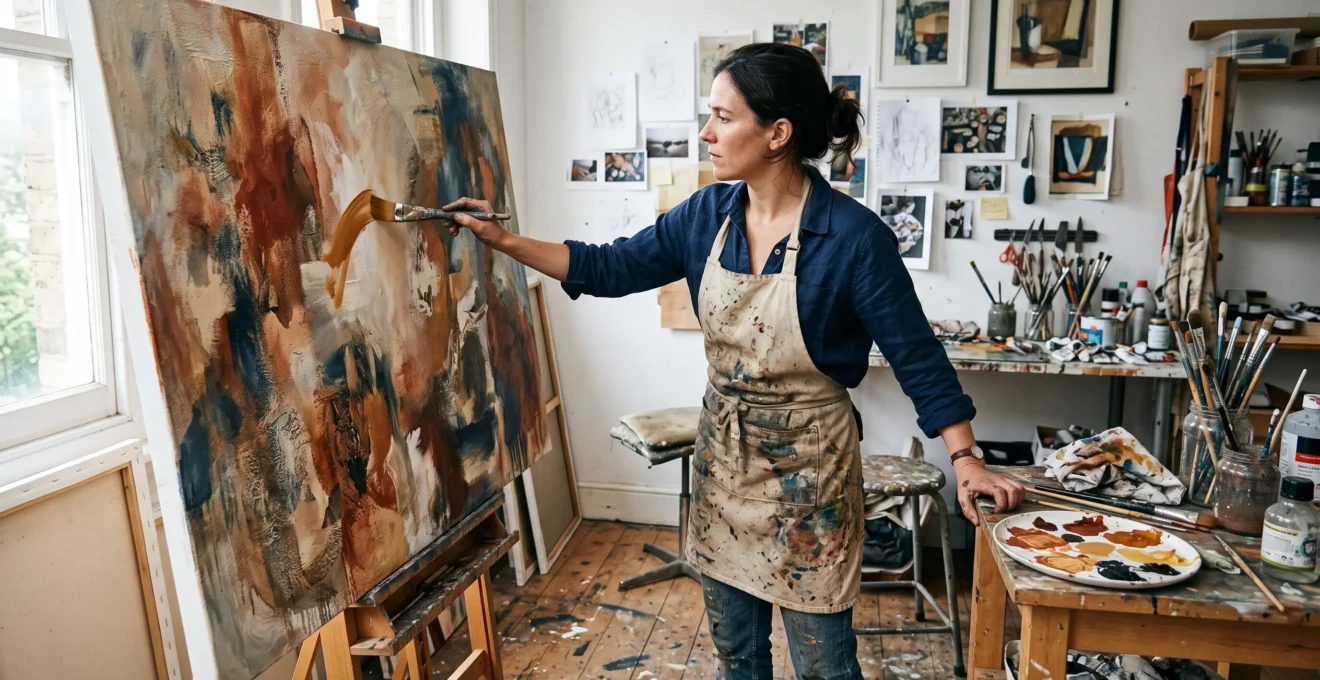
Developing artistic expression without copying other artists begins with understanding what genuinely attracts your attention, what experiences influence your perception and which visual decisions feel natural to you. Inspiration can come from studying established artists, exploring contemporary movements and experimenting with unfamiliar techniques. However, authentic creative communication requires transforming those influences rather than reproducing their visible results.
For emerging creators, the challenge is not necessarily finding a completely original subject or inventing an entirely new technique. It is learning to make deliberate choices about colour, composition, materials, subject matter and emotional atmosphere. Personal memories, recurring interests and individual preferences provide valuable starting points. Experimentation then helps reveal which choices deserve further development.
An individual artistic style is not something that needs to be manufactured immediately. It develops through repeated decisions, reflection and a willingness to change. By recognising personal themes, translating experiences into visual language and balancing experimentation with structure, artists can communicate ideas more convincingly while developing a recognisable practice that does not depend on imitation.
Developing authentic artistic expression: key principles
- Use personal memories, observations and recurring interests as starting points for meaningful artistic subjects.
- Translate emotions and experiences into visual decisions instead of reproducing another artist’s imagery or technique.
- Build an individual style through experimentation, self-review and deliberate variation rather than following trends or repeating a fixed formula.
- Why Do Personal Memories Influence an Artist’s Choice of Subjects?
- How to Turn a Personal Experience Into an Abstract Artwork?
- Intuitive Painting or Planned Composition for Emotional Subjects?
- Why Following Every Art Trend Can Weaken Personal Expression
- How to Review Finished Artworks to Identify Recurring Personal Themes?
- Why Do Artists Develop Recognisable Styles Without Planning Them?
- Free Experimentation or Creative Constraints for New Ideas?
- How to Develop an Individual Artistic Style Without Becoming Repetitive?
Why Do Personal Memories Influence an Artist’s Choice of Subjects?
Personal memories influence an artist’s choice of subjects because emotionally significant experiences can continue to shape what they notice, remember and want to communicate. An artist may repeatedly return to particular places, relationships, objects or natural environments because these subjects carry personal meaning. Their influence can also remain invisible, shaping colour, atmosphere and composition rather than appearing as an identifiable autobiographical scene.
This connection offers an important starting point for authentic expression. Instead of searching constantly for unusual subjects, emerging artists can examine what already attracts their attention. A recurring interest in empty rooms, changing landscapes, family objects or fragmented figures may reveal a personal concern worth exploring.
Two forms of influence deserve particular attention:
- Memory as a subject: An artwork directly represents an event, person, place or object connected to personal history.
- Memory as a perceptual filter: An experience changes how the artist interprets light, colour, distance, scale or atmosphere, even when the original event is absent from the composition.
The second form is especially useful for artists who want to communicate personal ideas without producing literal illustrations of their lives. A childhood environment, for example, might influence the scale of architectural forms or the emotional temperature of a palette without appearing as a recognisable location.
The work of Arshile Gorky illustrates how personal history can influence pictorial decisions. The Whitney Museum of American Art discusses how Gorky reworked a photograph of himself and his mother, transforming its recognisable composition through simplification and loosely brushed passages. His painting connects personal memory and loss with a distinctive visual treatment rather than simply reproducing the original photograph.
This example can be explored through the Whitney Museum’s profile of Arshile Gorky. It demonstrates one documented artistic response to personal history, not a universal formula for emotional expression.
Artists sometimes worry that using personal memories will make their work self-indulgent or inaccessible. The opposite can happen when personal material is developed through precise observation. A specific detail, such as the faded colour of a familiar room or the texture of an old object, can give viewers an accessible point of entry into an experience they have never shared.
A useful question separates genuine creative interest from external pressure: What would you still choose to paint if nobody would ever see the result? The answer can reveal subjects that matter independently of recognition, trends or expectations.
Personal experience does not need to dictate what an artwork depicts. Its greater value often lies in the way it changes the artist’s visual decisions, providing material that can later be translated into abstraction, composition and atmosphere.
How to Turn a Personal Experience Into an Abstract Artwork?
A personal experience can become an abstract artwork by translating its emotional qualities into formal visual decisions rather than illustrating the event itself. Identify the dominant feeling, tempo, texture and spatial impression associated with the experience, then express them through colour, brushwork, layering, scale and composition. This approach preserves emotional meaning without requiring recognisable figures, places or narrative details.
The first step is to distinguish what happened from what the experience felt like. A difficult conversation, for example, might involve frustration, hesitation, emotional distance or sudden relief. These qualities provide more useful starting points for abstraction than simply attempting to depict two people speaking.
A practical translation process involves four stages:
- Identify the dominant emotion. Decide whether the experience felt tense, peaceful, overwhelming, uncertain or fragmented. Avoid selecting several unrelated emotions without identifying their relationship.
- Describe its tempo. Consider whether the experience unfolded slowly, in sudden interruptions, through repetition or in a continuous movement.
- Identify its physical and spatial qualities. Was the experience constricted, expansive, dense, unstable, distant or close?
- Translate these qualities into formal decisions. Explore colour temperature, mark-making speed, layering, negative space, scale and compositional balance.
This process prevents abstraction from becoming merely decorative. A visually attractive arrangement of colours is not automatically an effective translation of personal experience. The emotional intention needs to guide the formal choices.
Consider a hypothetical example involving two artists remembering the same experience: leaving a familiar home. One artist might retain the emotional sensation of separation, using large areas of empty space, muted colours and interrupted horizontal marks. Another might focus on uncertainty and movement, creating dense overlapping layers, abrupt changes in colour and fragmented forms.
Both artists begin with the same hypothetical event, but their interpretations differ because they select different emotional qualities to preserve. Neither needs to reproduce a doorway, a suitcase or a recognisable building.
Another important decision concerns the narrative elements that remain in the artwork. Some recognisable forms may strengthen emotional communication, while others exist only to explain the original event. Ask whether removing a particular element changes the emotional impact or simply makes the story harder to identify. If it only improves narrative legibility, consider removing it.
Joan Mitchell offers a relevant historical example. The Museum of Modern Art describes how memories and emotional experiences informed her use of rhythmic marks and layered colour. Although her paintings could appear spontaneous, her process involved deliberate attention to colour relationships, brushstrokes and compositional balance. Her practice demonstrates how an emotional starting point can coexist with formal control.
For further context, consult MoMA’s artist profile of Joan Mitchell. Her working methods are an individual artistic example rather than a universal prescription for abstraction.
The essential principle is to let emotional intention determine the visual language. When formal decisions emerge from a clearly understood experience, abstraction becomes a way of communicating personal meaning rather than an exercise in arranging attractive shapes.
Once an experience has been translated into formal elements, the next challenge is deciding how much of the artwork should emerge intuitively and how much should be deliberately structured.
Intuitive Painting or Planned Composition for Emotional Subjects?
Intuitive painting and planned composition are complementary approaches rather than opposing artistic philosophies. Intuition is particularly useful when an emotional subject remains ambiguous or difficult to understand, while planning helps communicate an idea that has already become clearer. A combination of spontaneous exploration and deliberate revision often allows artists to preserve emotional vitality while making their intentions more readable.
The most appropriate method depends on the relationship between the artist and the subject. If the meaning is still emerging, a detailed composition can impose an interpretation too early. Conversely, when the artist already understands the central message, an entirely intuitive process may produce an expressive result that does not communicate the intended idea effectively.
The following comparison helps identify the appropriate starting point:
| Consideration | Intuitive painting | Planned composition |
|---|---|---|
| Emotional understanding | Still emerging or ambiguous | Relatively clear and defined |
| Primary objective | Discovering visual possibilities | Communicating a deliberate idea |
| Working method | Spontaneous marks and exploratory decisions | Structured composition and considered relationships |
| Potential difficulty | Unclear visual communication | Loss of emotional spontaneity |
A hybrid method can bring the strengths of both approaches together. Begin by making spontaneous studies without trying to control every mark. Select the passages that carry the strongest emotional energy, then examine their relationships through composition, contrast and visual hierarchy.
For example, an artist exploring loneliness might initially create several loosely structured studies. During revision, they could deliberately increase the empty space around a central form or reduce the number of contrasting colours. The final decisions introduce clarity without necessarily removing the vitality of the original response.
There is also a risk of over-intellectualising emotional subjects. Excessive corrections can make compositions stiff, encourage unnecessary detail and weaken the qualities that made the initial work compelling.
To avoid this, preserve the first studies as reference points. Compare the revised work with the spontaneous version and ask whether the changes improve communication or simply make the composition more controlled.
Joan Mitchell’s working process, documented by MoMA, offers an example of apparent spontaneity combined with deliberate evaluation. She assessed relationships between visual elements and considered her paintings from a distance between layers. This illustrates how intuition and critical judgment can coexist without one eliminating the other.
The distinction is not between emotional and intellectual painting. It is between discovering what an artwork needs and making conscious decisions that help it communicate.
With a more deliberate process established, artists can also become more selective about the external influences they allow into their work, particularly contemporary trends that may compete with personal judgment.
Why Following Every Art Trend Can Weaken Personal Expression
Following every art trend can weaken personal expression because it encourages artists to prioritise external approval over their own developing visual judgment. When creative decisions repeatedly respond to what is currently popular, an artist risks adopting subjects, palettes and techniques without understanding why those choices matter. Awareness of trends can be valuable, but imitation becomes limiting when it replaces individual artistic exploration.
Trends often make particular visual approaches immediately recognisable to an audience. A popular colour combination, composition style or image treatment may attract attention because viewers already understand its visual language. For emerging creators, this familiarity can make imitation appear like a reliable route towards recognition.
However, repeated adoption of external visual formulas can gradually weaken the ability to make independent choices. Instead of asking whether a particular technique serves the subject, artists may begin asking whether it resembles work that is already receiving attention.
This creates an important distinction between understanding an influence and adopting its appearance.
- Understanding an influence means analysing why a composition works, how colour relationships establish atmosphere or how a particular technique directs attention.
- Adopting its appearance means reproducing recognisable surface characteristics without necessarily developing an independent reason for using them.
A useful filter is to ask whether a trend aligns with themes and formal instincts already recurring in your work. If a new technique expands an existing interest, it may provide a productive direction. If adopting it requires abandoning your established concerns simply because it is popular, the influence deserves more scrutiny.
There is also a structural difference between competing through imitation and developing personal material. Artists reproducing a recognisable trend are often evaluated against its established examples and originators. Artists working from their own experiences and concerns can develop a more individual basis for comparison.
That does not mean an artist should ignore contemporary art. Observing different practices can expand technical knowledge and reveal possibilities that might otherwise remain unexplored.
A practical method is to analyse trending works through three questions:
- What compositional principle makes the work effective?
- Which technical or colour decisions contribute to its atmosphere?
- What does my reaction reveal about the visual choices I personally prefer or reject?
Record these observations without copying the original imagery. A preference for strong contrast, for example, might become a starting point for an entirely different subject, medium or compositional structure.
The goal is not complete independence from artistic influence. Artistic development naturally involves learning from existing practices. The important distinction is whether those influences expand personal expression or gradually replace it.
As external influences become easier to evaluate, reviewing completed artworks can reveal which preferences have already become part of an individual visual language.
How to Review Finished Artworks to Identify Recurring Personal Themes?
Reviewing finished artworks helps identify recurring personal themes by revealing visual and emotional patterns that may be difficult to recognise while creating individual pieces. Organising work chronologically, comparing formal decisions and examining repeated subjects can show which interests persist across different periods. The process helps distinguish meaningful artistic preferences from temporary habits, making future creative choices more deliberate.
Artists often struggle to recognise their own patterns because they experience each artwork as a separate problem to solve. A preference for particular colours, recurring spatial arrangements or repeated emotional atmospheres may seem accidental when viewed one piece at a time.
Distance makes these relationships easier to identify. Instead of evaluating each work according to whether it looks successful, examine the body of work as a developing record of artistic decisions.
A useful review separates two categories:
- Formal patterns: Repeated colours, textures, brushwork, materials, shapes, subjects, scale and compositional structures.
- Emotional patterns: Recurring concerns such as isolation, belonging, movement, memory, tension, vulnerability or transformation.
These categories should be examined separately because an emotional theme does not always appear through the same visual treatment. An artist interested in uncertainty, for example, might express it through fragmented figures in one period and unstable spatial relationships in another.
Several distance techniques can make the review more objective:
- Arrange artworks chronologically rather than grouping them only by medium or subject.
- Review photographs or reproductions at a reduced size to identify broad compositional tendencies.
- Return to older work after a period away from it.
- Ask another viewer to describe recurring impressions before explaining the intentions behind individual pieces.
External observations can be particularly revealing. A viewer may identify a repeated emotional atmosphere that the artist never consciously intended to create. Such feedback is not automatically definitive, but it provides another perspective from which to examine the work.
Once patterns emerge, the next step is deciding whether to deepen them or question them. A repeated preference may represent a genuine artistic concern that deserves further exploration. Alternatively, it may have become a comfortable solution that no longer contributes meaningfully to the work.
Ask whether the recurring choice still carries emotional or conceptual significance. Does it reveal something new when applied to different subjects? Does it support the intended atmosphere? Or does it appear automatically because it is familiar?
Avoid drawing firm conclusions from a very small body of work. A colour palette or subject that appears in several recent pieces may simply reflect a temporary period of experimentation. A more convincing personal theme should remain visible across distinct periods, subjects or emotional conditions.
A practical five-step artistic self-review
- Arrange finished artworks in chronological order and create a dated visual inventory.
- Record repeated formal elements, producing a separate list of colours, marks, materials, subjects and compositions.
- Write down recurring emotional or conceptual themes, with at least one example of each from the artwork collection.
- Compare observations with feedback from another viewer and identify agreements or differences in interpretation.
- Choose one pattern to deepen and one habitual decision to question, recording both as priorities for the next body of work.
This process turns reflection into a practical tool for artistic development. Rather than searching for an entirely new identity after every completed project, artists can recognise what already connects their work and decide how those connections should evolve.
Recognising recurring patterns provides a clearer understanding of artistic identity. Over time, these accumulated preferences can become a recognisable style, even when the artist never deliberately set out to design one.
Why Do Artists Develop Recognisable Styles Without Planning Them?
Artists often develop recognisable styles without planning them because repeated creative decisions gradually establish consistent visual preferences. Choices involving brush pressure, colour relationships, cropping, scale, texture and composition accumulate through practice. Over time, these preferences create continuity between artworks, even when their subjects or techniques differ. Style can therefore emerge through repeated exploration rather than from an initial decision to imitate a particular aesthetic.
Every creative session involves numerous small decisions. An artist chooses how much space to leave around a subject, whether to use broad or delicate marks, which colours to combine and how to balance contrasting elements.
These decisions may initially appear unrelated. However, repeated preferences can create a visual language that becomes increasingly recognisable across different works.
This explains why attempting to select an artistic style before developing a substantial body of work can be limiting. An artist may choose a particular aesthetic because it looks coherent or commercially attractive, without understanding whether its underlying decisions correspond to their own interests.
The result can be surface consistency without genuine personal connection. Works may resemble one another technically while feeling disconnected from the subjects or experiences the artist actually wants to communicate.
The development of Frank Stella provides an interesting historical perspective on how artistic approaches change. The National Gallery of Art documents his progression from systematic geometric paintings towards curved forms, brighter colours and increasingly spatial constructions. His work demonstrates that a recognisable artistic practice can evolve substantially through changes in materials, scale and composition.
The National Gallery of Art’s biography of Frank Stella provides historical context for this development. His career also shows why artistic style should not be understood as necessarily unconscious: systematic decisions and deliberate experimentation can contribute to an individual visual language.
For emerging creators, the practical implication is to replace the question « What should my artistic style be? » with a more useful one: Which of my recurring creative decisions am I willing to continue developing?
Those decisions can include a particular relationship between empty space and dense detail, a preference for specific materials or an interest in transforming recognisable subjects into simplified forms.
However, an emerging style should not become an unquestioned formula. Repeated choices remain valuable only while they contribute to the artist’s intentions. A familiar signature can eventually become a mannerism if it continues to appear after its original meaning has disappeared.
Periodic self-review therefore remains essential. It allows artists to recognise which elements deserve consistency and which require reconsideration.
Once recurring preferences become clearer, experimentation and creative constraints can help artists develop them further without relying on predetermined aesthetic formulas.
Key principles to guide creative development
- Authenticity depends on the relationship between personal intention and formal artistic decisions, not on complete freedom from external influences.
- Creative experimentation should reveal new possibilities, while reflection helps distinguish meaningful discoveries from habits.
- A recognisable style needs continuity, but it must remain flexible enough to communicate evolving interests and experiences.
Free Experimentation or Creative Constraints for New Ideas?
Free experimentation and creative constraints serve different purposes in artistic development. Free exploration is particularly useful when fear, self-censorship or uncertainty prevents new ideas from emerging. Constraints are more effective when too many possibilities create confusion or make it difficult to develop a coherent direction. Combining both approaches allows artists to discover unexpected possibilities before concentrating on the most promising ones.
The choice should depend on the type of creative difficulty being experienced rather than on a belief that one method is universally superior.
When an artist feels blocked because every decision seems likely to produce an unsuccessful result, unrestricted experimentation can reduce pressure. Working with unfamiliar materials, making rapid studies or exploring unexpected combinations can create opportunities that deliberate planning might overlook.
However, freedom can become counterproductive when it produces endless variations without meaningful development. Creating more studies does not automatically improve an artwork if the artist never decides which discoveries deserve attention.
Creative constraints address a different problem. By limiting selected possibilities, artists are encouraged to move beyond familiar solutions and reconsider how they approach a subject.
Examples include:
- Using a limited palette to explore relationships between colour and atmosphere.
- Working with one material to investigate its expressive possibilities.
- Changing the usual scale of a subject to reconsider its visual importance.
- Creating a composition without relying on the artist’s most familiar marks or shapes.
Patricia D. Stokes examines this relationship in her scientific article on creativity and constraints. Her conceptual framework considers how paired constraints can restrict familiar solutions while encouraging exploration of alternatives. The analysis discusses artists including Piet Mondrian and Paul Klee, suggesting that deliberate limitations can form part of creative problem-solving.
Read Patricia D. Stokes’s research article on creativity and constraints for the theoretical framework. It is a conceptual analysis illustrated through selected artists, not experimental proof that every constraint increases originality.
A productive sequence combines both methods:
- Begin with open experimentation to generate unfamiliar forms, materials and visual relationships.
- Review the results to identify the most interesting discoveries.
- Select one discovery and introduce a constraint that encourages further exploration.
- Develop a focused series of studies using that limitation.
- Evaluate whether the constraint has revealed new possibilities or simply become another repetitive formula.
This approach gives freedom and structure complementary roles. Experimentation expands the available material, while constraints help transform discoveries into more deliberate artistic decisions.
The main warning is to recognise when either approach stops being productive. Endless experimentation without selection can become a way of avoiding commitment. Conversely, constraints maintained for too long can harden into rigid habits.
A useful signal for changing direction is repetition without discovery. If several studies produce the same result, reconsider the limitation or introduce a different variable. If experimentation produces many unrelated possibilities but no meaningful development, introduce a more focused constraint.
Once a productive creative cycle is established, the final challenge is maintaining an individual style while allowing subjects, techniques and interests to evolve.
How to Develop an Individual Artistic Style Without Becoming Repetitive?
Developing an individual artistic style without becoming repetitive requires maintaining a consistent underlying sensibility while allowing its visual expression to change. A recognisable style can accommodate different subjects, materials, compositions and techniques. Repetition becomes limiting when an artist reproduces the same surface formula regardless of the subject or intention. The objective is to preserve meaningful continuity while continuing to discover new ways of communicating.
The most important distinction is between style and formula. Style reflects an artist’s broader approach to visual communication: recurring concerns, aesthetic preferences and ways of interpreting the world. A formula is a fixed collection of visual solutions that gets reproduced without reconsidering whether it serves the current artwork.
An artist might consistently explore themes of memory and displacement through different approaches to painting, drawing or mixed media. That continuity can make the work recognisable even when its appearance changes considerably.
By contrast, repeating the same composition, colour arrangement and subject treatment across every piece can produce superficial consistency without further development.
A useful framework for artistic evolution is the decision to deepen or widen a creative practice.
- Deepen an established theme: Investigate an existing subject more thoroughly, exploring different emotional dimensions, visual relationships or interpretations.
- Widen its visual expression: Introduce different materials, scales, compositions or subjects while retaining the underlying concern that connects the work.
Stagnation can occur when neither direction produces meaningful change. Repeating the same visual solution without developing its meaning creates a formula. Constantly changing subjects and techniques without retaining any conceptual continuity can make a body of work feel disconnected.
The solution is to introduce variation selectively. Changing one major structural variable at a time can help reveal how a visual language responds to new conditions.
For example, an artist whose paintings consistently use layered colour and fragmented forms might retain those characteristics while introducing larger canvases. Later, the artist could explore a different subject while preserving the established approach to spatial relationships.
This method makes change easier to evaluate. When several major elements change simultaneously, it becomes difficult to understand which decisions contributed to a successful result and which weakened the work.
Historical artistic development offers useful context. Frank Stella’s successive bodies of work demonstrate that a recognisable practice can move through substantially different formal approaches. His progression illustrates that consistency does not require an artist to remain attached to the earliest appearance of their work.
A long-term comparison can help maintain this balance. Every so often, place recent work beside pieces created several years earlier. Examine whether the artist’s concerns have become more developed, whether formal choices have expanded and whether recurring elements still carry meaning.
Some similarities across different periods indicate conviction rather than stagnation. A recurring interest in particular subjects or visual relationships can be an important part of artistic identity. The relevant question is whether that continuity has generated deeper understanding or merely repeated familiar solutions.
For emerging artists, a useful final test is to ask three questions:
- Does this new artwork communicate an idea that matters to me?
- Does it develop an existing visual language or introduce a meaningful alternative?
- Would I make these decisions even if they did not resemble my previous work or current artistic trends?
The answers help distinguish deliberate artistic continuity from automatic repetition. They also make it easier to decide when to preserve a familiar approach and when to experiment with something less predictable.
Authentic artistic expression is not a final aesthetic that needs to remain unchanged. It is an evolving relationship between personal experience, visual decisions and creative intention. Emerging creators can develop a more individual practice by observing what genuinely matters to them, learning from artistic influences without reproducing them, and remaining willing to question familiar solutions. The next meaningful artwork begins with a deliberate choice about what deserves to be communicated.
How can beginners find their own artistic style?
Beginners can start by creating regularly, exploring different materials and subjects, and reviewing completed work for recurring preferences. Rather than selecting an established artist’s style to reproduce, examine which colours, compositions, techniques and themes feel personally meaningful. An individual style gradually develops through repeated creative decisions and reflection.
Is it possible to be inspired by another artist without copying them?
Yes. Artists can study another creator’s techniques, compositional principles and use of colour without reproducing their distinctive imagery. The important step is to understand the principle behind an artistic decision and reinterpret it through a different subject, intention or visual approach. Inspiration becomes more productive when it expands rather than replaces personal judgment.
Does authentic art have to be autobiographical?
No. Authentic artistic expression does not require literal representations of personal experiences. Individual observations, imagined situations, cultural references and external subjects can all become meaningful artistic material. Personal perspective can influence how an artist interprets colour, atmosphere, composition and form, even when the artwork does not depict anything autobiographical.
How do artists know when their style has become repetitive?
A style may be becoming repetitive when the same visual solutions appear automatically, regardless of the subject or intended meaning. Comparing recent work with earlier projects can reveal whether recurring elements still communicate something meaningful. If the work repeats familiar appearances without exploring new ideas, changing a major variable such as medium, scale or composition may help restore creative development.
Should artists follow contemporary art trends to develop their careers?
Artists can benefit from understanding contemporary trends because they provide information about current visual approaches and creative conversations. However, following every trend can distract from developing a personal artistic direction. Studying the principles behind popular works, rather than reproducing their appearance, allows artists to remain informed while maintaining independent creative judgment.