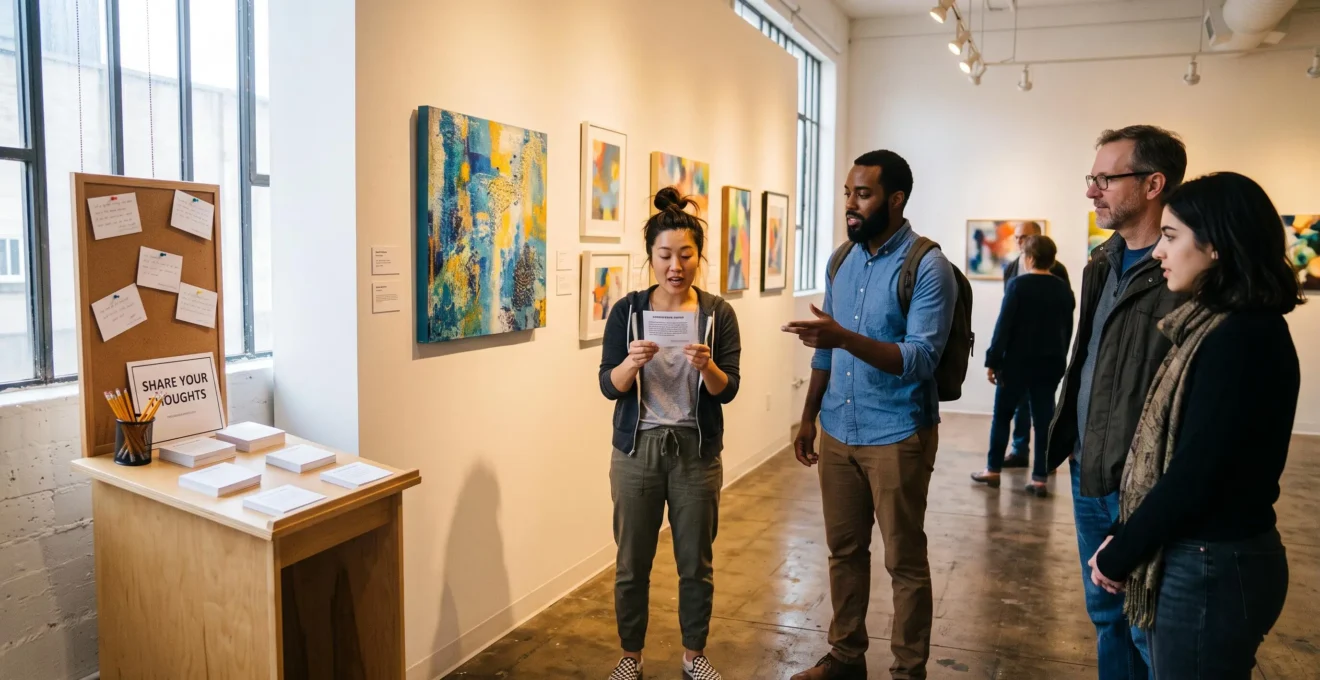
Meaningful audience engagement at a small art exhibition does not require elaborate technology, compulsory workshops or constant interaction. It begins with giving visitors accessible opportunities to respond to artworks in their own way, whether through a brief observation, a written comment, a conversation or a simple choice. For independent galleries, the challenge is to create these opportunities without turning the exhibition into an activity space that competes with the artworks.
The most effective approach combines optional participation, thoughtful facilitation and a clear understanding of different visitor preferences. Some people enjoy discussing contemporary art, while others prefer to reflect privately before sharing anything. Neither response indicates a lack of interest. Designing for both makes engagement more welcoming and sustainable.
Small galleries can start with inexpensive formats such as discussion cards, visitor polls, informal conversations and locally co-created programmes. The important consideration is not how many interactive elements an exhibition contains, but whether visitors can contribute meaningfully without feeling observed, tested or obliged to participate.
Key Principles for Increasing Gallery Engagement
- Offer optional, low-pressure activities that respect visitors who prefer quiet contemplation.
- Use accessible discussion prompts, simple polls and small-group conversations to encourage different forms of participation.
- Build long-term relationships with local communities through co-creation, accessible programming and meaningful feedback.
- Why Do Some Gallery Visitors Avoid Participatory Activities?
- How to Create Discussion Cards for a Contemporary Art Exhibition?
- Visitor Polls or Group Discussions: Which Produces Richer Feedback?
- Why Mandatory Interactive Activities Can Alienate Gallery Visitors
- How to Make Exhibition Activities Welcoming to Art Beginners?
- How to Encourage Multiple Interpretations During an Art Tour?
- Why Do Local Residents Feel Excluded From Museum Activities?
- How Can Public Engagement Make Art Programmes More Inclusive?
Why Do Some Gallery Visitors Avoid Participatory Activities?
Gallery visitors avoid participatory activities for different reasons, including uncertainty about their artistic knowledge, discomfort with group interaction and a genuine preference for quiet observation. These motivations require different responses. An independent gallery should therefore investigate what makes an activity uncomfortable rather than interpreting low participation as a general lack of interest in contemporary art.
Fear of giving the wrong answer is one possible barrier. Visitors unfamiliar with art terminology may assume that an exhibition activity expects knowledge of artistic movements, historical references or curatorial intentions. A question such as « What does the artist intend to communicate? » can feel like an examination, particularly when the artwork is abstract or conceptually unfamiliar.
Reframing the question around personal observation changes the dynamic. Asking « What catches your attention first? » or « Which detail would you like to explore? » allows visitors to contribute without demonstrating specialist knowledge. There is no requirement to recognise the artist or understand the intended interpretation before responding.
Social anxiety creates a different obstacle. A visitor may have an interesting opinion but feel uncomfortable speaking in front of strangers. Activities placed near entrances, reception desks or central circulation routes can intensify this feeling because participation becomes highly visible. Semi-secluded stations, private written responses and take-away cards provide more discreet alternatives.
A third group deliberately prefers contemplation. These visitors may enjoy the exhibition but consider conversation, group exercises or written tasks an interruption. Their choice should be respected rather than treated as a problem to solve.
The UK government’s 2024/25 Participation Survey report provides useful context about cultural participation in England. It reports that 41% of adults physically visited museums or galleries during the survey’s reference period. Among adults who had not physically engaged, 33% selected no particular reason and 29% cited lack of interest. These figures concern museum and gallery attendance, not refusal to participate in exhibition activities, and should not be used to infer individual motivations.
For gallery teams, low participation also creates an operational risk. Staff may interpret an empty activity station as evidence that visitors are uninterested, respond by prompting people more aggressively or abandon the format altogether. Neither reaction establishes why the activity failed to attract attention.
Observing where visitors pause, whether they read the instructions and how they respond to staff invitations can reveal practical improvements. The objective is to make participation accessible while preserving the freedom to experience art without interacting.
How to Create Discussion Cards for a Contemporary Art Exhibition?
Discussion cards encourage visitors to interpret contemporary artworks through short, accessible questions that do not require specialist knowledge. Effective cards combine observation, personal association and open-ended reflection. They should be easy to pick up, quick to understand and optional to complete, allowing visitors to participate individually or start conversations without interrupting the exhibition.
Contemporary art can present a particular challenge because visitors may not recognise familiar subjects, narratives or artistic references. A card that asks for an interpretation of the artist’s intention can unintentionally suggest that there is a correct answer. A better approach starts with what visitors can see, notice or personally associate with the work.
A practical card can contain three complementary prompts:
- Observation: « What do you notice first? » This encourages visitors to look closely and identify details that attract their attention.
- Association: « Where else have you seen something like this? » This connects the artwork with memories, experiences and familiar visual references.
- Personal response: « Would you hang this at home? » This invites an accessible opinion without requiring an art-historical explanation.
These questions create different entry points. Observation encourages attention, association expands interpretation and personal response introduces a conversational dimension. Visitors can answer one question rather than completing the entire card.
The structure also benefits from the principles demonstrated by Visual Thinking Strategies’ Image of the Week activity. Its method begins with quiet observation before inviting participants to interpret an image, identify visual evidence and explore further observations. This provides a useful model for gallery questions that encourage independent thinking instead of supplying a prescribed reading.
Physical design matters as much as wording. Cards should be compact enough to carry comfortably, printed with readable typography and presented with pencils or another simple response method. A clearly identified return point prevents visitors from wondering what to do with completed cards.
Another important decision concerns what happens to completed responses. A public display wall makes contributions visible and can encourage visitors to compare interpretations. However, it may discourage people who do not want their opinions displayed. Private collection offers greater discretion and can make feedback more comfortable, although visitors will not immediately see how others have responded.
Cards should also avoid embedding the curator’s preferred interpretation. Asking « What do you think the artist means by the fragmented figures? » already assumes that visitors recognise the relevant artistic intention. An open question about the figures, their arrangement or the viewer’s response is less restrictive.
A Practical Checklist for Designing Discussion Cards
- Write three prompts covering observation, personal association and individual response; keep the final wording in a draft card.
- Test every question with someone unfamiliar with the exhibition; record whether they can answer without additional explanation.
- Prepare a pocket-sized card with readable text and sufficient space for optional written responses; retain a print-ready version.
- Choose a public display or private collection method; document the decision and provide a clearly marked return point.
- Place the cards in a discreet but visible location and review their use after the exhibition opens; record the number distributed and returned.
Once the cards are in place, the next decision is how to collect and interpret visitor feedback. Polls and group discussions offer different advantages, and choosing between them requires more than simply counting responses.
Visitor Polls or Group Discussions: Which Produces Richer Feedback?
Visitor polls produce more accessible and structured feedback, while group discussions reveal the reasoning and personal associations behind visitors’ opinions. Neither method is universally better. Independent galleries should compare them according to response volume, honesty, depth and representation, then choose a format that matches available staffing, exhibition size and the type of insight they need.
A poll has a low participation threshold. Visitors can select an option, place a sticker or answer a short question without speaking to anyone. This makes polls particularly useful for capturing reactions from people who prefer not to join a conversation.
However, predetermined answers limit what visitors can communicate. A poll asking whether an artwork is appealing, challenging or confusing may identify general reactions but cannot explain the experiences behind them. The format also risks overlooking opinions that do not fit the available options.
Group discussions provide a different kind of information. Participants can explain their interpretations, disagree constructively and introduce associations that the curator may not have anticipated. Their comments can help gallery teams understand how visitors experience individual works and how meaning develops through conversation.
The limitation is that open discussion does not automatically produce representative feedback. People who feel confident speaking may dominate, while quieter participants remain unheard. Some visitors may also avoid a group activity altogether, even when they have valuable observations.
The following comparison helps clarify the trade-offs:
| Evaluation criterion | Visitor polls | Group discussions |
|---|---|---|
| Response volume | Can collect many short responses with little effort. | Usually involve fewer participants at a time. |
| Response depth | Limited by predefined choices unless written comments are added. | Allows explanations, examples and unexpected interpretations. |
| Participation threshold | Low; visitors can respond independently. | Higher; participants must be comfortable speaking. |
| Feedback format | Structured and relatively easy to compare. | Detailed but requires interpretation and documentation. |
| Staff requirements | Can operate without a dedicated facilitator. | Benefits from someone guiding and recording the conversation. |
| Representation | Can reach visitors who avoid public speaking. | May favour confident participants unless carefully facilitated. |
A useful strategy is to sequence the two formats. A visitor first encounters a simple poll, perhaps asking which of two artworks they would like to discuss. The poll creates an initial opportunity to contribute. Visitors who want to explore their choices further can then join an optional conversation.
When a facilitator is available, small conversations involving two to four people can offer a manageable alternative to large open discussions. This is a practical design recommendation rather than an experimentally established optimum. Smaller groups can make it easier for participants to contribute, provided the facilitator prevents one person from controlling the exchange.
Without a facilitator, a poll combined with an optional written-response wall is more practical than an unattended discussion activity. The gallery can still collect structured reactions and individual comments without creating an expectation that visitors should organise their own conversation.
Regardless of the chosen method, participation should remain voluntary. A format that collects impressive numbers but makes visitors feel obliged to contribute can undermine the quality of the experience.
Why Mandatory Interactive Activities Can Alienate Gallery Visitors
Mandatory interactive activities can alienate gallery visitors because they replace the freedom to explore art with an expectation to perform. People may visit an exhibition to observe quietly, think independently or spend time with a particular artwork. When interaction becomes compulsory, visitors who prefer different experiences can feel excluded, uncomfortable or less willing to return.
The distinction between an invitation and an obligation is fundamental. An optional activity offers an additional way to experience an exhibition. A compulsory task implies that visitors have not completed the experience properly unless they participate.
This can change the atmosphere of a small gallery. Instead of approaching an artwork with curiosity, visitors may begin wondering whether they are expected to answer a question, complete a worksheet or join a conversation. The exhibition starts to resemble an assessment environment rather than an open cultural experience.
Several visitor groups may be particularly affected:
- Neurodivergent visitors may have sensory, communication or processing preferences that make certain interactive formats uncomfortable.
- Visitors experiencing social anxiety may prefer written or individual activities over conversations with strangers.
- Repeat visitors may already have a personal relationship with the exhibition space and want to explore it differently on each visit.
- Accompanying partners may enjoy spending time in the gallery without having a particular interest in participating in art-related exercises.
Compulsion also creates a measurement problem. If everyone must complete an activity, participation figures may increase without demonstrating genuine interest. A gallery could report high interaction levels while overlooking whether visitors felt comfortable, valued the experience or wanted to return.
For this reason, engagement metrics should distinguish between participation, satisfaction and longer-term relationships. A completed worksheet does not necessarily indicate meaningful involvement, just as a visitor who quietly examines an artwork should not automatically be classified as disengaged.
The Museums Association’s Engaging Audiences and Communities competency framework offers a useful professional reference. It encourages welcoming environments, recognition of diverse visitor needs, multiple ways of engaging with collections and attention to audience feedback. These principles support a flexible approach rather than a single prescribed form of interaction.
A practical design test can help teams evaluate an activity before launch: can someone complete the entire exhibition and leave with a meaningful experience without touching any interactive element? If the answer is yes, participation remains an invitation. If the answer is no, the activity may have become an obligation.
That test does not mean every exhibition must avoid structured activities. Scheduled workshops, guided tours and facilitated sessions can legitimately involve active participation when their format and expectations are clearly communicated beforehand. The distinction is that visitors choose to attend an activity designed around interaction rather than being forced into it during an otherwise open exhibition visit.
Once visitors can choose their level of involvement, the next challenge is making those opportunities understandable and comfortable for people who have little previous experience with art.
How to Make Exhibition Activities Welcoming to Art Beginners?
Exhibition activities become more welcoming to art beginners when they rely on familiar abilities rather than specialist knowledge. Visitors should be able to participate without knowing an artist’s biography, recognising an artistic movement or reading every exhibition label. Personal associations, sensory observations and simple choices provide accessible starting points while allowing more experienced visitors to explore deeper questions.
The first step is applying a no-prerequisites test to every activity. Someone unfamiliar with the exhibition should be able to understand the instructions and contribute a meaningful response immediately. If an activity requires visitors to understand a historical reference or identify a technical process first, it may be better suited to an advanced interpretation station.
Personal and sensory prompts are particularly useful because they draw on experiences that do not belong exclusively to the art world. For example, visitors could be invited to choose which of two artworks they would prefer to live with, identify a work that reminds them of a particular memory or associate a painting with a piece of music.
These questions do not make artistic interpretation less sophisticated. Instead, they create a starting point from which visitors can develop more detailed observations and connections.
Staff language is equally important. A question such as « Why do you think that? » can unintentionally sound like a challenge, especially when a beginner is unsure whether their interpretation is acceptable. A more welcoming approach might be: « Some people find this unsettling, while others respond differently. Where do you land? »
This type of facilitation acknowledges that visitors can have different reactions without immediately evaluating them. Staff should listen to answers, ask neutral follow-up questions and avoid correcting personal responses simply because they differ from the curator’s interpretation.
There is also a balance to maintain between beginners and regular visitors. Repeating only introductory activities may make the exhibition feel simplistic to people who already engage with contemporary art. The solution is to provide different levels of depth within the same activity.
For instance, a station could begin with « What do you notice first? » and offer an optional follow-up asking visitors to consider how the arrangement of materials changes their interpretation. The first question is accessible to everyone; the second rewards visitors who want to explore further.
The Museums Association’s professional guidance on audience engagement also supports multiple ways of engaging with collections and recognising diverse learning and participation needs. For independent galleries, this translates into flexible activities rather than dividing visitors into rigid categories of beginners and experts.
When visitors feel that their observations are legitimate, they are more likely to contribute naturally. Guided tours provide another opportunity to develop this confidence by making space for different interpretations rather than presenting a single authorised reading.
How to Encourage Multiple Interpretations During an Art Tour?
To encourage multiple interpretations during an art tour, guides should invite visitors to describe what they notice before introducing the artist’s background or the curator’s interpretation. They can then use visual evidence, contrasting observations and open-ended questions to develop a conversation in which different readings coexist without requiring everyone to reach the same conclusion.
The first technique is to delay contextual information. Instead of beginning with an explanation of the artist’s intentions, the guide can ask participants to look quietly at the work and identify what attracts their attention.
Questions such as « What is happening here? » and « What do you see that makes you say that? » encourage participants to connect their interpretations with visible details. This makes the artwork the shared reference point rather than the guide’s specialist knowledge.
The approach is consistent with Visual Thinking Strategies, which uses observation, interpretation and visual evidence to structure discussions about images. Context can be introduced later, once visitors have had an opportunity to develop their own readings.
Disagreement should also be treated as an opportunity. If one visitor interprets an artwork as peaceful and another finds it unsettling, the guide does not need to select a winner. Instead, they can ask which elements of the work support each response.
This technique validates participation while demonstrating that interpretation can be influenced by personal experience, attention and perspective. It also helps visitors understand that disagreement does not necessarily mean that someone has misunderstood the artwork.
The tour structure can reinforce this principle. Revisiting an artwork near the end of a visit allows participants to compare their initial impressions with their later observations. New contextual information and other visitors’ comments may have changed what they notice, producing a more reflective experience.
Guides must also avoid pseudo-open questions. Asking « What do you feel? » and then steering every answer towards a predetermined curatorial interpretation quickly undermines trust. Visitors notice when their contributions are welcomed only until they diverge from the explanation the guide intends to deliver.
A genuinely open discussion requires facilitators to accept interpretations they did not anticipate. They can introduce factual information, clarify the context of the work and challenge unsupported assumptions without dismissing personal responses.
The practical distinction is between offering context and using context to close a conversation. A guide can explain the artist’s stated intentions while acknowledging that visitors may experience the work differently.
These principles can strengthen individual exhibition experiences, but meaningful public engagement also depends on relationships beyond the gallery walls. Local residents need opportunities to recognise themselves in the institution’s activities and decisions.
Why Do Local Residents Feel Excluded From Museum Activities?
Local residents can feel excluded from museum activities because of both practical barriers and signals that cultural programming is not intended for them. Ticket prices, inconvenient opening hours and unsuitable event schedules limit access, while specialist communications, unfamiliar environments and a lack of local representation can create a deeper sense of exclusion even when admission is affordable.
Practical barriers are often the easiest to identify. An independent gallery that organises every public event during standard working hours may unintentionally exclude residents who cannot attend at those times. Admission costs, transport difficulties and limited family-friendly opportunities can create additional obstacles.
However, solving these logistical problems does not automatically create a sense of belonging. A gallery may offer free entry and accessible opening hours while continuing to communicate mainly with established art audiences. Technical language, references to unfamiliar artistic networks and formal promotional material can suggest that participation requires prior cultural knowledge.
The entrance experience also matters. Security-heavy arrangements, unclear visitor information or an atmosphere that feels overly formal can make a neighbourhood resident question whether the space is genuinely open to them.
Programming choices can either reinforce or challenge this perception. One-off flagship events may attract attention, but lasting relationships often require repeatable opportunities to become familiar with the institution. Regular evening openings, local artist showcases and neighbourhood-themed activities can give residents reasons to return.
Representation is another important factor. Residents are more likely to recognise genuine community involvement when they see local artists, neighbourhood organisations and community perspectives influencing the programme. Being invited to attend an event is not equivalent to having a meaningful role in shaping it.
For independent galleries, a useful starting point is to examine who is absent from existing visitor information. Looking at available postcode, age and household data can reveal groups that are rarely represented in attendance figures. This should be done with appropriate privacy safeguards and without assuming that demographic information alone explains individual motivations.
England’s 2024/25 Participation Survey provides wider context for geographical differences in museum and gallery engagement. Physical engagement was reported by 30% of adults in the most deprived areas, compared with 49% in the least deprived areas. These national figures identify a disparity in attendance but do not establish the causes of exclusion at any particular local gallery.
Rather than launching a generic campaign aimed at the entire neighbourhood, gallery teams should identify which groups are missing, listen to their experiences and investigate the barriers that matter to them. A conversation with a local youth organisation may reveal different needs from a discussion with older residents or neighbourhood artists.
Once the gaps are understood, public engagement can become part of programme development itself. This shifts the objective from attracting new audiences to creating cultural activities that communities can genuinely influence and sustain.
Key Considerations for Inclusive Public Engagement
- Identify which communities are missing from existing participation data instead of treating the neighbourhood as a single audience.
- Involve residents in shaping artistic themes, activities and partnerships before programming decisions are finalised.
- Evaluate whether engagement creates lasting relationships through repeat participation, meaningful feedback and continued community involvement.
How Can Public Engagement Make Art Programmes More Inclusive?
Public engagement makes art programmes more inclusive when communities influence how activities are designed, scheduled and delivered. Rather than relying on isolated outreach events, independent galleries can involve residents in choosing themes, selecting formats and developing partnerships. This approach makes inclusion part of programme planning and creates opportunities for relationships that extend beyond a single exhibition.
The distinction between consultation and co-creation is important. Consultation asks residents to react to an existing proposal, often after the main decisions have already been made. Co-creation gives participants an opportunity to influence those decisions from an earlier stage.
For example, a gallery planning a neighbourhood exhibition could invite local residents and artists to discuss potential themes before selecting the final programme. Community partners might contribute ideas about suitable activities, exhibition formats or ways to present local stories.
This does not mean that every programming decision must be transferred to a public committee. Curators and gallery teams retain responsibility for artistic direction, resources and practical delivery. However, meaningful participation requires demonstrating how community contributions have influenced the final choices.
The Museums Association’s Power to the People framework provides a professional reference for improving participatory practice and developing sustainable relationships between museums and communities. Its emphasis on participation and longer-term community connections is relevant to independent galleries seeking to move beyond isolated engagement events.
Inclusive programming also requires a broader understanding of when and how people can participate. A gallery could combine evening openings, informal artist conversations, written contributions and accessible family activities rather than relying on a single event format.
Partnerships with local schools, community organisations, independent artists and neighbourhood groups can help galleries understand existing needs and establish more relevant activities. These relationships should involve genuine collaboration rather than simply using partner organisations to distribute promotional material.
Measurement is essential because attendance alone does not demonstrate inclusion. A programme can attract large audiences while repeatedly reaching the same established visitors. Gallery teams should therefore distinguish between:
- Reach: How many people attended or contributed to an activity.
- Audience diversity: Whether different local groups are represented in participation.
- First-time engagement: Whether the programme attracted people who had not previously visited or participated.
- Retention: Whether participants returned for another exhibition or activity.
- Influence: Whether community contributions changed any aspect of the programme.
These measures provide a more meaningful understanding of engagement than a single attendance figure. They also help galleries distinguish between reaching a new audience and developing an ongoing relationship with that audience.
Sustainability deserves equal attention. If engagement depends entirely on short-term project funding, activities may disappear as soon as a grant ends. Residents who have contributed time and ideas can then feel that their involvement was temporary or instrumental.
Independent galleries should therefore consider which activities can become recurring parts of their programming, even when resources are limited. A regular community discussion, an annual local artist showcase or a continuing partnership with a neighbourhood organisation may provide a more realistic foundation than an ambitious one-off campaign.
Transparency strengthens these relationships. When a proposed community idea cannot be implemented, explaining the reasons and identifying possible alternatives is more constructive than allowing contributions to disappear without feedback.
For independent galleries, the next practical step is to review an upcoming exhibition and identify one activity that can be made more accessible, one community perspective that is currently missing and one relationship that can be developed over time. This creates a manageable starting point for audience engagement without compromising the experience of the artworks.
What are the most effective low-cost audience engagement activities for small art galleries?
Discussion cards, sticker polls, written-response walls, informal artist conversations and short guided discussions are practical low-cost options. Their effectiveness depends on accessible instructions, thoughtful placement and optional participation. Galleries should select activities according to their available staff, exhibition layout and audience preferences rather than introducing multiple interactive elements at once.
How can a gallery measure meaningful visitor engagement?
Combine participation counts with qualitative feedback, visitor observations and repeat-visit information. Track how many people use an activity, what kinds of responses they provide and whether new audiences return. Attendance and completed activities are useful indicators, but they do not independently demonstrate visitor satisfaction, inclusion or meaningful involvement.
How can galleries encourage participation without disturbing quiet visitors?
Keep interactive stations away from essential circulation routes, offer discreet written activities and allow visitors to take discussion cards with them. Avoid requiring verbal responses or placing staff in positions where visitors feel pressured to participate. Every visitor should be able to enjoy the complete exhibition without using an interactive element.
How often should independent galleries organise community engagement activities?
There is no universal frequency. Galleries should choose a sustainable schedule that reflects their resources, local demand and existing partnerships. Regular, manageable activities can help residents become familiar with the institution, while occasional larger events can complement these relationships. Consistency and continuity matter more than organising events simply to increase their number.
How can contemporary art exhibitions engage visitors who have little knowledge of art?
Use questions based on observation, personal memories, sensory reactions and everyday experiences. Avoid assuming that visitors know the artist, artistic movement or historical context. Offer optional deeper prompts for those who want to explore further, and train gallery staff to welcome different interpretations without judging whether an answer is correct.