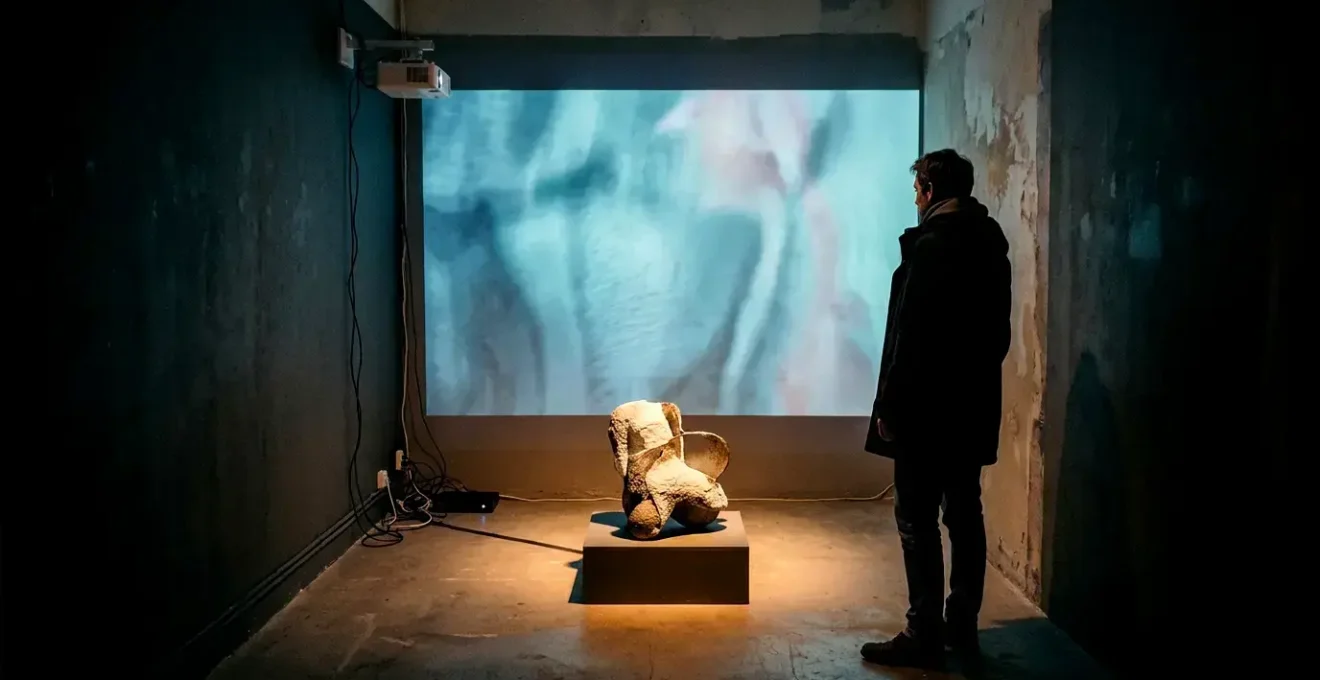
An immersive art experience does not depend on filling every wall with monumental projections. It depends on how convincingly a space invites visitors to enter an artistic world, remain attentive and feel physically connected to what surrounds them. For experience designers, the real challenge is to coordinate spatial composition, sound, lighting, movement and sensory intensity so that each element contributes to a coherent encounter.
A compact gallery can create a powerful sense of presence through proximity, carefully controlled darkness, a single physical object or an intentional soundscape. Conversely, a technically impressive installation can lose its impact when transitions feel abrupt, adjacent rooms interfere with one another or interactive elements compete for attention. The difference lies in the relationship between the artwork and the visitor’s perception.
Creating an integrated experience therefore means designing more than visual spectacle. It means anticipating how people enter, move, listen, adapt, pause and leave. It also means considering accessibility from the beginning, rather than treating it as an adjustment made after the artistic decisions are complete.
What Makes an Immersive Art Experience Work?
- Design spatial, visual and acoustic transitions as connected parts of the artwork, maintaining perceptual continuity between scenes and rooms.
- Use proximity, controlled sensory layers and intentional circulation to create presence without relying on large-scale projections.
- Balance artistic intensity with accessibility, visitor autonomy and opportunities for meaningful engagement.
- Why Do Abrupt Changes in Sound and Light Break Immersion?
- How to Transform a Small Room Into a Walk-Through Artwork?
- Enclosed Room or Open Gallery for an Immersive Artwork?
- How Flashing Light and Loud Audio Can Exclude Sensitive Visitors
- In What Order Should Visitors Experience Connected Art Rooms?
- When Multisensory Displays Become Distracting Instead of Immersive
- Why Do Visitors Cast Disruptive Shadows in Projection Installations?
- How to Increase Audience Engagement at Small Art Exhibitions?
Why Do Abrupt Changes in Sound and Light Break Immersion?
Abrupt changes in sound and light break immersion because visitors continuously interpret sensory information as part of an unfolding environment. When brightness, volume or colour temperature suddenly shifts without an artistic reason, attention moves away from the artwork and towards the physical conditions of the exhibition. Instead of remaining inside the experience, visitors become aware of the equipment, the room and the transition itself. Gradual, coherent changes help preserve the relationship between successive scenes.
This response makes transition design a central part of immersive exhibition production. A scene does not exist independently of what comes before or after it. A bright projection fading into darkness, for example, creates a different perceptual effect depending on whether the soundtrack fades simultaneously, continues beneath the blackout or introduces a new sound before the next image appears.
Experience designers should therefore map transitions with the same attention given to the main visual compositions. A practical transition score can specify:
- Light behaviour: the starting and ending brightness, fade duration and changes in colour temperature.
- Audio behaviour: volume progression, overlap between soundtracks and the timing of silence.
- Visual continuity: whether imagery dissolves, moves, disappears or changes suddenly.
- Visitor orientation: whether people need to move, turn or adjust their vision during the transition.
The distinction between intentional disruption and accidental inconsistency is equally important. An artist may deliberately use a sudden blackout, a sharp sound or a moment of silence to create tension. Such a rupture can become a meaningful artistic gesture when its timing, context and recovery are carefully considered. An unexpected equipment delay, inconsistent loop or uneven speaker coverage, however, introduces a disruption that visitors cannot interpret as part of the work.
The Smithsonian Guidelines for Accessible Exhibition Design recommend gradual lighting transitions and attention to changes in illumination between exhibition areas. The guidance is particularly relevant to visitors with low vision, who may need additional time to adapt. Although these recommendations concern accessibility rather than a scientifically established threshold for immersion, they provide a useful foundation for designing perceptually considerate transitions.
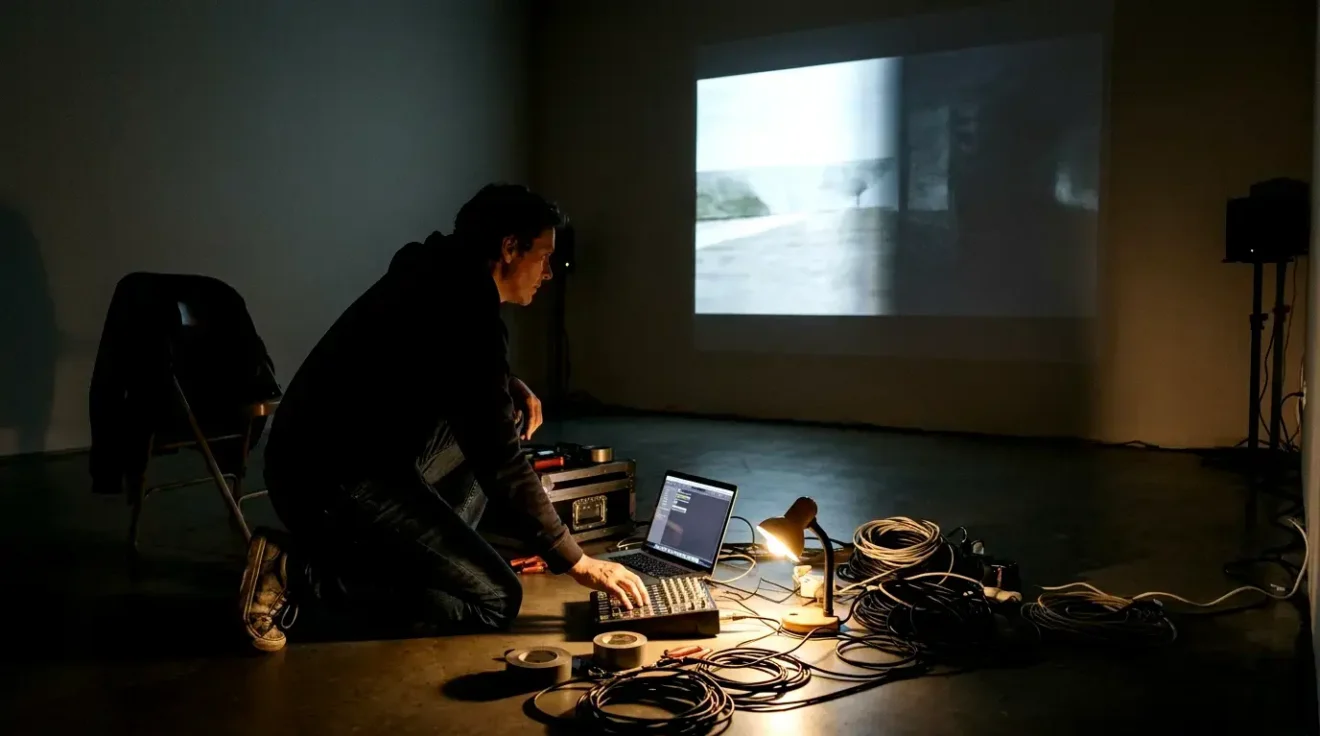
One additional problem deserves attention: technical inconsistencies become more noticeable when repeated. A loop that occasionally restarts before the sound has finished, or a transition that varies unpredictably in brightness, can gradually undermine visitor confidence in the installation. Repetition does not necessarily make a flaw disappear; it can make the flaw increasingly distracting.
Ultimately, a successful transition does not need to be invisible. It needs to feel intentional. Whether the artwork calls for continuity or rupture, the visitor should encounter a coherent artistic decision rather than an accidental interruption.
How to Transform a Small Room Into a Walk-Through Artwork?
A small room can become a walk-through artwork by turning its limited dimensions into an advantage. Close contact with walls, floors, sound sources and physical objects creates an immediate bodily relationship with the installation. Rather than attempting to reproduce the scale of a monumental projection environment, designers can use proximity, controlled movement and a sequence of perceptual moments to make a compact space feel complete.
The first step is to stop treating the room as a reduced version of a larger gallery. Its dimensions should inform the artistic concept from the beginning. A narrow passage, a low ceiling or a single uninterrupted wall can establish a distinctive relationship between the visitor and the artwork.
For instance, a projected image placed close to eye level can surround the visitor’s immediate field of attention without requiring multiple enormous surfaces. A physical sculpture placed within the projected environment can create a meeting point between digital imagery and material presence. Subtle sound positioned near one wall can also encourage visitors to turn and discover the room through movement.
A useful spatial sequence contains three moments:
- Threshold: an identifiable entrance signals the transition from everyday surroundings into the artwork. A change in lighting, sound or floor material can establish this boundary.
- Encounter: one or two carefully composed perceptual moments encourage exploration, observation or movement without overcrowding the available space.
- Release: the exit provides a gradual return to the surrounding environment, allowing visitors to recover their orientation and complete the encounter.
Projection coverage is another important decision. Short throw distances can make it difficult to cover every surface without producing excessive brightness, distorted geometry or uncomfortable viewing conditions. Full-surface projection is not automatically the strongest solution. Leaving some walls dark can give projected imagery greater visual definition and create a meaningful contrast between illuminated and unilluminated areas.
The same principle applies to physical objects. A single sculptural element, a carefully positioned reflective surface or an accessible tactile feature may contribute more to the atmosphere than several competing projections. Darkness, when used deliberately and safely, becomes an active spatial material rather than an empty background.
Circulation must remain understandable even when the room is visually complex. The Smithsonian’s exhibition guidance emphasises clearly identifiable and accessible circulation routes, including continuity through exhibition spaces. This is particularly useful in compact installations where equipment, cables, furniture and visitor movement compete for the same limited floor area.
Designers should also distinguish between perceived enclosure and actual obstruction. A room can feel intimate without restricting movement. Visitors need enough space to change direction, avoid other people and leave without negotiating an unnecessarily complicated route.
Scale alone does not determine immersion. A modest room becomes memorable when every spatial decision reinforces the visitor’s relationship with the artwork.
Enclosed Room or Open Gallery for an Immersive Artwork?
An enclosed room is generally better suited to immersive artworks that require controlled lighting, concentrated sound and a deliberate sense of entry. An open gallery offers greater freedom of movement, visibility and spontaneous discovery. Neither format guarantees a stronger experience: the right choice depends on how much environmental control the artwork needs, how visitors should move and whether the experience benefits from containment or interaction with its surroundings.
Rather than deciding according to architectural preference alone, designers should compare both formats against the actual conditions of the installation.
| Design criterion | Enclosed room | Open gallery |
|---|---|---|
| Light control | Greater potential to control ambient illumination. | More exposed to daylight and neighbouring displays. |
| Sound control | More opportunities for concentrated sound, although acoustic treatment remains important. | Greater risk of competing sound sources and acoustic spill. |
| Visitor movement | Can encourage a defined route but may restrict circulation. | Usually allows more flexible movement and multiple approaches. |
| Entry commitment | Creates a distinct threshold that invites visitors to enter fully. | Allows visitors to approach gradually or engage from a distance. |
| Visibility from outside | Can limit the visibility of the artwork before entry. | Allows visual previews that can attract attention. |
| Potential dwell time | Can support concentrated encounters, depending on comfort and capacity. | Allows visitors to pause briefly or explore more freely. |
An enclosed environment is especially useful when the artwork relies on subtle sound, darkness, precise colour relationships or a controlled visual field. However, a strong sense of enclosure can also create hesitation. Visitors may wonder how long they are expected to stay, whether the room is crowded or whether they can leave easily.
Open galleries reduce the psychological commitment associated with entering a separate room. Visitors can observe the artwork before approaching it, making spontaneous engagement easier. The trade-off is that the work may become something people watch while walking past rather than an environment they actively enter.
There is also a third option: partial enclosure. Screens, curtains, architectural partitions and carefully positioned openings can create a sense of separation without closing the environment completely. An opening might reveal a moving image while concealing the main sound source. Another might offer a partial view of an adjacent installation, encouraging exploration without exposing the entire experience at once.
This controlled permeability is especially valuable in exhibitions with several connected works. It allows the designer to manage what visitors see and hear before entering, while preserving a degree of architectural openness.
The audience relationship changes accordingly. An enclosed room encourages a deliberate decision to enter, while an open gallery supports incidental discovery. The former can favour visitors willing to commit to a concentrated experience; the latter can reach people who would not necessarily seek out an immersive installation.
Neither outcome is inherently preferable. The appropriate format depends on whether the artwork asks visitors to withdraw from their surroundings, engage with a shared environment or move fluidly between different levels of attention.
The most effective spatial solution may combine both approaches, using thresholds and partial boundaries to create an environment that feels immersive without becoming inaccessible or restrictive.
How Flashing Light and Loud Audio Can Exclude Sensitive Visitors
Flashing lights and loud audio can exclude visitors when sensory intensity creates discomfort, disorientation or a health risk that makes entering or remaining in an installation difficult. People with photosensitive epilepsy, migraine, sensory processing differences and other sensory sensitivities may experience particular challenges. Accessibility therefore requires more than a general warning: designers need to understand the characteristics of the sensory environment, communicate them clearly and provide meaningful choices without automatically removing the artistic intensity of the original work.
One important distinction is between photosensitive seizures and other adverse reactions to visual stimulation. The Epilepsy Foundation explains that particular flashing lights and visual patterns can trigger seizures in susceptible individuals. It estimates that people with epilepsy experience seizures triggered by flashing lights or certain visual patterns approximately 3%.
Approximately 3%
The Epilepsy Foundation reports that this proportion of people with epilepsy experience seizures triggered by particular flashing lights or visual patterns. This figure does not represent the general population or the proportion of visitors affected in an exhibition.
Source: Epilepsy Foundation, medically reviewed information on photosensitivity and seizures.
Frequency is only one consideration. The Epilepsy Foundation identifies flashing frequencies between 5 and 30 flashes per second as particularly likely to provoke seizures in susceptible individuals. Brightness, contrast, viewing distance and wavelength can also influence exposure. This range should not be treated as a universal safety threshold: individual susceptibility varies, and staying outside it does not guarantee safety.
Other visitors may experience headaches, nausea or dizziness without experiencing epileptic seizures. Loud or spatially complex audio can also create difficulties for people with hearing aids, sensory sensitivities or a preference for lower stimulation. Autism, PTSD and age-related sensory differences may affect how people experience intense environments, although their needs should not be assumed to be identical.
These considerations do not mean that every intense installation must become quiet or visually restrained. They mean that intensity should be an informed artistic choice, accompanied by appropriate information and alternative ways to engage.
Useful mitigation measures include:
- Specific pre-visit advisories: describe flashing patterns, darkness, sound intensity, moving imagery and other relevant sensory conditions rather than relying on a generic warning.
- Alternative sessions: consider lower-intensity or calm-hour sessions where technically and artistically feasible.
- Directional audio: use localised sound sources or acoustic treatments instead of making the entire exhibition uniformly loud.
- Independent exit routes: allow visitors to leave without crossing the most intense area again.
- Resting opportunities: provide seating or appropriate points of support where visitors can pause and regulate stimulation.
A useful sensory advisory should explain what visitors can expect before they arrive. Where relevant, it can identify the frequency and nature of flashing effects, measured peak sound levels, periods of darkness, sudden sound changes and the presence of moving or high-contrast imagery. Measurements should be based on actual installation testing rather than estimates presented as facts.
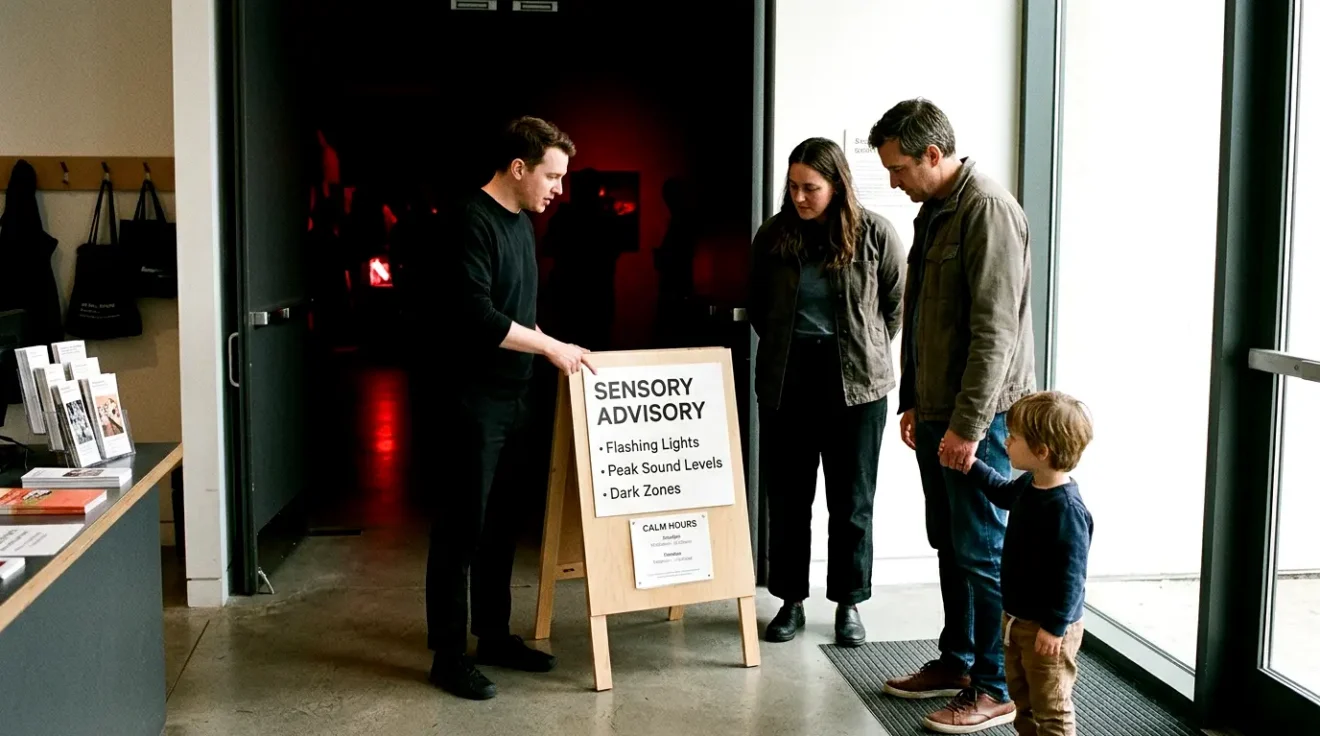
Communication is as important as the physical environment. A notice that simply states that an exhibition contains flashing lights may not provide enough information for someone to make an informed decision. Specificity gives visitors the opportunity to assess whether the experience is appropriate for them. It also helps staff respond to questions without making unsupported assurances about safety.
Accessibility can also be approached through different versions of an artwork. A modified session might reduce flashing effects, lower sound intensity or provide a less stimulating route. Where an unmodified version remains artistically essential, a clearly communicated alternative can allow more visitors to engage with the work on their own terms.
Five Practical Checks Before Opening an Immersive Installation
- Measure the visual effects and document the tested flashing characteristics, including frequency, brightness and contrast where relevant. Deliverable: a sensory-effects specification.
- Measure and record the sound conditions in the visitor areas. Deliverable: an audio-level assessment with identified high-intensity zones.
- Map dark areas, movement effects and changes in sensory intensity across the installation. Deliverable: a visitor-facing sensory environment description.
- Inspect circulation, seating and exit options, including routes that avoid unnecessary exposure to the most intense zones. Deliverable: an annotated accessibility and circulation plan.
- Prepare accurate pre-visit information and evaluate whether alternative sessions or reduced-intensity experiences are feasible. Deliverable: a published sensory advisory and access plan.
These measures should be reviewed against applicable local accessibility and safety requirements. The Smithsonian’s institutional recommendations can inform exhibition planning, but they should not be mistaken for universally binding legislation or a substitute for a project-specific safety assessment.
Preserving artistic ambition and improving access are not necessarily competing objectives. A well-designed experience can retain its original intensity while offering visitors clearer information, greater control and alternative ways to participate.
In What Order Should Visitors Experience Connected Art Rooms?
Visitors should experience connected art rooms in an order that supports the intended emotional and perceptual progression of the exhibition. The sequence determines how people encounter contrast, intensity, discovery and resolution. A quiet introductory room followed by a more expansive installation creates a different experience from the reverse order. Designers should therefore establish whether the artwork needs a controlled narrative route, flexible exploration or a hybrid circulation system.
Sequencing is a form of dramaturgy. Each room establishes expectations for the next one. A subdued environment can make a sudden increase in brightness feel significant, while an intense room can make a quieter space feel restorative. The rooms are not simply individual artworks placed next to each other; their relationships create an additional layer of meaning.
One useful approach is to develop a spatial and emotional arc. For example, an exhibition might move from intimacy to expansion, from silence to complexity or from observation to participation. The precise progression should emerge from the artistic concept rather than follow a universal formula.
Two principal circulation strategies are available:
| Consideration | Linear route | Free circulation |
|---|---|---|
| Narrative control | Maintains a defined sequence of encounters. | Allows visitors to construct their own sequence. |
| Visitor autonomy | Offers a more directed experience. | Encourages personal exploration and revisiting. |
| Climax management | Helps reserve a particular room for a planned moment. | May expose visitors to the climax before earlier scenes. |
| Sensory interference | Can help organise sound and light transitions between spaces. | Requires careful management of competing sensory environments. |
| Late arrivals | May make it harder for visitors to join at an intermediate point. | Generally accommodates different entry points more easily. |
A linear route is particularly appropriate when the work relies on a narrative sequence, a gradual revelation or a controlled build-up of sensory intensity. However, visitors who enter midway may miss important context. The exhibition should therefore offer introductory information or other orientation cues that explain the experience without requiring everyone to begin at the same point.
Free circulation supports revisiting and individual interpretation. It can work well when each room presents a relatively independent encounter. Its main challenge is managing sensory collisions. Visitors might encounter the loudest soundtrack first, see the final scene before the introduction or hear several competing audio environments simultaneously.
Sound bleed and light spill deserve particular attention in both formats. A loud installation beside a quiet reflective space can undermine the intended atmosphere of the latter. Buffer zones, acoustic thresholds, directional speakers and carefully positioned partitions can help reduce interference. The loudest or brightest environment should be placed where its overflow has the least impact on neighbouring spaces.
The Smithsonian Guidelines for Accessible Exhibition Design also discuss ways of making an instructional route available within free-flowing exhibitions through introductory labels, printed information and audiovisual material. Their guidance on limiting overlapping audio between interactive areas offers another useful consideration when designing connected spaces.
Each room should ideally work at two levels: as a meaningful stage in the overall journey and as an encounter that remains understandable when visitors arrive independently. Environmental cues, recurring visual elements or short contextual information can help establish where a person is within the larger experience.
Key Decisions Before Sequencing the Exhibition
- Determine whether the artistic concept depends on a fixed emotional progression or supports independent encounters.
- Identify where visitors may enter, leave, pause or revisit the experience, including during an intermediate scene.
- Map the transfer of sound and light between neighbouring rooms to prevent unwanted sensory interference.
When the sequence is carefully designed, movement between rooms becomes part of the artwork rather than an administrative necessity. The next challenge is ensuring that the sensory elements within each room reinforce rather than compete with that progression.
When Multisensory Displays Become Distracting Instead of Immersive
Multisensory displays become distracting when their different sensory channels compete for attention instead of reinforcing a coherent experience. Adding sound, scent, touch or interactive technology does not automatically make an installation more immersive. Each additional element should deepen the visitor’s understanding of the same artistic world. When a sensory layer introduces an unrelated task or demands independent interpretation, attention becomes fragmented and the sense of presence can weaken.
The important distinction is between sensory richness and sensory accumulation. A projected landscape accompanied by a soundscape that reflects its movement and atmosphere creates a coherent environment. A vibration that follows the movement of an image can reinforce the same perceptual event. In both cases, the additional channel supports an existing artistic relationship.
By contrast, an unrelated scent, an unnecessary touchscreen or a decorative sound effect can introduce a second object of attention. Visitors must decide whether to watch, listen, smell, touch or interact. The installation becomes a collection of stimuli rather than a unified environment.
A useful test for every proposed sensory layer is simple:
- Does this element confirm or deepen the world already established by the artwork?
- Does it create a meaningful relationship with another sensory channel?
- Can visitors understand its purpose without receiving additional instructions?
- Does it support contemplation, exploration or emotional involvement?
- Would removing it make the experience less coherent or simply less busy?
Interactivity deserves particular scrutiny. Touchscreens, gesture sensors and participatory stations can turn visitors into task-performers. Instead of experiencing an environment, they begin to concentrate on activating a feature, following instructions or completing a sequence. This can be appropriate when participation is central to the artistic concept, but it becomes counterproductive when interaction replaces the experience it was supposed to deepen.
There is also a practical difference between meaningful agency and compulsory interaction. A visitor should not always need to touch a screen, trigger a sensor or complete a task to access the main artistic experience. Optional interaction can provide an additional layer without making the installation dependent on constant participation.
The Smithsonian’s exhibition accessibility guidance recognises that multisensory presentation can provide alternative ways of accessing information, while overlapping visual and auditory stimuli may create difficulties for some visitors. The distinction matters: multiple sensory channels can improve access when they are thoughtfully organised, but simultaneous stimulation is not automatically beneficial.
One effective evaluation technique is to remove one sensory layer temporarily during testing. Compare the visitor experience with and without that element. Observe whether people remain attentive for longer, understand the work more easily or engage more deeply. If the experience improves when a feature disappears, that feature may be adding complexity without adding meaning.
Testing should also distinguish between different visitors. An element that enriches the experience for one group may create a barrier for another. The aim is not to reduce every installation to a single sensory channel, but to make each additional channel purposeful and appropriately accessible.
Immersion emerges from meaningful relationships between sensory elements, not from the number of technologies or stimuli present. A restrained installation can therefore be more convincing than a technically elaborate one.
Why Do Visitors Cast Disruptive Shadows in Projection Installations?
Visitors cast shadows in projection installations because their bodies interrupt the path of light travelling from the projector to the projection surface. In front-projection environments, anyone standing between the projector and the image can create a moving obstruction. The effect becomes especially noticeable when the projector is positioned at an angle that directs its beam through occupied visitor space. Shadow management should therefore be considered during spatial planning rather than left until the installation is operational.
The geometry is straightforward. A projector sends light towards a surface, and any object placed between the two blocks part of that light. A visitor walking across the beam becomes a temporary obstruction. Depending on projector placement, image dimensions and visitor position, the resulting shadow can cover a small part of the image or a substantial section of the projected scene.
In interactive installations, this behaviour can become a persistent design challenge. Visitors naturally move closer to the artwork, turn around or stand in front of the projected surface. A projection arrangement that looks effective in an empty room may behave very differently once the space is occupied.
Research published by Carnegie Mellon University’s Robotics Institute examines this issue in front-projection displays. The paper Dynamic Shadow Elimination for Multi-Projector Displays describes how users positioned in the projection path create unwanted shadows and investigates a camera-assisted approach to compensating for occlusions.
The research also highlights an important technical distinction: using multiple projectors can reduce shadow visibility, but overlapping illumination does not necessarily eliminate every obstruction. The researchers describe a system that detects occlusions and dynamically adjusts projector output to illuminate affected regions. This is a historical technical study, not a specification for contemporary commercial installations.
For experience designers, possible responses can be grouped into two broad strategies.
First, reduce or eliminate unwanted shadows. Rear projection can remove visitors from the light path when the architecture allows it. Ceiling-mounted or strategically positioned projectors may also reduce the likelihood of visitors obstructing the beam. Multiple projectors can provide redundant illumination, although the result depends on geometry, calibration and the specific projection environment.
Second, integrate shadows into the artwork. A visitor’s silhouette can become an intentional compositional element. Their movement might reveal hidden imagery, interrupt a visual pattern or create an evolving relationship between the human body and the projected environment. In this approach, the shadow is no longer simply a technical defect.
The social dimension is equally important. Visitors may feel that they are damaging the experience for others when they accidentally block an image. This can lead them to remain at the edge of the room, avoid movement or leave earlier than intended. These behavioural effects are plausible design considerations, but the cited technical research does not measure visitor self-consciousness or dwell time.
Designers can respond by providing shadow-free viewing positions, making the relationship between bodies and projections explicit, or choreographing where visitors are invited to stand. If shadows are intentional, the installation should communicate that visitors are welcome to become part of the composition.
When that decision is made early, projection geometry, visitor circulation and artistic composition can support one another. The installation becomes more comfortable to explore, and the presence of the audience can be treated as part of the spatial design.
How to Increase Audience Engagement at Small Art Exhibitions?
Audience engagement at small art exhibitions improves when designers prioritise the depth and quality of the visitor experience rather than relying exclusively on attendance figures. A compact exhibition can encourage sustained attention, personal interaction and repeat visits through meaningful spatial encounters, accessible interpretation and carefully planned programming. The objective is to create reasons for visitors to stay, return and talk about the work, without surrounding the artwork with unnecessary distractions.
Small venues have a different set of opportunities from large institutions. They can create a more direct relationship between artists, mediators and visitors. They can also experiment with intimate formats that would be difficult to reproduce at a larger scale.
One useful approach is to provide several levels of engagement. The initial encounter should be immediately understandable, allowing someone to appreciate the work without reading extensive instructions or completing a task. Visitors who choose to stay longer can discover additional material, hear contextual explanations or participate in optional activities.
Four practical levers can support this approach:
- Scheduled artist or mediator presence: defined periods when visitors can discuss the artistic concept, process or technical decisions with someone directly involved in the exhibition.
- Layered interpretation: a clear introduction for visitors who have limited time, accompanied by additional information for those who want to explore further.
- Accumulating visitor contributions: participatory elements that develop throughout the exhibition, giving later visitors the opportunity to encounter the contributions of earlier audiences.
- Return-oriented programming: workshops, conversations, performances or changing activities that provide a genuine reason to revisit the exhibition.
Engagement should also be evaluated through observation rather than assumptions. A busy room does not necessarily indicate meaningful participation, just as a quiet room does not necessarily indicate a lack of interest. The relevant question is how visitors interact with the work and how the spatial environment influences their behaviour.
A study published in Visitor Studies, titled Participant Reactivity in an Exhibition: The Effect of Overt Observation on Engagement Times, examined visitor engagement at the National Park Center Multimar Wattforum in Germany. The researchers used paper-and-pencil timing and tracking to compare engagement times between visitors who knew they were being observed and those who were not cued to observation.
The study demonstrates that exhibition behaviour can be investigated without electronic tracking equipment. Its findings should nevertheless be interpreted within their original setting: the research concerned a specific exhibition environment, not immersive art galleries in general. It does not establish an optimal dwell time or prove that longer visits automatically indicate greater emotional engagement.
For small exhibition teams, direct observation can still provide useful design information. Staff can record where visitors stop, which spaces they bypass, where conversations occur and where people tend to leave. These observations can reveal practical problems such as unclear entrances, competing sound environments, confusing interpretation or uncomfortable waiting areas.
Privacy should remain part of the process. Observation should be proportionate to the evaluation purpose, avoid unnecessary personal identification and comply with applicable local ethical and legal requirements.
The most useful feedback loop connects observations to specific design decisions. If visitors consistently overlook an installation, the entrance or sightline might need adjustment. If people leave a room quickly, the team can examine its sound, brightness, circulation and interpretation before concluding that the artwork itself is responsible. A subsequent exhibition can then test whether the adjustment improves the visitor experience.
Ultimately, engagement is closely connected to sustained presence. A visitor who feels comfortable exploring, understands how to interact with the work and has the freedom to remain or return is more likely to develop a meaningful relationship with the exhibition. Engagement strategies should deepen this relationship rather than compete with the artwork for attention.
For experience designers, the most valuable measure of success is not simply how many people enter the gallery, but whether the exhibition gives them a compelling reason to engage, reflect, share their experience and come back. The next step is to evaluate the installation as a complete visitor journey, from its first sensory cue to its final moment of release.
Can an immersive art installation work without large-scale projections?
Yes. Immersive art can use spatial sound, directional lighting, physical sculptures, reflective materials, tactile elements and carefully controlled movement to create a strong sense of presence. Large projections are only one possible medium. The essential requirement is that the different elements work together to establish a coherent artistic environment in which visitors feel involved rather than simply observing a display.
What makes a small room suitable for an immersive exhibition?
A small room can support an immersive exhibition when its layout, circulation, lighting and sensory elements are designed around its actual dimensions. Clear entry and exit points, purposeful use of proximity, sufficient visitor movement space and controlled projection coverage are particularly important. A compact installation does not need to reproduce the visual scale of a large gallery to create a convincing artistic encounter.
How can exhibition designers make immersive experiences more accessible?
Designers can improve accessibility through specific sensory advisories, clearly identifiable circulation routes, appropriate seating, controlled sound distribution and accessible exit options. Where relevant, information should explain flashing effects, periods of darkness and sound intensity. Alternative sessions or modified versions can also provide additional ways to experience works that rely on intense sensory stimulation.
Should immersive exhibitions always follow a linear visitor route?
No. Linear circulation is useful when an artwork depends on a defined narrative progression or a carefully controlled sequence of sensory experiences. Free circulation works better when individual rooms can be explored independently and visitors benefit from personal choice. Hybrid approaches can combine a suggested route with opportunities to revisit spaces, provided that orientation and sensory interference are properly managed.
How can designers evaluate whether an immersive installation is successful?
Evaluation can combine visitor observation, feedback, circulation analysis and qualitative discussions. Useful indicators include where people stop, which elements attract attention, whether visitors understand how to navigate the space and where they decide to leave. Dwell time can provide additional information, but it should not be treated as a direct measure of emotional engagement or artistic appreciation. The results are most valuable when they inform specific improvements to the next exhibition iteration.