
A creator’s intent influences the meaning of an artwork by establishing its conceptual direction, informing its formal choices and providing context for interpretation. However, intention does not necessarily determine a single correct meaning. The finished artwork enters a public environment where viewers encounter it through their own experiences, cultural references and emotional associations.
This distinction becomes particularly important in conceptual and ambiguous art, where understanding the artist’s purpose may substantially change how an object, image or installation is perceived. An interpretation can differ from the creator’s original motivation while remaining consistent with the artwork itself.
For artists, the challenge is to communicate enough context without prescribing the audience’s response. For viewers, it is to distinguish a defensible alternative interpretation from a reading that overlooks essential evidence. Artist statements, exhibition texts and the timing of their disclosure all influence this relationship between creative purpose and experienced meaning.
Artistic intent and interpretation: the essentials
- Artistic intention provides a framework for understanding an artwork, but its authority depends partly on how convincingly that intention is expressed through the work and its context.
- Viewers contribute personal and cultural perspectives that can produce legitimate meanings beyond those originally anticipated by the artist.
- Artist statements and exhibition texts are most useful when they provide essential context without unnecessarily resolving deliberate ambiguity.
- Why Does an Observer’s Perception Change the Meaning of Art?
- How First Impressions Can Mislead Viewers of Ambiguous Art
- Why Do Viewers Misread the Message Behind Conceptual Art?
- Why Highly Personal Symbols Can Confuse Exhibition Visitors
- How to Write an Artist Statement That Explains Purpose Without Jargon?
- Personal Motivation or Public Meaning: Which Should Shape an Exhibition Text?
- Why Overexplaining a Concept Can Reduce an Artwork’s Ambiguity
- When Should Visitors Read the Artist’s Intent During a Gallery Tour?
Why Does an Observer’s Perception Change the Meaning of Art?
An observer’s perception changes the meaning of art because interpretation involves more than recognising what the creator intended to communicate. Viewers bring memories, cultural knowledge, emotional responses and expectations to an encounter with an artwork. These influences shape which details become significant and which relationships emerge between the work and the observer’s experience.
From a reception-oriented perspective, meaning is partly constructed through the encounter between the artwork and its audience. The artist establishes the conditions for interpretation, but cannot fully control the associations that arise when another person experiences the work.
Two dimensions of artistic meaning help clarify this relationship:
- Meaning as intended: the ideas, questions or experiences the creator sought to express through particular artistic decisions.
- Meaning as experienced: the significance an observer attributes to the artwork through its perceptible features, context and personal associations.
These dimensions can coexist without being identical. A painting intended to explore geographical displacement might evoke emotional isolation for a viewer. That response does not necessarily contradict the artist’s purpose, provided the interpretation remains connected to the work.
Roland Barthes’ essay The Death of the Author represents an influential challenge to the assumption that authorial intention should govern interpretation. Applied to visual art, this perspective encourages attention to the meanings a work makes available beyond its creator’s biography.
Nevertheless, interpretive freedom is not unlimited. As explained in the Internet Encyclopedia of Philosophy’s discussion of art and interpretation, intentionalist and anti-intentionalist theories disagree about the authority of artistic purpose. Moderate intentionalism also recognises that an artist’s intended meaning must be considered alongside what the artwork can plausibly communicate.
Documented intentions may therefore undermine readings that make incompatible claims about an artwork’s origin or purpose, without invalidating every alternative interpretation.
Recognising this distinction makes interpretation more flexible, but also exposes a difficulty: the observer’s earliest assumptions can influence everything noticed afterwards.
How First Impressions Can Mislead Viewers of Ambiguous Art
A first impression can establish an interpretive anchor that influences how subsequent details are understood. In an ambiguous artwork, an observer might initially identify a shape as threatening, decorative or symbolic, then interpret the remaining composition through that assumption. The risk is not forming an initial impression, but treating it as a settled conclusion.
This tendency becomes problematic when contradictory evidence is explained away rather than examined. A viewer who initially understands an installation as a criticism of consumer culture might overlook features suggesting a different concern, such as domestic memory or the changing function of everyday objects.
In this hypothetical example, the first interpretation is not necessarily invalid. Its weakness emerges when the observer refuses to reconsider it despite encountering relevant evidence.
A practical way to resist premature interpretive closure is to delay assigning a definitive meaning:
- Describe the artwork’s visible materials, forms, spatial relationships and apparent alterations without attributing a symbolic purpose.
- Develop at least two plausible interpretations based on those observations.
- Identify details that support or challenge each interpretation before consulting explanatory material.
This exercise also helps distinguish deliberate ambiguity from insufficient information. Ambiguity permits several coherent readings, whereas confusion may result from missing contextual knowledge or an inability to establish a meaningful connection with the work.
Marcel Duchamp’s readymades illustrate why unfamiliarity should not automatically be treated as artistic failure. According to MoMA’s educational resource on Marcel Duchamp and the readymade, his selection and presentation of manufactured objects challenged conventional expectations concerning beauty, craftsmanship and artistic creation.
Approaching these objects exclusively through aesthetic criteria risks overlooking their conceptual significance.
Such reconsideration becomes especially valuable in conceptual art, where the visible object may represent only one component of the artistic proposition.
Why Do Viewers Misread the Message Behind Conceptual Art?
Viewers may misread conceptual art when they interpret its physical appearance without considering the idea, gesture or context that gives the work significance. Personal associations and conventional expectations about artistic beauty can also obscure its purpose. However, an interpretation that differs from the artist’s stated intention is not automatically a misunderstanding.
Conceptual art places particular emphasis on ideas rather than relying primarily on the visual qualities of an object. Understanding the relationship between the artistic proposition and its material expression therefore becomes an important part of interpretation.
Three potential sources of misunderstanding deserve particular attention:
- Missing conceptual context: interpreting an ordinary object solely according to its practical function rather than examining why it has been selected or displayed.
- Projecting personal symbolism: assigning meanings to materials or gestures without considering whether the artwork supports those associations.
- Applying inappropriate aesthetic criteria: judging a conceptual proposition exclusively through beauty, technical virtuosity or decorative appeal.
Conceptual practices can deliberately require viewers to establish connections that are not immediately apparent. Under these conditions, interpretive divergence is a foreseeable possibility rather than evidence that the audience lacks artistic understanding.
Hypothetical example: interpreting an empty chair
Imagine an artist exhibiting an empty chair to examine who is permitted to occupy institutional spaces. A visitor initially understands the chair as a memorial to an absent person. Discovering the artist’s purpose introduces a political dimension, but the visitor’s association with absence may remain relevant if supported by the installation’s arrangement and context.
A useful verification habit is to reconsider an interpretation after discovering the artist’s stated purpose. Does the original reading still account for the work’s significant features? Does it contradict an established fact, or merely introduce another dimension of meaning?
An interpretation that remains coherent after this comparison may represent a defensible alternative rather than a mistake. Conversely, a reading that depends on an incorrect account of the artist’s actions requires revision.
This distinction becomes harder to maintain when the creator relies on symbols whose significance is known primarily through personal experience.
Why Highly Personal Symbols Can Confuse Exhibition Visitors
Highly personal symbols can confuse exhibition visitors because their significance may depend on experiences, memories or associations that the artist has not made publicly accessible. Unlike culturally shared symbols, private references do not necessarily offer viewers an established interpretive framework. The audience may recognise the form while remaining unaware of its intended significance.
A culturally familiar symbol provides a potential starting point, although its meaning can still vary across communities. A private symbol, by contrast, may originate in a family ritual, childhood memory or recurring personal experience without possessing an externally recognisable meaning.
For example, imagine an artist repeatedly incorporating a blue thread into sculptures because it recalls a garment worn by a deceased relative. Without contextual information, visitors might interpret the thread through associations with water, continuity or physical connection. None of these readings necessarily reveals the biographical reference.
The artistic value of private symbolism lies partly in its specificity. It allows creators to develop an individual visual vocabulary rather than relying exclusively on familiar cultural conventions. Yet when understanding a work depends heavily on inaccessible references, visitors may struggle to establish a meaningful point of entry or choose to disengage.
A balanced curatorial strategy is to provide a minimal interpretive key. This might take the form of a suggestive title, a short reference to the symbol’s origin or a single sentence of wall text.
In the hypothetical blue-thread installation, identifying the material as a reference to family memory would establish relevant context without prescribing whether visitors should experience the work as an expression of grief, attachment or continuity.
The same principle applies to artist statements: accessibility depends on communicating what matters without removing the complexity that makes the artwork distinctive.
How to Write an Artist Statement That Explains Purpose Without Jargon?
An effective artist statement explains what an artwork does, why it was created and which questions it leaves open. Concrete descriptions of materials, processes and artistic decisions make conceptual ideas accessible without reducing their complexity. The statement should provide enough information to support interpretation while avoiding instructions about what every viewer must understand or feel.
Begin with the artwork rather than an abstract declaration about artistic practice. Describe the relationship between its physical or conceptual structure and the purpose behind its creation. The reader should be able to recognise how the stated intention connects to something present in the work.
Augsburg University’s artist statement writing guidance recommends addressing what the work is, why it was created and how it was made. It also encourages artists to remove generic language, avoid unnecessary jargon and revise their statements by reading them aloud.
These recommendations can be adapted into a structure that preserves interpretive openness:
- What the work does: identify its materials, operations, visual relationships or conceptual proposition.
- Why it was made: explain the motivation, experience or question informing those artistic choices.
- What remains open: acknowledge the unresolved tension without dictating how the audience should respond.
Precision should not be confused with specialist vocabulary. In a hypothetical statement, describing how discarded household objects are arranged to obstruct movement communicates a concrete artistic operation more effectively than an unexplained reference to the destabilisation of domestic spatiality.
Apply a uniqueness test during revision: if a sentence could describe almost any contemporary artwork without modification, it probably needs greater specificity.
Reading the statement aloud also helps identify terms that a non-specialist might need to investigate. Retain technical vocabulary when it expresses a necessary distinction, and explain it when its meaning cannot be inferred from the surrounding text.
Artist statement revision checklist
- Write one opening sentence describing an identifiable action, material or relationship within the artwork.
- Add a sentence connecting a specific artistic decision to the motivation behind the work.
- Replace unnecessary specialist vocabulary and produce a revised passage using concrete descriptions.
- Apply the uniqueness test and mark every remaining sentence that depends on features specific to the artwork.
- End with an unresolved question or tension, then obtain feedback from a non-specialist reader who can identify the central purpose.
Although an artist statement begins with the creator’s perspective, an exhibition text must also consider the needs and expectations of its audience.
Personal Motivation or Public Meaning: Which Should Shape an Exhibition Text?
Personal motivation should shape an exhibition text when the artwork’s origin is essential to understanding its significance. Public meaning should take priority when visitors need a shared conceptual framework to engage with the work. Effective exhibition writing balances these functions according to audience knowledge, artistic context and the consequences of withholding biographical information.
Personal motivation explains why a creator chose to make a particular work. Public meaning concerns the questions, relationships and experiences that become accessible to an audience through that work. Confusing these functions can produce texts that are either excessively autobiographical or disconnected from the artist’s actual practice.
Audience proximity offers a practical basis for deciding how much emphasis each function deserves. The following comparison presents editorial recommendations rather than fixed institutional rules.
| Exhibition context | Recommended emphasis | Editorial consideration |
|---|---|---|
| Intimate solo gallery exhibition | Personal motivation and artistic development | Biographical details can establish connections between individual works. |
| Institutional group exhibition | Shared themes supported by individual artistic intentions | Visitors need to understand relationships between distinct practices without losing their differences. |
| Public-space exhibition | Accessible questions and immediate contextual information | The text should remain meaningful to visitors without specialist knowledge or prior familiarity with the artist. |
| Autobiographical or research-based installation | Essential background and conceptual purpose | Omitting relevant context may conceal an important component of the work. |
The relationship between artist and curator introduces a further ethical consideration. When curatorial interpretation diverges from the creator’s documented intentions, presenting that interpretation as though it were the artist’s own position can misrepresent the work.
An exhibition text can legitimately introduce historical, social or thematic perspectives that extend beyond the artist’s motivation. However, clear attribution matters. Distinguishing what the artist intended from what the curator proposes allows visitors to recognise that the exhibition itself participates in constructing meaning.
The appropriate balance is therefore not determined solely by the artist’s biography or the curator’s thematic priorities. It also depends on which information enables visitors to engage with the work on informed terms.
Once that distinction is established, the remaining editorial challenge is determining how much interpretation the text should provide before it begins to restrict the visitor’s experience.
Why Overexplaining a Concept Can Reduce an Artwork’s Ambiguity
Overexplaining a concept can produce interpretive foreclosure: a situation in which an authoritative explanation settles a question that the artwork could otherwise leave open. When exhibition texts prescribe a single meaning, visitors may approach the work primarily as evidence supporting that interpretation rather than exploring its unresolved relationships.
This risk is particularly relevant to artworks that depend on contradiction, uncertainty or the coexistence of several perspectives. Explaining every symbol and formal decision may convert a complex encounter into the recognition of an already articulated argument.
Two forms of explanation should therefore be distinguished:
- Necessary context: information about materials, historical circumstances, artistic procedures or references that enables informed engagement.
- Directive interpretation: language that presents a particular response or conclusion as the meaning visitors are expected to adopt.
The distinction concerns the function of the explanation rather than its length. A short label can be excessively directive, while a substantial contextual text can expand the possibilities available to an observer.
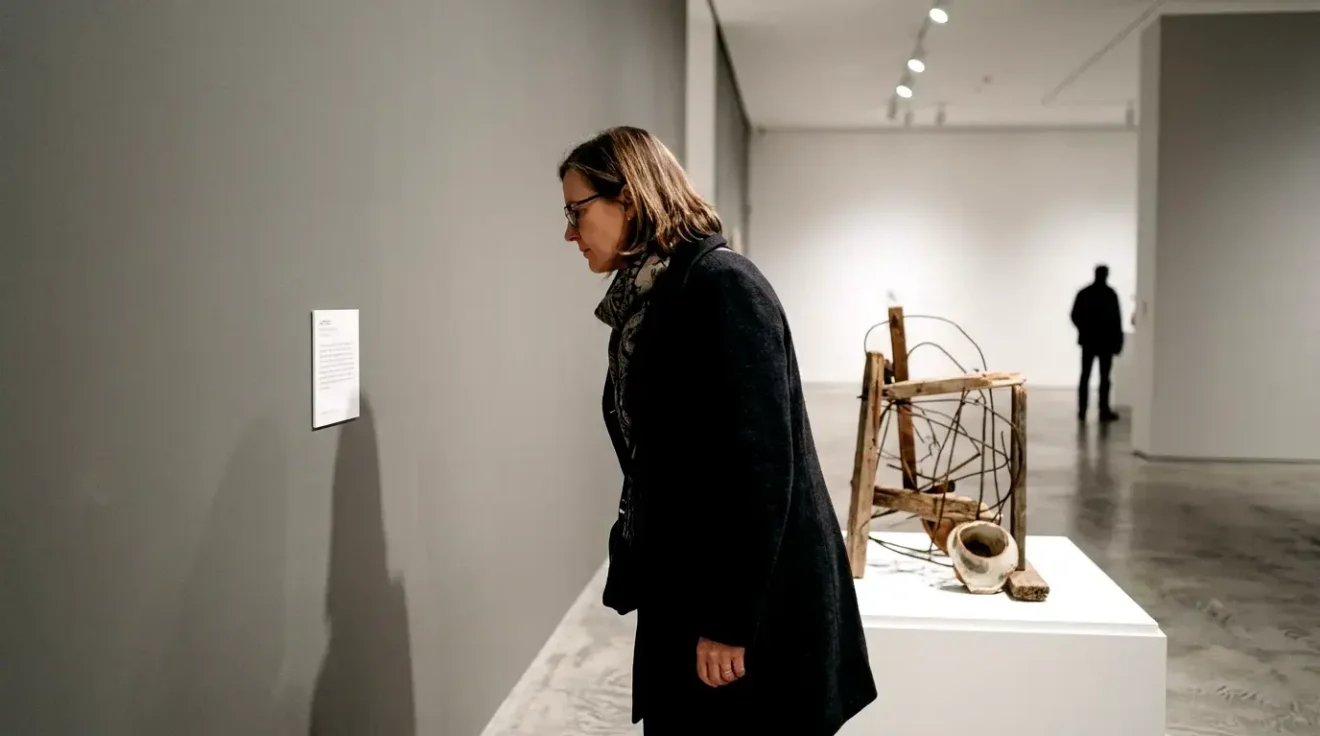
Museum visitor research: how exhibition labels influence interpretation
In their 2022 study Looking to Read: How Visitors Use Exhibit Labels in the Art Museum, Luise Reitstätter, Karolin Galter and Flora Bakondi examined visitor behaviour before and after a museum collection was reinstalled. Their methods included mobile eye tracking, subjective mapping and questionnaires.
As reported in the University of Vienna’s research record on museum exhibit labels, additional information was associated with deeper and different interpretations. The findings indicate that explanatory material can enrich engagement rather than necessarily restricting it. Because the reinstallation involved several changes, the abstract alone does not establish an isolated causal effect for exhibition labels.
For artists, the potential cost of excessive explanation is that a work may be appreciated for its conceptual clarity while being remembered primarily as an illustration of a predetermined thesis. This is an interpretive risk rather than an established universal effect on visitor memory.
Even carefully written contextual information can influence an encounter differently depending on when visitors receive it, making the timing of disclosure another important curatorial decision.
Key takeaways before consulting artistic intent
- Determine whether the missing information concerns an essential fact about the work or a question that can reasonably remain unresolved.
- Treat the artist’s documented purpose and the curator’s interpretive framework as distinct contributions to understanding.
- Preserve an opportunity to reconsider the artwork after reading contextual information rather than allowing the written explanation to replace direct observation.
When Should Visitors Read the Artist’s Intent During a Gallery Tour?
Visitors can often benefit from reading the artist’s intent after an initial encounter with the artwork and before forming a final interpretation. This sequence preserves an opportunity for independent observation while allowing contextual information to refine or challenge the first reading. However, works that depend on prior instructions or conceptual knowledge may require earlier disclosure.
A practical approach is to organise the encounter into three stages:
- Observe the artwork independently, identifying its significant features and recording an initial question or interpretation.
- Consult the artist statement, exhibition label or guided explanation to discover relevant intentions and contextual information.
- Return to the artwork and examine which features acquire new significance, which interpretations remain plausible and which assumptions require revision.
This approach resembles the art-label-art viewing pattern identified by Reitstätter, Galter and Bakondi in their museum visitor study. The observed pattern demonstrates how looking and reading can interact during an exhibition visit, although it does not establish that this sequence is universally superior.

Consulting artistic intent is particularly useful when an observer cannot determine whether confusion arises from missing information or from a deliberate artistic strategy. The statement may clarify an unfamiliar material, a historical reference or the significance of a particular gesture.
Conversely, when an artwork deliberately sustains an unresolved question, seeking an immediate explanation may be unnecessary. Remaining with uncertainty can form a meaningful part of the encounter.
There are also important exceptions to delayed disclosure. Some research-based installations, including approaches associated with exhibitions such as documenta, can make contextual documents integral to the artistic experience. Participatory or instruction-based works may similarly require visitors to understand a proposition before engaging with it.
In these circumstances, reading is not merely preparation for interpretation. It can constitute part of experiencing the artwork itself. The appropriate sequence depends on whether the artistic structure invites independent discovery or requires contextual knowledge from the outset.
During the next gallery visit, choose an artwork that permits independent observation and record an initial interpretation before reading its accompanying statement. Return to the work afterwards and identify what the artist’s explanation has clarified, challenged or left unresolved. The differences between those readings offer a practical way to understand how creative purpose and personal perception contribute to artistic meaning.
Can an artist’s intention change after an artwork is completed?
An artist may reconsider an artwork’s significance or develop a different understanding of its purpose after completion. However, a retrospective explanation should be distinguished from the intentions that informed its original creation. Both perspectives can contribute to interpretation without representing the same historical account of the creative process.
Does an untitled artwork have no intended meaning?
No. An artwork can express a specific intention without possessing a descriptive title. Its materials, composition, presentation and relationship to the creator’s broader practice may provide relevant interpretive evidence. Leaving a work untitled can also be an artistic decision that avoids privileging a particular verbal framework.
How can an artwork be interpreted when the artist’s intention is unknown?
Interpretation can draw on the artwork’s observable features, established historical circumstances, artistic conventions and publicly available contextual evidence. Hypothetical intentionalism, as discussed by the Internet Encyclopedia of Philosophy, offers one philosophical approach by considering intentions that an informed audience could reasonably attribute to the creator. Such reconstructions should not be presented as confirmed facts about the artist’s private motivations.
Is an emotional response the same as an interpretation of art?
An emotional response describes what an observer experiences, whereas an interpretation attempts to explain the significance of the artwork or its features. Feeling unsettled by an installation is an emotional response. Proposing that its arrangement explores vulnerability is an interpretation that requires supporting observations. Emotional experiences can inform interpretation without independently establishing its validity.
Can artists deliberately create work without a predetermined message?
Yes. An artist may intend to explore a process, establish an encounter or investigate an unresolved question rather than communicate a predetermined message. In such cases, artistic intention concerns the conditions under which meaning can emerge. The absence of a fixed conclusion does not necessarily indicate an absence of creative purpose.