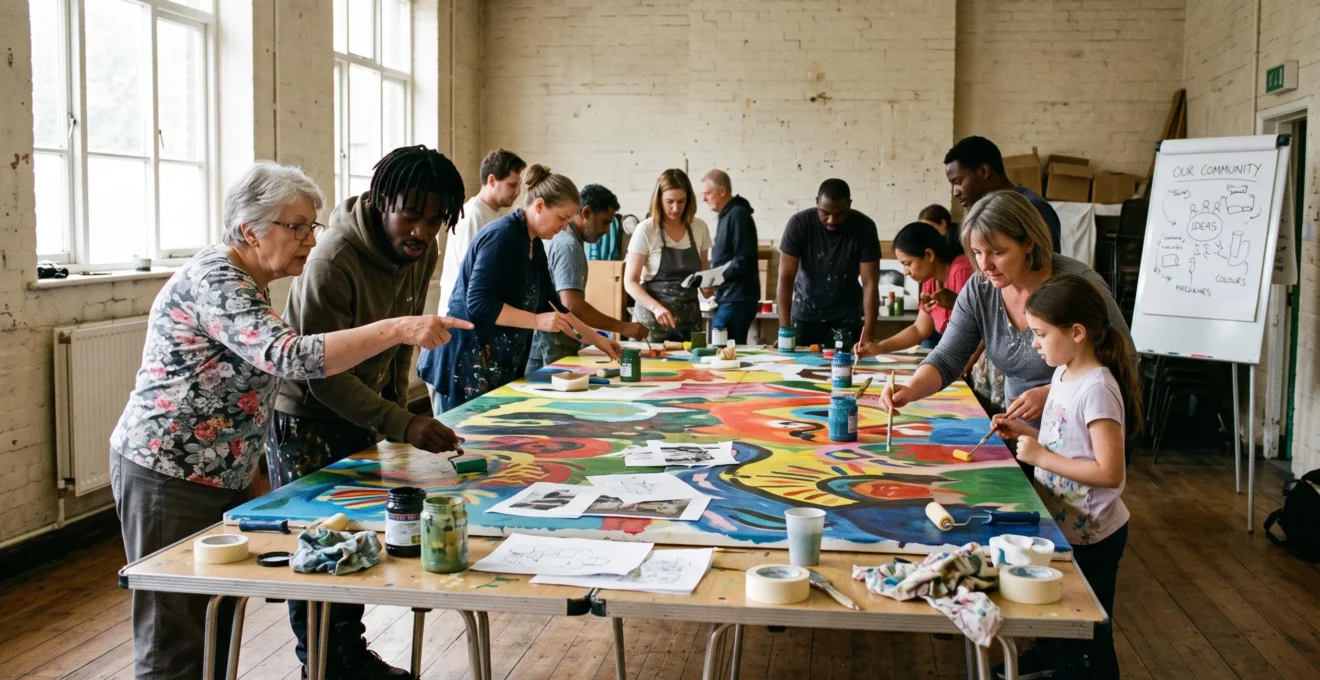
Public engagement makes art programmes more inclusive when local people can influence what cultural institutions offer, how activities are delivered and whose experiences are represented. For museums and cultural organisations, meaningful participation involves more than attracting larger audiences. It means developing relationships in which residents feel welcome, respected and able to contribute.
A free exhibition, community workshop or public consultation can create an initial opportunity for engagement. Yet participation may remain uneven when institutions overlook everyday barriers, communicate through unfamiliar channels or invite residents to comment on decisions that have effectively been finalised.
Building sustained local participation therefore requires a different approach: listening before designing programmes, sharing appropriate decision-making power, demonstrating how community contributions influence outcomes and maintaining contact beyond individual events.
The practical challenge is to make these commitments achievable within an institution’s staffing, budget and responsibilities. Inclusion becomes more credible when community engagement is treated as an ongoing relationship rather than a temporary audience-development exercise.
Building more inclusive art programmes: essential principles
- Identify practical, cultural and decision-making barriers before assuming that low attendance means limited interest.
- Give residents meaningful opportunities to shape programmes, with clear expectations about their influence and available resources.
- Evaluate relationships over time through repeat participation, community-initiated involvement and feedback from people who remain outside existing audiences.
- Why Do Local Residents Feel Excluded From Museum Activities?
- How to Run a Community Listening Session Before an Art Initiative?
- Public Consultation or Co-Creation for a Neighbourhood Art Project?
- Why One-Off Community Feedback Can Undermine Cultural Trust
- How to Measure Community Trust After a Participatory Art Programme?
- Visitor Polls or Group Discussions: Which Produces Richer Feedback?
- Drop-In Art Activities or Booked Sessions for a Community Festival?
- How to Increase Audience Engagement at Small Art Exhibitions?
Why Do Local Residents Feel Excluded From Museum Activities?
Local residents may feel excluded from museum activities because physical obstacles, unfamiliar cultural expectations and limited opportunities to influence decisions make participation difficult or unappealing. Even when admission is free, institutional language, programming choices and previous experiences can signal that a museum is intended for other audiences. Understanding these different barriers is essential before designing inclusive programmes.
Physical exclusion involves barriers such as travel distance, transport availability, opening hours, admission costs and accessibility arrangements. A museum may offer free entry yet remain difficult to visit for residents whose working hours conflict with its schedule or who cannot easily reach the building.
Symbolic exclusion concerns belonging. Residents may associate museums with specialist knowledge, unfamiliar etiquette or cultural traditions that do not reflect their own experiences. Exhibition descriptions, publicity photographs, staff interactions and programming decisions can reinforce the impression that a venue is not intended for them.
Procedural exclusion arises when people have little practical opportunity to influence cultural activities. Consultation may happen after key decisions are made, depend on online-only participation or rely heavily on existing museum supporters.
These barriers can overlap. Someone who has never visited a museum may not describe themselves as excluded. They may simply believe that its activities have little relevance to their life. This form of self-exclusion is particularly difficult to recognise through visitor surveys because the people concerned are absent from the sample.
30% versus 49%
In England during 2024/25, 30% of adults living in the most deprived areas physically engaged with museums or galleries, compared with 49% in the least deprived areas. The figures demonstrate unequal participation, not the causes of that disparity.
Department for Culture, Media and Sport, DCMS Participation Survey 2024/25 report.
A useful institutional diagnostic compares museum participation with the surrounding community. Record visitor and programme-participant profiles by neighbourhood where appropriate, then compare these patterns with reliable local population information. Consider age, accessibility needs and socioeconomic circumstances where data collection is lawful, voluntary and proportionate.
This comparison can reveal areas that appear underrepresented, but it cannot explain why residents are absent. Conversations outside the museum are needed to understand the reasons. Institutions should also avoid assuming that neighbourhood residents share identical interests or cultural identities.
Most importantly, low attendance does not automatically indicate low interest in art. It may reflect an unfamiliar institution, unsuitable activities or relationships that have never been developed. Previous commitments that were not fulfilled can also shape residents’ perceptions, although this must be established through local evidence rather than assumed.
Once an institution understands who is missing and what might be preventing participation, community listening can turn those observations into informed programme decisions.
How to Run a Community Listening Session Before an Art Initiative?
A productive community listening session begins by inviting people beyond the institution’s established networks, identifying which decisions participants can genuinely influence and creating space for different experiences. Facilitators should use accessible language, record disagreements accurately and explain how feedback will inform the initiative. The process is only complete when participants receive a clear account of what happens next.
The first distinction is between listening for approval and listening to shape decisions. Asking residents to endorse a completed exhibition concept offers little influence. Inviting them to discuss themes, formats, locations or accessibility requirements before these are settled creates meaningful possibilities for change.
The Ontario Museum Association‘s Engaging your Community toolkit provides a structured framework covering institutional self-assessment, community consultation and future action planning. Its resources include methods for identifying participants, facilitating conversations and translating findings into practical plans.
For a neighbourhood initiative, institutions can organise listening in three stages:
- Recruit beyond familiar audiences. Work with trusted neighbourhood organisations, community centres, libraries and everyday meeting places. Where appropriate, use face-to-face outreach rather than relying exclusively on mailing lists or museum social media.
- Facilitate an open conversation. Explain the purpose in ordinary language, clarify which decisions remain open and ask participants what would make the initiative relevant to their lives. Give quieter contributors opportunities to speak without requiring everyone to agree.
- Report back and act. Share the main findings, decisions made and unresolved questions through communication channels participants already use. Explain why some requests cannot be accommodated.
Preparation should also address practical participation needs. Consider accessible venues, transport difficulties, interpretation, childcare responsibilities and whether participant payment or expenses are appropriate. Avoid repeatedly depending on the same unpaid community representatives, particularly when their involvement requires substantial time.
Five actions to prepare an accountable listening session
- Map participating and underrepresented neighbourhood groups; produce a one-page recruitment map identifying outreach gaps.
- List decisions participants can influence; publish a decision-scope statement before sending invitations.
- Confirm accessibility, facilitation and participation arrangements; complete a session logistics checklist.
- Prepare open questions and a method for recording disagreements; create a facilitator guide and anonymised discussion template.
- Assign responsibility for communicating outcomes; produce a feedback timetable showing when and how residents will hear back.
A listening session should record competing priorities rather than manufacture consensus. Residents may disagree about artistic themes, venue choices or whom a programme should serve. These disagreements provide useful design information when reported fairly.
Effective listening establishes what matters to residents. The next decision is how much authority they should hold as the project moves from planning towards delivery.
Public Consultation or Co-Creation for a Neighbourhood Art Project?
Public consultation is appropriate when residents need to inform institutional decisions, while co-creation is better suited to projects where communities should help produce artistic outcomes. Co-design sits between these approaches by giving residents influence over important design choices. The right model depends on available time, resources, artistic responsibilities and the decision-making power the institution can genuinely share.
These participation models are not interchangeable. Each creates different expectations about responsibility, creative ownership and how decisions will be made.
| Criterion | Consultation | Co-design | Co-creation |
|---|---|---|---|
| Community role | Offer views and identify priorities | Help shape important project decisions | Participate directly in producing artistic work |
| Decision-making | Institution retains final authority | Selected decisions are shared | Creative responsibilities are negotiated |
| Typical activities | Interviews, surveys, listening sessions | Planning workshops, collaborative concept development | Collective artistic production and creative workshops |
| Resource considerations | Recruitment, facilitation, analysis and feedback | Repeated meetings, coordination and design revisions | Artist time, materials, accessibility and participant support |
| Appropriate objective | Understand local needs before deciding | Develop a programme reflecting shared priorities | Create work through direct community involvement |
Increasing community influence generally introduces additional coordination and the possibility of unexpected outcomes. Institutions may need to reconsider timelines, artistic concepts or established working practices. These are practical trade-offs rather than evidence that one participation model is universally better.
For a project prioritising quick public visibility, a well-designed consultation may be more realistic than a lengthy collaborative process. For an initiative seeking enduring local relationships, co-design or co-creation may create more opportunities for shared responsibility and ownership, provided those arrangements are genuine.
Problems emerge when the promised model does not match institutional capacity. Calling a project co-created while reserving every meaningful decision for the museum can create misleading expectations. Asking residents to undertake substantial creative work without budgeting for appropriate remuneration, expenses or accessibility support can make participation inequitable.
Likewise, inviting consultation after a preferred outcome has already been fixed risks treating community contributions as an endorsement exercise.
Hypothetical example: developing a neighbourhood mural in stages
A small museum wants to commission a mural with nearby residents. It begins with conversations about local stories, preferred locations and participation barriers. The project team explains that planning permission and conservation requirements may restrict certain choices.
Residents then help develop a shortlist of themes with the appointed artist. For a subsequent project, the museum budgets for supported creative workshops where participants can contribute directly to the final artwork. At each stage, the institution explains which decisions are shared and which remain subject to professional or regulatory constraints.
This progressive approach gives the organisation opportunities to demonstrate reliability before expanding shared decision-making. It does not guarantee stronger trust, but it avoids promising a level of participation that cannot be delivered.
Where community members contribute original creative work, expectations around attribution, permissions and future use should also be agreed in advance, with arrangements appropriate to the relevant jurisdiction.
The chosen model matters, but so does what happens afterwards. Residents are more likely to judge the sincerity of engagement through institutional follow-through than through participation terminology alone.
Why One-Off Community Feedback Can Undermine Cultural Trust
One-off community feedback can undermine cultural trust when institutions invite residents to contribute without explaining what happens to their views. Consultation creates an expectation that contributions will be considered, even when no particular outcome is guaranteed. If residents receive no response or evidence of consideration, they may question whether participation was meaningful, making subsequent engagement more difficult.
The central problem is an implicit expectation of follow-through. Residents invest time, share experiences and sometimes disclose difficult concerns. Even when they understand that not every request can be fulfilled, they reasonably expect their contributions to receive serious attention.
Feedback collected at one moment provides a snapshot. A continuing relationship, by contrast, creates repeated opportunities to listen, respond, test changes and revisit unresolved concerns.
A single consultation is not inherently damaging. Its potential to weaken trust depends on expectations, existing relationships, how decisions are explained and whether the institution delivers on its commitments. An unanswered consultation can be particularly problematic when residents have experienced similar disappointments before.
The Local Government Association‘s guidance on consulting residents recommends involving people before decisions are finalised, considering consultation fatigue and evaluating whether participants received adequate feedback and whether their involvement changed anything.
Museums can apply these principles through a simple feedback closure process:
- Summarise what participants said, including important disagreements.
- Identify suggestions that influenced the programme and describe the resulting changes.
- Explain which requests could not be adopted and the relevant constraints.
- Communicate outcomes within a timeframe announced during consultation.
- Provide a named contact or accessible channel for further questions.
Closing the feedback loop should not depend solely on publishing a lengthy report on the museum website. Participants may be more likely to encounter updates through a neighbourhood partner, local newsletter, community noticeboard or direct message using their preferred communication channel.
Institutions should also review previous engagement records before organising another consultation. Asking residents to repeat concerns they have already raised, without acknowledging earlier contributions, risks consultation fatigue.
Over time, public records of decisions and follow-up actions can help institutions maintain continuity when staff, budgets or programmes change. They also give residents a clearer basis for assessing whether their involvement has mattered.
Responsible follow-through makes institutional commitments more visible. Measuring whether those commitments translate into stronger relationships requires looking beyond immediate event satisfaction.
How to Measure Community Trust After a Participatory Art Programme?
Community trust after a participatory art programme should be assessed through several complementary indicators rather than a single satisfaction score. Repeat involvement, voluntary referrals, community-initiated contact and residents’ accounts of institutional responsiveness can reveal aspects of a developing relationship. Establishing a baseline and gathering views from non-participants are essential for interpreting change without overstating the programme’s impact.
Exit surveys answer questions about a particular experience: Was the workshop enjoyable? Was the facilitator welcoming? Were facilities accessible? These are useful measures of satisfaction, but they do not establish whether residents trust an institution enough to return, raise concerns or influence future activities.
Relational trust develops over time and involves perceptions of reliability, respect and responsiveness. Museums therefore need a combination of behavioural, qualitative and contextual evidence.
| Indicator | What to observe | Important limitation |
|---|---|---|
| Repeat participation | Residents voluntarily attend another activity | Convenience or personal interest may explain return visits |
| Local referrals | Participants introduce neighbours, friends or relatives | Referrals alone do not prove institutional trust |
| Community initiative | Residents suggest activities or initiate contact | More confident participants may be overrepresented |
| Perceived responsiveness | Residents describe whether concerns were heard and addressed | Responses may be influenced by social desirability |
| Non-participant perceptions | People outside existing audiences describe awareness and barriers | Recruitment and response bias still require attention |
The Museums Association’s Measuring socially engaged practice toolkit recognises that social impacts can continue beyond the end of a programme and that no single evaluation approach suits every organisation. It discusses qualitative methods, ethical considerations and the difficulty of quantifying social outcomes.
These principles support a proportionate evaluation design, although social impact and community trust are not identical concepts.
Before an initiative begins, institutions can document existing participation patterns, relationships with neighbourhood organisations and residents’ perceptions of accessibility and responsiveness. This creates a baseline for comparison.
During delivery, record attendance and participation patterns without collecting unnecessary personal information. After the programme, combine short interviews with observations of subsequent involvement. A later follow-up may help distinguish temporary enthusiasm from continuing engagement, although the appropriate interval depends on the programme.
A significant limitation is that participants are already more likely than non-participants to have engaged with the institution. Their positive responses should not be treated as representative of the wider neighbourhood.
To address this, invite views through trusted local partners and everyday community settings, including from residents who did not attend. Ask what they know about the initiative, whether they felt invited and what might influence future participation.
Evaluation should also allow negative and contradictory findings. A growing audience can coexist with residents who remain sceptical. Conversely, limited attendance growth may accompany stronger working relationships with a smaller group.
Once the intended outcomes are clear, institutions can select feedback methods capable of exploring both broad participation patterns and the experiences behind them.
Visitor Polls or Group Discussions: Which Produces Richer Feedback?
Visitor polls and group discussions produce different kinds of useful feedback. Polls help identify patterns across a larger number of respondents, while group discussions explore why people hold particular views, what prevents participation and which alternatives they might prefer. Neither method is automatically richer: the most informative choice depends on the research question, participant recruitment and how findings will influence decisions.
A short poll can reveal whether respondents prefer evening opening hours, recognise a particular programme or find registration straightforward. Standardised questions make responses easier to compare across groups or different periods.
However, polls can reproduce the institution’s assumptions. Closed questions limit possible responses, while self-selected respondents may differ substantially from residents who never encounter the survey.
Group discussions create opportunities to explore unexpected concerns. Participants can explain why they avoid an exhibition, what language feels unwelcoming or how a proposed workshop conflicts with everyday responsibilities.
Yet group discussions introduce different biases. Confident speakers may dominate, quieter participants may agree publicly despite private reservations, and group dynamics can influence what people feel comfortable sharing.
Facilitators should therefore use open questions, encourage balanced contributions and offer confidential ways to share sensitive feedback. Small-group or individual conversations may be more suitable when participants are uncomfortable speaking in a public setting.
A practical combined approach begins with a brief poll to identify common responses or apparent contradictions. Follow this with targeted discussions involving people who report different experiences. For example, survey respondents might say an event was accessible while conversations reveal that its booking process excluded some residents before they could attend.
For communities unfamiliar with cultural institutions, oral questions in everyday language may be more accessible than written questionnaires. Translation, interpretation and alternative communication methods should be considered where appropriate.
Poll results should be described as representative only when recruitment and sampling justify that conclusion. Group discussions, meanwhile, should be used to understand perspectives rather than estimate how many residents hold each view.
Understanding what residents think also helps institutions design participation formats that suit different levels of familiarity, confidence and available time.
Drop-In Art Activities or Booked Sessions for a Community Festival?
Drop-in art activities are generally better suited to spontaneous discovery, while booked sessions provide more predictable conditions for sustained creative engagement. Drop-in formats remove advance registration barriers but offer less control over attendance and interaction time. Booked workshops support structured activities yet can exclude residents who face digital, scheduling or confidence barriers. Combining both formats can balance accessibility with deeper participation.
At a community festival, an open craft table allows passers-by to participate without making a prior commitment. This can be valuable for residents who are curious about an activity but reluctant to register for a formal arts programme.
Drop-in activities can also accommodate different levels of engagement. One visitor might spend a few minutes experimenting with materials, while another begins a conversation that leads to a later workshop.
The main limitation is unpredictability. Facilitators may encounter fluctuating demand, materials can run out, and conversations may remain brief. Staff should therefore design activities that can provide a worthwhile experience even when participation is short.
Booked sessions are useful when an activity requires sustained attention, specialist materials, particular safety arrangements or a consistent group. They also allow organisers to prepare accessibility support and develop more continuous interactions between artists and participants.
However, advance booking is not socially neutral. Registration may depend on internet access, familiarity with booking systems, predictable schedules and confidence that participants will feel welcome.
Institutions can reduce these barriers by offering in-person registration, clearly communicating whether activities are free, allowing trusted neighbourhood partners to help with bookings and reserving some opportunities for spontaneous participants where capacity permits.
A mixed participation model can provide the strongest practical fit for festivals with both outreach and relationship-building objectives. Open activities create low-pressure introductions, while smaller sessions offer interested residents a chance to explore techniques or ideas in greater depth.
The transition between formats must be explicit. Facilitators can explain forthcoming sessions, offer simple registration options and make it clear that participation in the drop-in activity creates no obligation to continue.
Organisers should avoid judging success exclusively by the number of festival contacts. Record whether the activities were accessible, whether residents expressed interest in future involvement and whether arrangements exist to support that interest afterwards.
A festival can create an introduction to cultural participation. Smaller exhibitions provide another opportunity to turn that initial curiosity into a more personal relationship with an institution.
Key takeaways for sustained local participation
- Design the next invitation before an event ends, so interested residents know how to remain involved without pressure.
- Make room for visitors to contribute ideas or influence small decisions, not simply consume the completed programme.
- Assign responsibility for maintaining contact and acting on contributions after exhibition activity has finished.
How to Increase Audience Engagement at Small Art Exhibitions?
Small art exhibitions can increase audience engagement by prioritising meaningful interaction over visitor volume. Artist conversations, participatory interpretation and opportunities to influence future programming can make the experience more personal. To sustain engagement, institutions must also provide clear ways for visitors to reconnect after leaving, while ensuring that contributions are acknowledged and genuinely considered.
A small exhibition has practical advantages. Fewer visitors may allow staff, artists or curators to spend more time discussing works and listening to personal interpretations. This can be especially valuable for people who are unfamiliar with exhibition conventions or uncertain whether their opinions are welcome.
Instead of relying exclusively on conventional wall labels or scheduled talks, organisers can introduce flexible engagement opportunities. For example, visitors might contribute a short response to a work, discuss an artistic choice with its creator or participate in an informal conversation about themes relevant to the neighbourhood.
These mechanisms should remain optional and accessible. Some visitors prefer quiet observation, and meaningful engagement should not be defined solely by how visibly or verbally someone participates.
Engagement during a visit can be explored through observations of conversations, voluntary contributions, interactions with activities and visitor feedback. Time spent in the exhibition can provide context, but a longer visit is not automatically a better one.
Engagement after a visit requires a different approach. Possible indicators include return attendance, participation in subsequent activities, voluntary subscriptions to programme updates and introductions made through local networks.
Micro-decisions can help connect these stages. A museum might invite visitors to suggest a theme for a future conversation, contribute a word to a community display or vote between genuinely available options for an upcoming participatory activity.
The distinction is whether the contribution can influence a real decision. A vote that cannot affect anything risks becoming decorative participation. When visitors understand the scope of their input and later see what happened, they have a clearer opportunity to recognise their role in the programme.
For example, a small exhibition exploring local memories could invite residents to propose subjects for a subsequent discussion. Organisers could review these proposals with community partners, explain the selected themes and invite contributors to take part in planning the next event. This is a hypothetical programming approach, not evidence that any particular institution has achieved a measured engagement outcome.
Follow-up should be proportionate and respectful. Visitors may choose to leave contact details, but the organisation should explain how that information will be used and avoid making ongoing communication a condition of participation.
Strong exhibition engagement is therefore part of a wider cycle: listening to local communities, offering meaningful influence, communicating decisions and assessing whether relationships continue. Without that cycle, interactive activities may create enjoyable moments without producing lasting participation.
For the next exhibition, select one decision visitors can genuinely influence, identify how their contributions will be acknowledged and establish a realistic opportunity for continued involvement. This creates a manageable starting point for turning occasional attendance into a more inclusive cultural relationship.
Can a museum build community engagement without a dedicated outreach team?
Yes. A small museum can begin with a limited number of achievable commitments, such as working with one neighbourhood partner, holding accessible listening conversations and reporting back on programme decisions. Staff responsibilities and resources should be clearly allocated. A modest engagement process that receives consistent follow-through is more credible than an ambitious consultation programme the organisation cannot sustain.
Should community participants be paid for contributing to museum projects?
Payment should be considered in relation to the time, expertise, responsibilities and creative labour requested. Substantial advisory or artistic contributions may warrant remuneration, while expense reimbursement and accessibility support can help reduce participation barriers. Institutions should establish transparent arrangements before involvement begins and check applicable employment, tax, funding and intellectual property requirements in their jurisdiction.
How can museums engage residents who distrust formal institutions?
Begin through trusted community relationships rather than expecting residents to visit the museum immediately. Activities in familiar neighbourhood settings, conversations facilitated by respected local partners and clear explanations of decision-making boundaries can make involvement more approachable. Trust should not be assumed after a single positive encounter; consistent communication and demonstrated follow-through remain important.
What should an institution do when community requests exceed its budget?
Explain the financial and operational constraints openly, distinguish requests that are impossible from those that could be addressed later and invite discussion about achievable alternatives. Record decisions and communicate the reasoning to participants. Institutions should avoid suggesting that every proposal can be delivered simply to maintain enthusiasm during consultation.
How can cultural organisations maintain engagement between funded projects?
Maintain a manageable rhythm of communication, share updates on previous contributions and continue relationships with neighbourhood partners even when no major exhibition is scheduled. Low-resource activities such as informal conversations, periodic programme discussions and opportunities to propose future ideas can preserve contact. Commitments should match available capacity so that ongoing engagement remains reliable rather than becoming another short-lived promise.