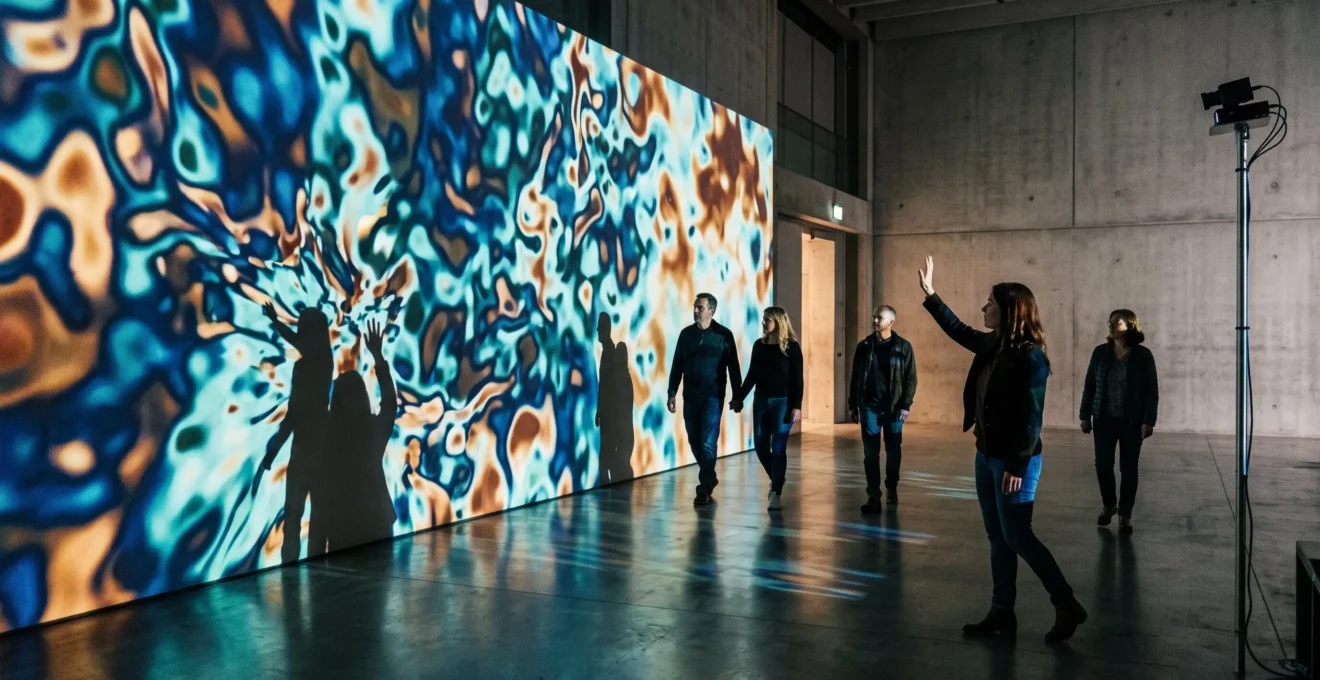
Contemporary artistic practice is changing as digital technologies become more than tools for producing images, sounds, or moving pictures. Data streams, programmable environments, sensors, and immersive interfaces can now determine how an artwork develops, responds to its surroundings, and encounters an audience.
In new media art, an artist may design a system rather than a fixed composition. Weather conditions can influence a projected landscape, visitor movement can reshape a digital installation, and virtual environments can transform the meaning of a physical location. These possibilities introduce new creative freedoms, but also questions about authorship, technological dependence, accessibility, and preservation.
The central shift is not simply from traditional materials to digital equipment. It is from making objects with predetermined properties toward creating experiences whose behavior may depend on changing information and human participation. Understanding that shift requires examining both the artistic decisions and the technical systems that make these works possible.
New media art: essential insights
- Data-driven and interactive artworks can produce changing outcomes because artists define rules rather than controlling every individual result.
- Generative systems, augmented reality, virtual reality, and real-time rendering offer different creative possibilities, each with practical limitations.
- Successful digital practice depends on artistic coherence, carefully designed constraints, accessible interaction, and documentation that supports long-term preservation.
- Why Does Data-Driven Art Produce Results Artists Cannot Fully Predict?
- How to Turn Live Weather Data Into a Generative Artwork?
- Augmented Reality or Virtual Reality for a Site-Specific Artwork?
- Why Software Obsolescence Threatens New Media Art Collections
- When Should an Artist Use Real-Time Rendering Instead of Video?
- Why Can Too Many Artistic Techniques Distract From the Subject?
- How to Increase the Difficulty of Constraint-Based Art Exercises?
- How to Create Interactive Digital Artwork That Responds to Visitors?
Why Does Data-Driven Art Produce Results Artists Cannot Fully Predict?
Data-driven art produces unpredictable results because artists delegate some compositional decisions to information that changes independently of their intentions. Sensors, online services, and audience activity supply inputs that a programmed system translates into artistic outcomes. The artist controls the rules, but not necessarily every result. This uncertainty can be an intentional creative quality rather than a technical weakness.
In a conventional digital animation, an artist can specify the movement, timing, and appearance of each element. A data-driven artwork operates differently: its final configuration emerges from relationships between incoming information and predefined instructions.
Consider a hypothetical installation that converts network activity into changing patterns of light. The artist chooses the colors, geometry, and transformation rules, but the frequency and distribution of incoming events influence which patterns appear. The work becomes a negotiation between artistic intention and external conditions.
Two types of uncertainty must be distinguished. Designed unpredictability occurs when an artist deliberately creates a range of acceptable outcomes. Uncontrolled technical drift occurs when corrupted data, software errors, or changes to an external service produce behavior outside that range.
Artists can maintain expressive control without fixing every result. Input values can be normalized, extreme measurements constrained, and outputs restricted to a deliberately chosen visual or sonic vocabulary. This creates space for variation while protecting the artwork’s central identity.
A practical decision framework separates three responsibilities:
- Delegate to data: variations in rhythm, movement, density, color relationships, or other features that benefit from external change.
- Retain artistic control: conceptual meaning, acceptable output ranges, interaction boundaries, and the conditions under which the work should stop or reset.
- Document the system: data sources, mapping equations, software dependencies, representative inputs, and examples of intended behavior.
Third-party services introduce a further risk. An API may change its response format, restrict access, or disappear. Recording representative input data and maintaining an offline playback mode can help artists test and exhibit a work when live services become unavailable. Such measures preserve selected behaviors, although they cannot necessarily reproduce the original live context.
This distinction becomes particularly tangible when environmental information, such as live weather, supplies the material from which an artwork develops.
How to Turn Live Weather Data Into a Generative Artwork?
To create a generative artwork from live weather data, select a reliable meteorological source, retrieve measurable variables, and map them to visual or sonic parameters. Temperature might influence color, wind speed might control movement, and humidity might affect texture. The artistic challenge is designing relationships that communicate an idea rather than merely displaying measurements.
A weather-responsive artwork begins with a clear concept. An artist exploring atmospheric instability might emphasize wind fluctuations, while a work about seasonal transitions could focus on changes in temperature. The chosen variable should have a meaningful relationship to the intended experience.
A practical production pipeline follows five stages:
- Choose a data source. A local sensor provides measurements from a particular place, while a weather API supplies observations collected through an external service.
- Establish a collection schedule. Select an update frequency consistent with the source’s availability, the desired responsiveness, and any operational restrictions.
- Prepare the data. Normalize units, identify timestamps and time zones, check missing values, and establish sensible input boundaries.
- Design the mapping. Translate measurements into artistic parameters such as particle velocity, brightness, sound frequency, or spatial density.
- Generate and test the output. Observe how the composition behaves during ordinary conditions, abrupt changes, and interruptions.
The National Weather Service API documentation provides an example of a technical data source for a weather-based installation in the United States. Its station-specific endpoints can return observations, including the latest available measurement. The service provides access without usage fees but applies rate limits whose numerical threshold is not publicly disclosed.
Its documentation also notes that observation quality varies by provider and that the documented real-time service retains seven days of station observations. Artists requiring longer records would therefore need to arrange suitable archival storage or another historical data source.
Weather-based generative works can follow three distinct temporal models:
- Real time: the artwork responds to recent observations, with any delay depending on measurement availability and processing.
- Memory: the system accumulates measurements, allowing past conditions to influence its present composition.
- Simulation or replay: recorded observations are processed again, enabling controlled exhibitions and comparisons between different periods.
Missing data should not automatically produce a blank screen or broken composition. A designed fallback might temporarily retain the last valid measurement, transition to a neutral state, or replay an explicitly identified recorded sequence. The choice should respect the artwork’s meaning and avoid presenting archival information as current conditions.
Start with one weather variable controlling one artistic parameter. Once the relationship becomes legible, introduce additional variables only when they contribute something distinct.
Environmental data can connect an artwork to a specific place without representing that place visually. Extended reality offers another approach: placing digital experience directly within, or conceptually alongside, a physical location.
Augmented Reality or Virtual Reality for a Site-Specific Artwork?
Augmented reality is generally better suited to site-specific artworks that need visitors to experience digital content in relation to an existing physical environment. Virtual reality is more appropriate when the artistic intention requires a constructed, immersive space. The choice depends on how essential the actual location is, what equipment visitors need, and how the experience should unfold.
According to Unity‘s XR technical manual, augmented reality overlays digital content onto a view of the physical world, while virtual reality simulates a self-contained environment. Mixed reality extends these possibilities by supporting interactions between virtual and physical elements.
For artists, this distinction concerns more than technical presentation. It changes the relationship between the artwork, its location, and the visitor’s body.
In augmented reality, a digital sculpture positioned within a historic building may depend on the building’s architecture, circulation, and visibility. In virtual reality, that same building could be reconstructed, transformed, or reimagined as an environment that visitors experience independently of the actual site.
The following comparison helps identify which format serves the artistic intention.
| Decision criterion | Augmented reality (AR) | Virtual reality (VR) |
|---|---|---|
| Relationship to place | Digital content appears within the existing physical setting. | The location can be reconstructed, referenced, or transformed virtually. |
| Visitor experience | Visitors remain visually connected to their surroundings. | Visitors enter an immersive environment that may obscure the physical setting. |
| Equipment | May use compatible smartphones, tablets, or specialized headsets. | Typically requires a suitable immersive headset and associated equipment. |
| Simultaneous access | Can support distributed participation when compatible devices are available. | Capacity often depends on available headsets, space, supervision, and session design. |
| Environmental constraints | Lighting, tracking, spatial alignment, and physical obstructions can affect the experience. | Comfort, safe movement, headset operation, and physical boundaries require attention. |
| Artistic advantage | Creates a dialogue between digital intervention and existing space. | Allows extensive transformation of space, scale, and physical expectations. |
Neither format is universally more accessible or less expensive. Smartphone-based AR excludes visitors without compatible devices unless shared equipment or alternatives are provided. VR requires suitable headsets and operational support, while some visitors may need seated modes, shorter sessions, or a non-headset alternative.
Outdoor AR also raises calibration challenges: unstable tracking or changing light conditions can make virtual objects appear to drift. Both formats can depend on platform licensing, operating-system compatibility, application distribution, and proprietary hardware.
Physical safety and accessibility should be incorporated into the installation design rather than treated as last-minute exhibition requirements. VR users need adequate unobstructed space, and AR users should not be encouraged to focus on a screen while navigating hazards.
Before choosing a format, prototype the same artistic proposition in both environments. A small AR test might position one object within the intended site; a VR prototype might reconstruct the spatial relationship that gives the object meaning. Compare visitor comprehension, bodily engagement, setup complexity, and the degree to which each format contributes to the concept.
Because immersive works depend on particular devices and software environments, decisions made during production also influence whether the artwork can still be experienced when today’s technologies become obsolete.
Why Software Obsolescence Threatens New Media Art Collections
Software obsolescence threatens new media art collections because digital artworks often depend on technologies that change or disappear. An installation may require specific hardware, operating systems, libraries, codecs, or online services. Failure at any one of these levels can disrupt the work. Preserving such art therefore involves maintaining its behavior and meaning, not simply storing its original files.
A conventional digital file is not necessarily a self-sufficient artwork. A program may need a particular runtime environment, an interactive installation may depend on a discontinued sensor, or a networked piece may require an API that no longer operates as originally designed.
These vulnerabilities occur across three connected layers:
- Hardware: displays, sensors, interfaces, dedicated computers, and physical components may become difficult to maintain or replace.
- Software: operating systems, programming libraries, plugins, codecs, and execution environments may lose compatibility.
- Online infrastructure: hosted resources, external platforms, APIs, authentication systems, and network services may change or become unavailable.
Even when the artwork’s source files survive, their preservation does not guarantee that the original experience can be recreated. An interactive work may remain technically executable while responding differently because its sensors, timing, or display characteristics have changed.
The Guggenheim‘s Variable Media Initiative, which emerged in 1999, provides an influential institutional framework for approaching these problems. It identifies storage, migration, emulation, and reinterpretation as possible preservation strategies.
Each strategy involves a different relationship between technological continuity and artistic identity.
| Strategy | Practical approach | Principal trade-off |
|---|---|---|
| Storage | Retain original equipment, files, and supporting materials. | Original components may deteriorate or become difficult to operate. |
| Migration | Transfer content or functionality to newer technological formats. | Changes in presentation or behavior may affect the work’s identity. |
| Emulation | Reproduce characteristics of an older technical environment using different technology. | Some original interactions or performance characteristics may be difficult to replicate. |
| Reinterpretation | Recreate the work under changed technological conditions. | The acceptable extent of artistic change must be established. |
The Smithsonian American Art Museum‘s Media Lab likewise identifies technological obsolescence as a challenge in conserving time-based media. Its conservation approach considers technological feasibility alongside the characteristics of individual works and artists’ intentions.
The essential preservation question is therefore not always whether the original machine can survive. It is which qualities must remain recognizable for the artwork to retain its identity. These might include interaction rules, visual relationships, physical scale, timing, or the experience of encountering the work.
Five actions to prepare a digital artwork for preservation
- Document the artistic intention: write a one-page statement identifying the work’s essential behaviors and the changes that would compromise its meaning.
- Inventory the technical environment: create a versioned list of hardware, operating systems, libraries, codecs, and online dependencies.
- Archive the production materials: assemble a structured package containing source code where available, project files, configuration settings, and representative input data.
- Record the installation process: produce a setup diagram, operating instructions, calibration notes, and a short reference video showing intended behavior.
- Test a recovery scenario: disconnect an external service or replace a nonessential component, then document the result and any approved fallback procedure.
These records should be maintained as the work evolves. They can support collaboration between artists, curators, technicians, and conservators without predetermining a single future conservation treatment.
For living artists, preservation is also a production concern. A work that cannot be installed after a software update may become difficult to exhibit long before it enters a museum collection.
That distinction also matters when choosing between a prerecorded video and a real-time rendering system, since these formats carry different operational responsibilities.
When Should an Artist Use Real-Time Rendering Instead of Video?
Artists should choose real-time rendering when an artwork needs to respond dynamically to visitors, environmental information, or changing conditions during exhibition. Prerecorded video is generally more suitable when precise timing, consistent playback, and a fixed composition are essential. The decision concerns the artistic role of variation and interaction, as well as the technical reliability required for public presentation.
Video presents a predetermined sequence. Even when projected across multiple surfaces or incorporated into an installation, its recorded content does not automatically change in response to the audience.
Real-time rendering instead generates or updates images as the system operates. It can modify perspective, geometry, color, sound relationships, or visual behavior according to incoming signals.
This capability is useful when responsiveness is central to the artwork’s meaning. A hypothetical installation examining collective movement, for example, could generate patterns that change as the number and position of visitors vary. A fixed video might demonstrate the idea, but it would not enact the same relationship between audience behavior and artistic form.
Several practical questions help guide the choice:
- Must the work react to audience movement, sound, touch, or environmental data?
- Should visitors encounter different outcomes during separate sessions?
- Does the artwork require a precise narrative sequence or repeated timing?
- Can the exhibition space support the necessary computing equipment, ventilation, and maintenance?
- How should the installation behave during long operating periods or after a technical interruption?
Real-time rendering introduces responsibilities that may be less prominent in a fixed-video presentation. The artist or exhibition team may need to address sustained processing demand, heat dissipation, graphics performance, device calibration, application recovery, and interactions between hardware and software versions.
A video-based installation still requires functioning players, displays, codecs, and power systems. It is not maintenance-free, but it can reduce the number of variables that influence the content during playback.
A useful compromise is a hybrid rendering system. Prerendered sequences can supply visually demanding imagery, while selected real-time elements respond to visitor presence or live information. The artwork retains controlled visual material without eliminating the possibility of meaningful variation.
For example, a hypothetical coastal installation could display a prerecorded landscape while dynamically changing an overlaid field of particles according to measured wind conditions. If the live feed fails, the underlying sequence could continue, with the system clearly indicating that the responsive layer is temporarily unavailable.
Such decisions should be made through prototypes tested under realistic exhibition conditions, rather than on the basis of visual sophistication alone.
Once that requirement is clear, the next challenge is resisting unnecessary additions that may complicate the work without strengthening its subject.
Why Can Too Many Artistic Techniques Distract From the Subject?
Too many artistic techniques can distract from a work’s subject because each medium introduces its own visual language, interactions, and technical demands. In digital art, combining sensors, immersive interfaces, generative imagery, and real-time effects can encourage audiences to focus on technological novelty rather than the underlying idea. Complexity becomes productive only when its elements serve a coherent artistic intention.
Digital systems make it possible to combine many different forms of expression within one installation. This flexibility can encourage artists to introduce additional technologies simply because they are available.
An artwork about environmental change might initially use temperature-driven light. Adding motion tracking, augmented reality, reactive sound, and several competing datasets could expand its expressive possibilities. Yet these additions might also make the original relationship between atmosphere and visual transformation harder to recognize.
The problem is not technical sophistication itself. It is competition for attention. When several interactions demand interpretation simultaneously, visitors may spend their time discovering what the system can do rather than considering what the artwork communicates.
A simple alignment test can clarify the value of each proposed technique:
- What artistic idea does this technique make perceptible?
- Could that idea be expressed just as effectively through a simpler medium?
- Does the technique reveal a new dimension of the subject, or mainly introduce an impressive effect?
- Can visitors understand the relationship between the technique and the concept without extensive technical explanation?
If the strongest justification is novelty alone, removing the technique may sharpen the composition.
Deliberately limiting the number of media or interactions can function as a creative constraint. An artist working with a single sensor and a restricted visual vocabulary must pay closer attention to timing, variation, perception, and meaning.
Nevertheless, multi-technique works can be conceptually coherent. A project exploring the relationship between physical and virtual identity might legitimately combine cameras, spatial audio, generated imagery, and immersive environments. In such a work, the techniques can contribute different but coordinated perspectives to a shared question.
The relevant measure is therefore not the quantity of technology, but the clarity of its artistic contribution.
Creative constraints make that evaluation practical, offering a structured way to develop new media skills without allowing technical possibilities to determine every artistic decision.
How to Increase the Difficulty of Constraint-Based Art Exercises?
Increase the difficulty of constraint-based art exercises by introducing one additional restriction at a time while preserving a clear creative objective. Artists can limit available media, reduce data inputs, shorten production time, or restrict interactive controls. Effective difficulty comes from forcing meaningful artistic decisions, not from increasing technical complexity without purpose.
Constraints are particularly useful in new media practice because digital environments can offer an overwhelming number of adjustable parameters. Restricting those possibilities makes the consequences of individual decisions easier to observe.
A structured progression might move through four levels:
- Level 1 — Restrict the medium: create a composition using only one visual or sonic technique. Focus on variation through rhythm, arrangement, and scale.
- Level 2 — Restrict the input: develop a generative work using only one external variable, such as wind speed. Examine how many distinct expressions can emerge from that single source.
- Level 3 — Restrict the interaction: allow visitors only one input, such as pressing a button or entering a defined area. Make the resulting transformation conceptually meaningful and easy to understand.
- Level 4 — Combine artistic and production constraints: impose a defined development period while restricting adjustable parameters or requiring the work to operate without a conventional screen.
Each level presents a different problem. Restricting media encourages compositional economy. Restricting data inputs encourages deeper experimentation with mapping. Restricting interaction emphasizes audience comprehension, while production constraints require prioritization.
For an illustrative, hypothetical exercise, an artist could create a weather-driven sound installation using only one wind measurement and one continuous sonic parameter. The challenge would not be to display all available meteorological information, but to make a single changing measurement feel expressive.
A more demanding version could preserve the same data restriction while removing visual feedback entirely. The artist would then need to consider whether changes in sound communicate environmental variation without requiring a written explanation.
Adding several constraints simultaneously is not necessarily more educational. If the restrictions make the artistic objective impossible or turn the exercise into a purely technical workaround, they may reduce exploration rather than deepen it.
After each iteration, assess what the restriction revealed. Did it improve clarity, expose a creative assumption, or lead to an unexpected compositional solution? Retain constraints that advance the inquiry and revise those that merely obstruct production.
These lessons become especially valuable when designing interactive artworks, where an audience introduces new behaviors that cannot be fully rehearsed within the studio.
Key takeaways for interactive art practice
- Choose inputs according to the artistic relationship they establish with visitors, rather than the number of sensors or interfaces available.
- Design for unpredictable public behavior, including simultaneous participation, inactivity, and technical interruption.
- Test whether visitors can perceive the connection between their actions and the artwork’s response before increasing complexity.
How to Create Interactive Digital Artwork That Responds to Visitors?
Creating interactive digital artwork requires an input system that detects visitor activity, a set of rules that interprets that activity, and an output that changes in response. Cameras, microphones, pressure sensors, and touch interfaces can provide inputs, while software translates them into visual or sonic transformations. Successful interaction depends on making this relationship perceptible, meaningful, and reliable.
The basic architecture consists of three connected stages: input, interpretation, and output. Each stage involves decisions about both artistic intention and technical execution.
Input determines which aspect of visitor behavior the system recognizes. A camera might detect movement, a microphone could measure sound intensity, and a pressure-sensitive surface might register bodily presence.
Interpretation defines what those measurements mean within the artwork. For example, the system might treat proximity as a condition for increasing visual density or sustained stillness as a reason to slow a composition.
Output determines how the experience changes. The response could appear as moving imagery, altered sound, changes in lighting, or transformations of a physical mechanism.
The mapping between behavior and response is an artistic decision. A system that brightens when visitors approach creates a different relationship from one that gradually becomes darker or quieter.
Interactive installations also need to account for visitors who behave differently from the artist’s expectations. Someone may stand still, move rapidly, enter with a group, or leave before the system completes a transition.
Practical design considerations include:
- Response latency: the interval between a visitor’s action and the system’s observable reaction should support the intended sense of connection.
- Trigger thresholds: the system should distinguish meaningful activity from incidental movement or background noise.
- Multiple participants: interaction rules should establish how simultaneous inputs are combined, prioritized, or separated.
- Idle behavior: the artwork needs an intentional state when nobody is present.
- Recovery and maintenance: the installation should have documented behavior for disconnections, sensor faults, application restarts, and unavailable inputs.
Too much responsiveness can make interaction difficult to interpret. If every small movement changes several unrelated visual properties, visitors may struggle to identify what they are influencing. Too little feedback creates the opposite problem: people may conclude that the artwork is not interactive at all.
Testing with people unfamiliar with the work is particularly important. Rather than explaining the interface immediately, observe whether visitors discover the interaction, understand its consequences, and remain engaged with the artistic idea.
These sessions can reveal delayed feedback, ambiguous triggers, uncomfortable movements, and difficulties that remain invisible during individual studio testing. Adjust one parameter at a time and repeat the observation to understand which changes improve the experience.
Accessibility should be considered throughout the process. An installation relying on gesture recognition may need an alternative input method for visitors with different mobility needs. Likewise, sound-dependent or visually intensive works may require complementary forms of feedback or interpretation.
Public installations using cameras or microphones should also be designed with attention to privacy. Detecting activity does not inherently require retaining identifiable recordings. Artists should distinguish immediate signal processing from storing personal information and assess applicable requirements for the exhibition context.
Finally, an interactive artwork concentrates many challenges found across new media practice. It depends on controlled unpredictability, meaningful real-time behavior, maintainable technology, and clear documentation. Preserving its artistic identity means understanding not only what it looks like, but how it responds.
Begin with a prototype that responds to one visitor action through one clearly observable transformation. Test it with unfamiliar participants, document its intended behavior, and add complexity only when it strengthens the experience. This approach allows technology to function as an expressive artistic medium rather than becoming the subject by default.
Does new media art require advanced programming skills?
Not necessarily. Artists can begin with visual programming environments, configurable interactive tools, or collaborations with creative technologists. Programming becomes more important when the work requires custom data processing, complex interactions, or specialized system behavior. Understanding how inputs, rules, and outputs relate is useful regardless of the production method.
Can generative artwork still be considered original if software produces its final form?
Generative art can express an artist’s original decisions through its concept, rules, data selection, constraints, and presentation. The artist may author the conditions under which a changing composition emerges rather than specifying every visible result. Questions of legal authorship and copyright are separate and depend on the jurisdiction, the creative contribution involved, and other relevant circumstances.
What should an artist document before exhibiting a technology-based installation?
Useful documentation includes the artistic concept, system architecture, equipment inventory, software versions, installation instructions, calibration settings, operating procedures, and representative examples of intended behavior. Artists should also identify external dependencies and acceptable substitutions. These materials support exhibition teams and may facilitate future conservation or reconstruction.
Does an interactive artwork need to collect visitors’ personal data?
No. Many interactive artworks can respond to temporary measurements such as motion intensity, proximity, or pressure without storing identifiable visitor information. When a system uses cameras, microphones, or connected services, artists should assess what data is processed, whether anything is retained, and which privacy obligations apply. Data minimization can be incorporated into the artistic and technical design.
How can an artist evaluate whether a digital technique improves an artwork?
Compare a prototype using the technique with a simpler version that communicates the same artistic idea. Observe whether the technology adds meaningful interaction, reveals information otherwise unavailable, or changes the visitor’s understanding of the subject. Also consider accessibility, operational demands, and preservation. A technique is justified when its contribution outweighs the complexity it introduces.