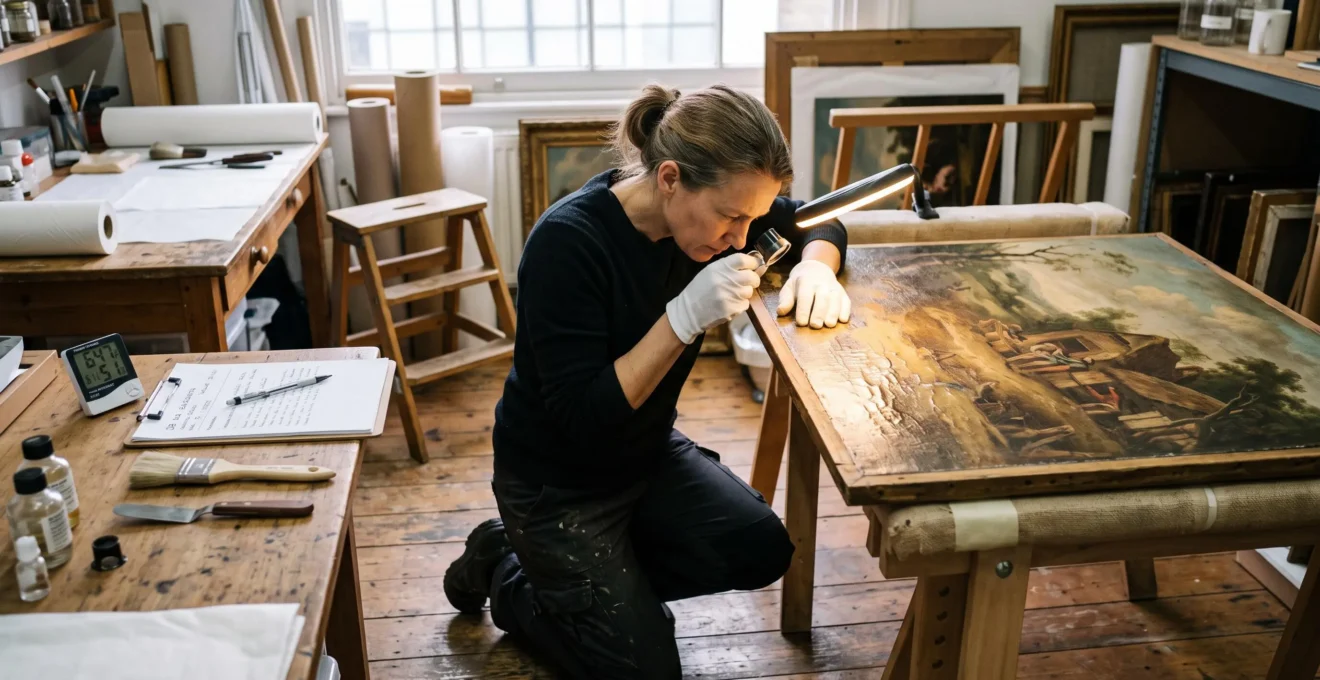
Artistic heritage is protected through a combination of preventive conservation, careful documentation, appropriate professional treatment and sustained public access. Whether a collection belongs to a museum, community organisation or family, preservation begins by recognising the conditions that cause damage and identifying which objects are most vulnerable.
Historic paintings, textiles, drawings and decorative objects respond differently to humidity, light, pollutants and handling. Digital artworks face additional threats from obsolete software and inaccessible technology. No single storage condition, cleaning technique or digitisation project can resolve all these risks.
The most effective approach is proportionate to the collection. An owner with limited resources can often prevent serious deterioration by improving storage, monitoring environmental changes and keeping reliable records. Where damage is already progressing, specialist assessment helps determine what intervention is justified.
Protecting heritage also means maintaining its meaning and availability. Objects that survive physically but lose their documentation, technical dependencies or connection with communities remain vulnerable in important ways.
Essential principles for protecting artistic heritage
- Prevent damage by maintaining reasonably stable environmental conditions, limiting unnecessary handling and avoiding unsuitable cleaning products.
- Document every object and prioritise professional assessment according to active deterioration, cultural significance and the consequences of delay.
- Preserve digital artworks and collection records alongside physical objects, while making heritage accessible to diverse audiences.
- Why Do Changes in Humidity Damage Historic Paintings and Textiles?
- How to Catalogue Family Artworks Without Specialist Software?
- Conservation or Digitisation: Which Should a Small Collection Prioritise?
- Why Household Cleaning Products Can Permanently Damage Historic Art
- Which Historic Artworks Should Be Assessed for Conservation First?
- Why Mouse-Only Navigation Excludes Some Digital Gallery Visitors
- Why Software Obsolescence Threatens New Media Art Collections
- How Can Public Engagement Make Art Programmes More Inclusive?
Why Do Changes in Humidity Damage Historic Paintings and Textiles?
Changes in relative humidity damage historic paintings and textiles because their constituent materials absorb and release moisture at different rates. Canvas, wooden supports, fibres and some paint layers expand or contract as conditions change. Repeated movement creates mechanical stress that can lead to deformation, cracking, flaking and separation between layers.
A painting is a structure of interacting materials rather than a single uniform surface. A wooden panel may change dimensions as humidity rises while its comparatively rigid paint layers respond differently. Canvas paintings can experience tension changes that aggravate existing cracks. Historic textiles may distort as fibres repeatedly absorb and release moisture, particularly where different materials or weakened areas are combined.
The Canadian Conservation Institute guidance on caring for paintings explains that humidity fluctuations can worsen cracks and contribute to paint delamination. Its discussion also identifies increased cracking risks for susceptible paintings at relative humidity below 35%, although this is not a universal threshold for every artwork.
Environmental stability matters more than pursuing one supposedly perfect humidity reading. The Canadian Conservation Institute discusses conditions in which fluctuations of 10 percentage points of relative humidity or less present negligible additional cracking risk. That finding must be interpreted within the materials and exposure conditions considered, not applied indiscriminately to textiles, damaged paintings or mixed collections.
For a small collection, reducing repeated environmental swings is often more achievable than maintaining tightly controlled museum conditions. Historic exposure, object condition and susceptibility all influence the appropriate range.
Environmental problems often originate in ordinary building features. Poorly insulated exterior walls can create local temperature differences. Basements may retain moisture, while radiators and heating ducts produce dry or rapidly changing conditions. Sunlight falling on a wall can alter its local temperature, and seasonal changes in heating can shift indoor relative humidity substantially.
A practical first step is to place a simple hygrometer close to the collection, away from direct sunlight, radiators and other immediate heat or moisture sources. Record readings at consistent times and compare them over several days and across seasons. Additional measurements near a suspected problem wall may help identify differences. A low-cost instrument indicates trends, but does not replace a professional environmental survey.
Look for warning signs such as cockling paper, warped supports, cupping or lifting paint, tide marks and mould. Some marks may be historic and stable, so changes should be documented rather than automatically attributed to current humidity.
Once the environment is understood, recording each artwork’s identity, location and existing condition makes it easier to recognise future changes before they become serious.
How to Catalogue Family Artworks Without Specialist Software?
Family artworks can be catalogued effectively using a spreadsheet, notebook or structured paper file. The essential requirement is a consistent record that identifies each object, describes its materials and condition, establishes what is known about its ownership and records its current location. Specialist collections software is helpful for complex inventories, but not necessary for basic documentation.
The Collections Trust‘s Spectrum inventory standard identifies unique object numbers, descriptions or images, current locations and ownership information as core elements of an accountable museum inventory.
These principles offer a useful starting point for family collections, although a private spreadsheet should not automatically be described as fully compliant with every museum documentation procedure.
A simple catalogue can use the following fields:
| Field | Information to record |
|---|---|
| Object identifier | A unique, consistent reference number. |
| Photograph | A clearly identified overview image and its date. |
| Dimensions | Height, width and depth where relevant, with measurement units. |
| Materials | Known or suspected media, supports and framing materials. |
| Maker | Artist, workshop or attribution, indicating uncertainty. |
| Provenance | Known ownership history, acquisition information and supporting documents. |
| Condition | Visible damage, previous repairs and the date of observation. |
| Location | Current room, storage position or display location, with date checked. |
Consistency and traceability are more valuable than elaborate software features. An owner should be able to identify an object unambiguously and locate its associated photographs and records.
Photographs should show the complete object, with additional details of significant damage where safely accessible. Use consistent lighting and angles when possible, retain the original image files and record when each photograph was taken. Repeating comparable photographs later helps identify newly developed cracks, stains or distortions.
Documentation should never create unnecessary physical risks. Avoid removing fragile works from their frames simply to photograph the reverse. Do not attach adhesive labels directly to historic materials or repeatedly unfold delicate textiles. Assign identifiers through the catalogue and suitable associated storage materials instead.
Insurance documentation and conservation records also serve different purposes. Insurers may require identifying photographs, proof of ownership, valuations and information about an object’s location, depending on the policy. A conservator generally needs more detailed observations about materials, previous treatments, physical condition and environmental history.
Neither record automatically substitutes for the other. For an insurance submission, confirm the insurer’s actual requirements rather than assuming that a basic inventory is sufficient.
With a reliable inventory in place, owners can make better decisions about whether their next investment should protect the physical objects or improve their digital documentation.
Conservation or Digitisation: Which Should a Small Collection Prioritise?
A small collection should generally prioritise preventive conservation and the stabilisation of actively deteriorating objects before investing heavily in digitisation. Digital images preserve information about an artwork, not the physical object itself. However, digitisation may come first when a fragile item can be recorded safely once, reducing future handling, or when a work exists primarily in digital form.
The decision should begin with the risks affecting the collection rather than the availability of scanning equipment. A photograph of a painting with actively lifting paint cannot prevent further losses. Similarly, a digitised document remains vulnerable to deterioration if its original is stored in unsuitable conditions.
Digitisation nonetheless provides distinct benefits. It can create reference images, support research, reduce demand for repeated handling and provide access to audiences unable to visit the collection. These advantages complement physical conservation rather than replace it.
The following decision grid helps establish priorities without assuming that all collections have the same needs.
| Object condition or risk | Recommended priority | Reason |
|---|---|---|
| Actively flaking painting | Professional stabilisation assessment | Material may be lost through further movement or handling. |
| Stable framed artwork | Preventive care and basic photography | Records can be created without major physical intervention. |
| Extremely fragile manuscript | Specialist handling assessment, then possible imaging | Safe digitisation may reduce future access-related handling. |
| Collection in unsuitable storage | Improve storage conditions | Environmental deterioration continues regardless of digital records. |
| Born-digital artwork with ageing media | Digital preservation planning | The work may depend entirely on vulnerable files and technology. |
Preventive conservation is often the most accessible initial investment. Suitable storage materials, safer handling procedures, reduced light exposure and environmental monitoring may be achievable without expensive treatment equipment.
Interventive conservation is different. Consolidating unstable paint, treating damaged textiles or repairing historic surfaces requires specialist judgement, appropriate materials and potentially substantial resources. A preliminary condition assessment can prevent money being spent on unnecessary or harmful treatments.
For fragile objects, imaging must itself be risk-assessed. Flattening a brittle document, forcing open a bound volume or repeatedly repositioning a textile may cause more immediate harm than leaving the item undigitised until appropriate equipment and expertise are available.
Born-digital heritage reverses the traditional priorities. Software-dependent installations, digital videos and interactive works may have no independently surviving physical original. Their preservation requires attention to files, storage media, playback environments and technical documentation.
Digitised records also require continuing care. Maintain identifiable master files, accessible working copies, more than one independently maintained backup and a documented process for checking whether files remain readable. A collection stored on a single device is not securely preserved simply because it has been digitised.
Even well-planned preservation efforts can be undermined by everyday maintenance practices, particularly when cleaning methods appropriate for modern furnishings are used on historic materials.
Why Household Cleaning Products Can Permanently Damage Historic Art
Household cleaning products can permanently damage historic artworks because their ingredients may react with original materials, old repairs and protective coatings. Water, solvents, detergents and polishing agents can dissolve sensitive surfaces, disturb pigments, alter varnishes or leave harmful residues. Damage may occur immediately or develop gradually, making apparently successful cleaning particularly misleading.
Commercial products are formulated for particular modern surfaces, not the complex combinations of aged materials found in historic objects. A product described as gentle for domestic furniture may still be unsuitable for a painted panel, gilded frame or historic textile.
Surfactants can move dirt and oily substances, but they may also redistribute contamination into porous materials or leave residues. Solvents can affect coatings and paints. Moisture can cause stains to spread, dyes to bleed or weakened fibres to distort.
Dusting and cleaning are not interchangeable conservation activities. Light dust removal from an appropriate, stable surrounding surface may be manageable, but direct contact with vulnerable artwork surfaces can cause irreversible losses.
For a non-specialist, the safest approach is to avoid touching the original surface unless its condition and an appropriate method have been established. A clean, dry, soft cloth may be suitable for some sound, non-historic outer frame surfaces, provided it cannot contact the artwork or fragile decoration. Even soft brushes can dislodge flaking paint, powdery pigments or loose gilding.
Avoid applying water, detergents, glass cleaner, furniture polish, wax or solvents to an artwork without appropriate professional guidance. Glass covering an artwork should not be sprayed directly, because liquid can enter the frame along its edges.
Damage can also arise indirectly. Cooking vapours deposit residues that attract dirt. Air fresheners, scented candles and other indoor emissions introduce contaminants whose effects depend on the materials and exposure involved. Adhesive tapes, unsuitable rubber products and certain storage materials may stain, adhere to or chemically affect neighbouring objects over time.
After an accidental spill or cleaning mishap, the immediate response should minimise additional contact:
- Stop the cleaning activity and prevent further exposure where it is safe to do so.
- Do not rub, scrape or attempt to dissolve an existing stain.
- If liquid is present, avoid spreading it. Blotting may be appropriate only for a known stable, accessible surrounding surface; fragile or unidentified artwork materials should not be blotted without specialist advice.
- Photograph the affected area without unnecessary handling and record the substance involved and approximate time of the incident.
- Contact a qualified conservator promptly, especially if paint, dyes, paper or other vulnerable materials are wet or visibly changing.
Some incidents require urgent professional guidance because rapid deterioration may continue. However, an improvised treatment based on the assumption that all stains respond alike can produce additional irreversible damage.
When damage is suspected, the next task is not to decide how to repair it independently, but to establish which objects need professional attention first.
Which Historic Artworks Should Be Assessed for Conservation First?
Historic artworks should be assessed first when deterioration is active, likely to accelerate or threatens an irreplaceable object. Priority depends on three connected questions: how severe is the damage, how quickly is it progressing, and how significant is the artwork? An old but stable object may require less urgent attention than a more recent work losing original material.
A conservation assessment should distinguish existing damage from continuing deterioration. An old, stable crack is not necessarily an emergency. Newly lifting paint, spreading mould or recent insect activity, however, may indicate an immediate threat to the object or nearby collection materials.
Observable warning signs include:
- Paint instability: flaking, cupping, lifting or fresh losses.
- Biological activity: suspected active mould, insects, larvae, fresh insect debris or recent feeding damage.
- Paper deterioration: new tears, increasing cockling, moisture marks or unstable attachments.
- Stone and ceramics: recurring salt deposits, surface powdering or developing cracks.
- Structural problems: unstable frames, weakened supports or objects at risk of falling.
These signs are screening indicators, not definitive diagnoses. White deposits may have different causes, and historic insect holes do not necessarily mean an infestation is ongoing. A conservator can distinguish conditions requiring intervention from damage that should simply be documented and monitored.
When resources are limited, cultural and personal significance must also be considered. An object may be financially modest but irreplaceable because it documents a community, family history or otherwise poorly represented artistic practice.
For example, in a hypothetical small collection containing a stable historic portrait and a less valuable drawing with actively spreading mould, the drawing may demand more immediate assessment. That does not necessarily mean an invasive treatment should begin before the portrait receives attention. The appropriate order depends on the risks and available stabilisation options.
The cost of delay can matter more than an object’s market value. A potentially stabilisable condition may become more difficult to address if original material continues to disappear.
A professional condition assessment should identify materials, existing damage, suspected causes, likely progression and recommended preventive measures. When treatment is proposed, the owner should ask about its objectives, limitations, possible risks, alternatives, documentation and estimated costs.
It is useful to request a prioritised written report distinguishing urgent stabilisation, longer-term treatment and routine monitoring. This makes the assessment actionable rather than simply descriptive.
Five practical steps to establish conservation priorities
- Review the inventory: produce a complete list of objects with their current locations and existing condition notes.
- Flag visible changes: create a dated photographic record of suspected active damage without disturbing fragile surfaces.
- Identify environmental threats: prepare a short register of observed humidity, water, light, pest or storage concerns.
- Rank assessment needs: create a provisional shortlist recording condition severity, evidence of progression and cultural significance.
- Request professional guidance: obtain a written assessment brief asking for treatment priorities, preventive measures and costed options where feasible.
Physical care is only one aspect of stewardship. As institutions increasingly provide collection access online, their digital interfaces also determine whether preserved heritage can be meaningfully used.
Why Mouse-Only Navigation Excludes Some Digital Gallery Visitors
Mouse-only navigation excludes digital gallery visitors who rely on keyboards, screen readers, switch devices or alternative input methods. Hover-dependent menus, inaccessible image viewers and controls that require dragging can prevent these users from exploring artworks. A collection may be available online yet remain effectively inaccessible when its interface assumes that every visitor uses a conventional mouse.
Digital accessibility is particularly relevant to heritage collections because detailed imagery, interpretation and contextual documentation are often central to understanding an artwork.
Consider a gallery viewer in which enlarging an image requires dragging a slider. A visitor using keyboard navigation may be unable to inspect the same details as someone using a mouse. Similarly, an interactive exhibition timeline may contain valuable information that cannot be reached or understood using assistive technology.
The W3C Web Content Accessibility Guidelines (WCAG) 2.2 provide an internationally applicable technical framework addressing keyboard operation, text alternatives, visible focus and pointer interactions, subject to specified exceptions.
These guidelines are a benchmark for assessing digital collection interfaces. Their legal status varies by jurisdiction and the obligations applicable to a particular organisation.
Accessible navigation should be considered part of long-term digital stewardship. Keeping files available does not by itself ensure that future audiences can discover, inspect or interpret them.
A basic manual review can reveal obvious barriers without specialist software:
- Open a digital gallery and use the Tab key to move through its interactive controls.
- Check that the currently focused control is visually identifiable.
- Try opening and closing menus, artwork details and image-viewer dialogs without using a mouse.
- Check whether zoom and navigation functions offer accessible alternatives to dragging or complex gestures.
- Review whether important images have meaningful text alternatives appropriate to their purpose and context.
For detailed artwork reproductions, useful alternative text should communicate relevant visual information, while longer descriptions may be needed for complex content. The appropriate description depends on how the image is used; a decorative thumbnail and a primary collection object do not necessarily require identical treatment.
This quick test can identify potential problems, but it is not a complete WCAG conformance audit. Screen-reader testing, code inspection and evaluation with people who use assistive technologies are valuable further steps.
Accessibility failures can also create reputational and, where applicable, legal risks for cultural institutions. The specific obligations depend on national legislation and organisational status rather than WCAG alone.
Even accessible interfaces cannot guarantee long-term access when the underlying digital artwork depends on software or hardware that eventually becomes unusable.
Why Software Obsolescence Threatens New Media Art Collections
Software obsolescence threatens new media art because digital artworks often depend on specific operating systems, applications, codecs, plug-ins or hardware. When these technologies are discontinued, an artwork may become impossible to display as originally intended even if its files still exist. Preserving such works therefore requires more than copying data onto newer storage devices.
A software-based installation might rely on an obsolete graphics environment, while an interactive artwork may require a controller or sensor no longer manufactured. A file can remain technically intact but lose its functionality when the software needed to interpret it disappears.
This creates a preservation challenge distinct from the physical deterioration of traditional objects. A comparatively recent digital installation can become inaccessible through technological change, although there is no universal basis for claiming that digital artworks always deteriorate faster than historic paintings.
Institutions use several complementary strategies to address these risks:
| Approach | Potential benefit | Main limitation |
|---|---|---|
| Emulation | Recreates aspects of an older computing environment on newer technology. | May not reproduce every interaction, timing characteristic or hardware behaviour. |
| Migration | Converts or adapts content for a newer supported format or platform. | May alter appearance, functionality or other significant properties. |
| Hardware preservation | Retains original equipment and potentially its distinctive presentation characteristics. | Equipment may become unreliable, difficult to repair or dependent on unavailable components. |
| Experience documentation | Records the appearance, behaviour and interpretation of the artwork. | Documentation cannot necessarily recreate the original interactive experience. |
No strategy preserves every aspect of a work equally. An emulator may reproduce software behaviour while altering the tactile characteristics of an original interface. Migration may improve accessibility but change the artwork’s visual presentation or responsiveness.
Artist intent is therefore central to preservation decisions. The important question is not merely whether the program still runs, but which characteristics are essential to the work’s identity.
The Smithsonian Institution maintains Smithsonian interviews on time-based media and digital art conservation, documenting conversations with artists and professionals involved in acquiring, conserving and exhibiting these works. Such records illustrate the importance of understanding a work’s technical and interpretive requirements alongside its digital components.
For private collectors and small organisations, practical measures include retaining original files, installation instructions, licences where relevant, technical specifications and available equipment. Record how the artwork responds to users, which components are replaceable and which features the artist considers essential.
A video recording of an interactive work can help document its appearance and behaviour, but it does not necessarily preserve the experience of participating in it.
Before changing file formats or replacing equipment, assess the likely effect on authenticity and functionality. Preserve the original version where possible and record any modifications. Storage copies should be maintained and checked so that accidental loss or corruption does not compound obsolescence.
Preservation ultimately concerns more than keeping individual objects operational. Cultural heritage also depends on the people who interpret it, use it and support its continued care.
Key takeaways for long-term heritage stewardship
- Conservation planning should identify not only vulnerable materials but also the people and knowledge needed to sustain a collection.
- Accessible digital resources and documented artistic intent help preserve opportunities for future interpretation.
- Community involvement can influence which objects, histories and experiences receive attention when institutional resources are limited.
How Can Public Engagement Make Art Programmes More Inclusive?
Public engagement makes art programmes more inclusive when communities can influence decisions about collections, exhibitions and interpretation rather than simply being invited to attend existing events. Meaningful participation helps institutions recognise overlooked histories, identify barriers to access and develop programmes that reflect a wider range of experiences. It can also strengthen long-term public support for heritage preservation.
Outreach and participation are related but different activities. Outreach increases awareness of programmes already designed by an institution. Participation creates opportunities for people to influence what those programmes contain, how collections are interpreted and which forms of heritage receive attention.
For example, a museum might advertise an exhibition through additional community channels. That may improve attendance, but it does not necessarily change how the exhibition was conceived.
By contrast, inviting community representatives to help select objects, contribute interpretations or identify missing histories can influence the programme itself. Such involvement should include clear expectations about responsibilities, decision-making authority, recognition and compensation where appropriate.
Practical approaches to inclusion include:
- Reducing financial barriers: offering free admission opportunities or pay-what-you-can programmes where financially sustainable.
- Broadening communication: providing relevant multilingual interpretation and accessible information about visits.
- Accommodating different needs: organising sensory-friendly sessions and offering alternative ways to experience exhibitions.
- Sharing interpretation: developing community co-curation projects that incorporate local knowledge and perspectives.
- Building relationships: working with community organisations already trusted by groups that cultural institutions have historically struggled to reach.
These measures should be selected in consultation with the intended participants. A programme designed around assumptions about a community’s needs may reproduce the exclusion it seeks to address.
Public engagement can also contribute to conservation. Communities with a sustained relationship to a collection may become advocates for its protection, contribute expertise, support fundraising or participate in appropriately supervised volunteer activities.
However, higher attendance or greater visibility does not automatically produce more conservation funding. The connection depends on institutional relationships, resources and whether engagement leads to sustained involvement.
Inclusion should be evaluated through participation and influence, not attendance alone. Visitor numbers can indicate reach, but they cannot establish whether people felt represented or had meaningful opportunities to shape decisions.
Useful evaluation questions include whether participants return, whose perspectives appear in collection interpretation, whether community partners can influence future programming and whether the institution acts on feedback.
Institutions should also consider who is absent from consultation and whether participation requirements inadvertently exclude people with limited time, transport, income or digital access.
Long-term stewardship benefits when engagement is treated as an ongoing relationship rather than a temporary project. Communities may hold knowledge about objects, places and artistic traditions that is missing from formal records. Respectful collaboration can help retain that contextual knowledge alongside the physical and digital collection.
A practical next step is to review one collection or programme with both conservation staff and relevant community representatives. Identify a physical preservation risk, a documentation gap and an access barrier, then agree on achievable actions, responsible people and a date to review progress. This connects technical conservation with the public relationships that help heritage remain meaningful and protected.
Can an artwork be safely stored in an ordinary home?
Yes, many artworks can be cared for in domestic environments when storage and display conditions suit their materials. Avoid locations subject to substantial humidity changes, direct sunlight, water exposure or nearby heat sources. Keep objects securely supported, minimise handling and monitor vulnerable items. Particularly fragile or valuable works may require a specialist assessment of their storage needs.
How often should a small art collection be inspected?
There is no single inspection interval suitable for every collection. Stable objects in appropriate conditions may require less frequent checks than fragile works or objects exposed to known environmental risks. Establish a documented inspection schedule, review objects after significant environmental incidents and compare dated condition records. Suspected active deterioration warrants earlier professional attention rather than waiting for the next scheduled review.
Should damaged historic artworks always be restored?
No. Restoration is not automatically necessary or desirable. Some historic damage is stable and forms part of an object’s history. Conservation decisions should consider material stability, cultural significance, treatment risks and the likely consequences of inaction. A qualified conservator may recommend preventive measures, monitoring or limited stabilisation instead of extensive restoration.
What should happen to collection records when ownership changes?
Relevant cataloguing information, condition photographs, provenance documentation and known treatment records should accompany the collection through an appropriate and securely documented transfer. Any restrictions involving confidential, personal or sensitive information should be respected. Keeping records associated with their objects reduces the risk of losing essential knowledge about identity, ownership and previous conservation work.
How can a small cultural organisation begin preservation work with limited funding?
Begin with an inventory, a basic condition review and an assessment of storage and environmental risks. Address affordable preventive measures before commissioning unnecessary treatments. Seek professional guidance for actively deteriorating objects and prioritise irreplaceable materials when delay may cause further loss. Document decisions so that future volunteers, staff and funding partners can understand the collection’s needs and continue the work consistently.