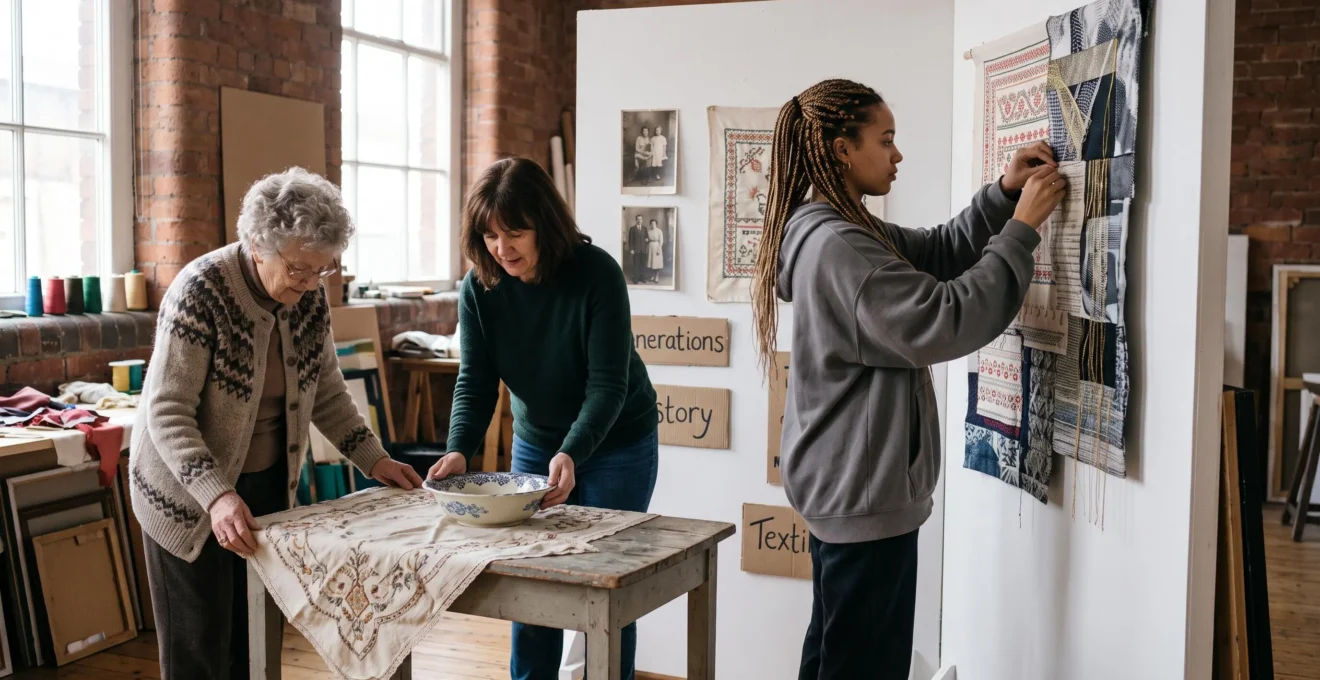
Art represents cultural identity across generations by giving visible form to inherited memories, everyday practices, shared histories and changing ideas of belonging. A family photograph, textile, portrait or community installation can preserve evidence of cultural continuity while questioning which traditions remain meaningful, who defines them and whose experiences are excluded.
This process is rarely a straightforward transfer of identity from older people to younger ones. Cultural meanings change as families encounter migration, new technologies, social expectations and different opportunities for self-expression. An object associated with belonging for one generation may communicate pressure, absence or creative possibility to another.
Artistic representation therefore involves more than preserving recognizable heritage symbols. It requires attention to the relationships, disagreements and choices through which cultural knowledge is transmitted.
For artists and cultural researchers, the central question is not whether an artwork accurately captures an entire community. It is how particular artistic decisions make cultural experiences visible without presenting one perspective as universal.
How art carries cultural identity across generations
- Everyday objects, family rituals and artistic techniques preserve memories while acquiring new meanings through changing circumstances.
- Portraits, installations and cultural symbols shape whose experiences become visible and which interpretations remain contested.
- Responsible representation depends on contextual research, meaningful participation, appropriate attribution and respect for cultural knowledge.
- Why Do Household Objects Symbolise Cultural Belonging in Contemporary Art?
- How to Create Art About a Mixed Cultural Background Without Stereotypes?
- Portraits or Collective Installations for Exploring Shared Identity?
- Why Repeating Familiar Cultural Symbols Can Distort Community Identity
- How to Compare Generational Views of Identity in a Local Art Exhibition?
- Why One-Off Community Feedback Can Undermine Cultural Trust
- Why Uncredited Cultural Borrowing Can Damage Artistic Partnerships
- How Do Artistic Traditions Survive While Techniques and Tastes Change?
Why Do Household Objects Symbolise Cultural Belonging in Contemporary Art?
Household objects symbolise cultural belonging because everyday activities give them meanings beyond their practical functions. Through repeated family rituals, inherited uses and personal memories, ordinary belongings can connect generations to shared experiences. Contemporary artists use these objects to explore cultural continuity, while revealing how their significance changes through migration, social expectations and individual choices.
A cooking utensil may initially serve a practical purpose, but its repeated use during family celebrations can make it a reminder of relationships and inherited knowledge. An embroidered tablecloth may communicate domestic labour, craftsmanship or hospitality. A family photograph may preserve a particular moment while revealing which relatives and experiences were considered worth recording.
The distinction between physical objects and living cultural practices is important. UNESCO‘s Convention for the Safeguarding of the Intangible Cultural Heritage recognizes practices, knowledge and expressions transmitted across generations, together with objects and artefacts associated with them. It also describes heritage as continually recreated rather than simply preserved unchanged.
However, an inherited possession does not automatically constitute recognized intangible cultural heritage. Its cultural significance must be understood through the people, practices and circumstances connected to it.
Consider a hypothetical inherited tea set. A grandparent might associate it with hospitality and family continuity. A parent might remember the obligation to maintain formal traditions. A grandchild might select one cup for an artwork exploring a partial reconnection with family history. The object remains familiar, but its meaning is neither fixed nor unanimously shared.
Artistic transformation makes these differences visible. Displaying the intact tea set may suggest preservation, while presenting fragments, casts or traces could raise questions about displacement, loss or reconstruction. Enlarging an embroidered pattern might emphasize overlooked domestic craftsmanship; placing it beside contemporary materials could suggest reinvention.
Interpretation also depends on context. Researchers should distinguish the object’s family history, the artist’s intended meaning and what an unfamiliar exhibition audience might infer. An explanatory label can clarify whether an object communicates one family’s experience rather than a supposed cultural characteristic shared by everyone.
Objects become particularly revealing when their meanings are allowed to conflict. Those conflicts provide a starting point for representing complex family backgrounds without reducing identity to recognizable ethnic imagery.
How to Create Art About a Mixed Cultural Background Without Stereotypes?
Artists can represent mixed cultural backgrounds without stereotypes by focusing on specific experiences rather than combining familiar symbols associated with different ancestries. Family memories, changing languages, conflicting expectations and experiences of belonging offer more precise material. Effective representation shows how individuals negotiate cultural influences instead of presenting identity as a fixed combination of inherited categories.
Flags, traditional clothing and recognizable decorative motifs can carry meaningful cultural associations. However, using them solely to indicate ancestry risks replacing lived experiences with an easily recognizable visual formula.
For example, an artist might remember speaking one language with grandparents and another at school. The resulting work could use overlapping handwritten texts, interrupted narratives or contrasting sound recordings to investigate language, intimacy and exclusion. The artistic decisions would emerge from a particular experience rather than from assumptions about how a cultural background should look.
A useful method is personal narrative mapping, an editorial exercise connecting three elements:
- Identify an inherited practice, memory or family expectation.
- Describe how its meaning changed between relatives or generations.
- Choose a moment of acceptance, rejection, uncertainty or reinterpretation, then translate that relationship into material, composition or narrative perspective.
Suppose an artist inherited a family embroidery technique but initially avoided using it because it seemed incompatible with contemporary artistic expectations. An artwork combining unfinished stitching with digital projections might represent this changing relationship more specifically than a decorative collection of cultural motifs.
Mixed identity also involves tensions between self-definition and external expectations. Artists may be asked to demonstrate authenticity through familiar imagery even when their experiences do not fit those expectations. Ambiguity can be an intentional artistic choice: an unresolved composition may express uncertainty about belonging more accurately than a harmonious arrangement of heritage symbols.
The National Gallery of Art’s Expressing the Individual educational resource examines how artists address individual identity, stereotypes and social expectations through particular artworks. Its examples offer interpretive possibilities, not universal rules for representing mixed cultural backgrounds.
Before exhibiting a work, artists can test its representational limits by separating personally experienced details, inherited family accounts and assumptions about a wider community. This distinction helps prevent a situated artistic narrative from appearing to speak for everyone with similar ancestry.
Representing complexity is not the same as avoiding cultural references. The stronger question is which artistic format allows personal experiences and collective relationships to remain distinct.
Portraits or Collective Installations for Exploring Shared Identity?
Portraits are especially useful when cultural identity is explored through individual agency, family relationships or differences in self-definition. Collective installations are better suited to examining shared memories, participation and competing community narratives. Neither format is inherently more inclusive or authentic: their effectiveness depends on the artistic question, selection process and visibility given to individual contributors.
Portraiture can reveal how people construct or negotiate identity through expression, gesture, clothing, posture and setting. A series depicting relatives from different generations may expose differences in how individuals wish to be remembered.
Collective installations can instead bring multiple voices, objects and memories into the same space. Their arrangement may reveal relationships that a single portrait cannot communicate, including disagreement, absence or overlapping experiences.
The comparison becomes clearer when the format is evaluated against the representation goal.
| Consideration | Portraits | Collective installations |
|---|---|---|
| Primary focus | Individual identity, agency and self-presentation | Shared memory, relationships and multiple contributions |
| Generational comparison | Contrasts between people, gestures and personal histories | Coexistence of inherited objects, narratives and interpretations |
| Representational risk | One individual may appear to represent an entire group | Individual differences may disappear within the overall arrangement |
| Authorship question | Who directs the sitter’s representation? | Who selects, edits and arranges contributions? |
| Useful contextual support | Personal captions and participant accounts | Contribution records and contrasting testimonies |
A series of artist-directed family portraits may communicate emotional intimacy while concentrating interpretive authority in the photographer or painter. An installation assembled from contributions by several generations may distribute the source material more widely without necessarily sharing final artistic control.
This distinction matters because participation does not automatically equal shared authorship. The person selecting, arranging and interpreting material can substantially influence what audiences understand as collective memory.
Byron Kim‘s Synecdoche, begun in 1991, provides a useful example of how individual representation and collective composition can overlap. The National Gallery of Art describes the work as both a group portrait and a collection of painted panels representing individual skin tones. Its format encourages questions about collective categorization and individual specificity, although it is not specifically a study of generational identity.
Artists can also combine the strengths of both approaches. Individual portraits accompanied by personal objects, contrasting testimonies or spatially separated contributions may preserve personal agency while revealing relationships between participants.
The central choice concerns not only appearance but interpretive authority. Even a carefully designed format can distort identity when its visible symbols repeatedly privilege one version of cultural belonging.
Why Repeating Familiar Cultural Symbols Can Distort Community Identity
Repeating familiar cultural symbols can distort community identity when a limited collection of images comes to stand for a diverse population. Although repetition can preserve memory and communicate pride, it may also obscure changing practices, internal disagreements and contemporary experiences. The problem is not recognizable symbolism itself, but treating selected visual markers as a complete representation of living culture.
A textile pattern, ceremonial object or ancestral landscape can communicate different meanings depending on its history and the people using it. For some, repetition reinforces continuity. For others, the same motif may recall displacement, restricted social roles or commercial representations that overlook present-day experiences.
Artistic meaning therefore requires more investigation than identifying a symbol’s origin. Researchers should examine its historical function, the circumstances in which it is reproduced and whether different generations interpret its continued use in similar ways.
For example, consider a hypothetical exhibition in which nearly every artwork about a migrant community features traditional clothing and ancestral buildings. Those references may be meaningful, but their dominance could leave contemporary workplaces, multilingual households, urban environments and changing family structures largely invisible.
The exhibition would then risk confusing symbolic visibility with cultural completeness.
A visual representation audit can help artists and curators identify this imbalance. The following is a practical editorial framework rather than a formally validated research instrument.
Five steps to audit cultural representation in an exhibition
- Inventory recurring motifs: Record every prominent cultural symbol and its frequency in a motif register.
- Document contextual meanings: Note each symbol’s known historical uses, current associations and disputed interpretations in a contextual reference sheet.
- Identify represented experiences: Match artworks to the family histories, social practices or perspectives they address in a representation matrix.
- Locate missing perspectives: Compare that matrix with the exhibition’s stated scope and produce a documented list of omissions and uncertainties.
- Review the curatorial narrative: Propose changes to labels, artwork selection or spatial arrangement in a revision log explaining what each change addresses.
The resulting audit should not assume that every community experience must appear in a single exhibition. Its purpose is to identify where limited artistic choices are being presented as comprehensive cultural representation.
Placing inherited imagery beside contemporary adaptations can also challenge the impression that culture belongs exclusively to the past. A traditional motif may remain meaningful while an artist deliberately changes its context, combines it with unfamiliar materials or questions its relevance.
Meaningful representation requires attention to what becomes visible and what remains absent. Comparing artworks across generations can help reveal those differences, provided artistic style is not mistaken for cultural attitude.
How to Compare Generational Views of Identity in a Local Art Exhibition?
To compare generational views of cultural identity in an exhibition, examine what each artwork preserves, challenges and reinterprets. Compare works addressing similar cultural references while considering their dates, materials, historical settings and creators’ experiences. This method identifies differences in cultural meaning without assuming that older artists are necessarily traditional or younger artists are automatically innovative.
A useful first step is to organize observations around three questions: What is inherited? What is contested? What is transformed? These questions can be applied to paintings, family photographs, textiles, sculptures and participatory installations.
Suppose a local exhibition includes three hypothetical artworks about family meals: an older artist’s painting of a communal table, a middle-generation photographer’s image of an interrupted gathering and a younger artist’s installation incorporating recorded voices and mismatched utensils.
The first work might emphasize continuity, the second uncertainty and the third reconstruction. Yet those interpretations should remain provisional until the researcher examines the artists’ statements, production circumstances and available contextual evidence.
Differences may reflect migration, economic conditions, artistic training or access to cultural institutions rather than age alone. A contemporary artist working in a traditional medium may challenge inherited values, while an older artist using experimental materials may actively reinterpret cultural history.
The National Gallery of Art’s Faces of America: Portraits resource offers educational approaches for studying poses, clothing, objects, settings and family relationships. It also encourages comparisons that account for historical circumstances and artistic conventions.
For a focused exhibition study, select two or three works sharing a recognizable reference, then record:
- The historical and personal circumstances surrounding each artwork.
- The symbols, materials and compositional choices used to express identity.
- The emotional tone and narrative perspective presented.
- The inherited practices retained, challenged or omitted.
- The contextual evidence supporting each interpretation.
Compare the results to develop a specific conclusion. Rather than declaring that younger generations reject tradition, for example, the evidence might suggest that certain family practices remain valued while their social expectations are being renegotiated.
Curatorial decisions can also influence the comparison. A chronological display may encourage visitors to see cultural development as a progression from tradition to modernity. Thematic groupings may instead emphasize shared concerns across different ages.
Exhibition labels, artwork placement and missing contributors should therefore be treated as part of the interpretation rather than neutral background information.
Comparative interpretation becomes more credible when it recognizes uncertainty and disagreement. The same principle applies when artists invite communities to contribute feedback about their representation.
Why One-Off Community Feedback Can Undermine Cultural Trust
One-off community feedback can undermine cultural trust when contributors are invited to comment without having a meaningful opportunity to influence artistic decisions. A single consultation, particularly after an exhibition is largely complete, may create expectations of shared authority that the project cannot fulfil. Sustained dialogue offers a clearer basis for addressing sensitive histories and conflicting interpretations.
There is an important difference between informing community members about a completed artwork and involving them in its development. Both activities may have legitimate purposes, but they should not be presented as equivalent forms of participation.
A consultation conducted after the artist has selected family narratives, edited testimonies and finalized the display may reveal concerns that are difficult to address. Contributors might question whether their personal experiences have been accurately represented or whether private memories have been placed in an unfamiliar context.
Generational diversity further complicates consultation. Established representatives may hold valuable knowledge while not necessarily reflecting the perspectives of younger participants, recent migrants or people less connected to cultural institutions.
Artists should therefore distinguish factual corrections, concerns about cultural sensitivity and disagreements over interpretation. These require different responses. A disputed historical date may be corrected, while conflicting memories may need to remain visibly unresolved.
UNESCO’s ethical principles for safeguarding intangible cultural heritage emphasize transparent collaboration, dialogue and sustained, informed consent. They provide an ethical reference for cultural projects, although they are not a universal legal framework governing artistic participation.
A practical staged feedback process can be organized around three artistic decision points:
- Concept development: Discuss the project’s purpose, proposed narratives and intended audiences before selecting sensitive material.
- Production: Revisit interpretations when editing testimonies, adapting techniques or arranging contributions.
- Pre-exhibition review: Provide a defined opportunity to respond to sensitive representations before their public presentation.
At each stage, artists should explain which decisions remain under their control and which may be revised collaboratively. This prevents consultation from implying shared authority that contributors have not actually been granted.
Disagreement should also be documented without being automatically treated as failure. A record of substantive concerns, proposed revisions and final editorial decisions makes the process more transparent.
Consultation cannot guarantee community consensus, and no group should be assumed to possess a single interpretation of its identity.
Trust depends partly on whether people understand how their contributions will be used. That expectation extends beyond consultation to the acknowledgment and treatment of cultural knowledge incorporated into finished artworks.
Why Uncredited Cultural Borrowing Can Damage Artistic Partnerships
Uncredited cultural borrowing can damage artistic partnerships when knowledge, techniques or narratives supplied by community members become part of a recognized artwork without appropriate acknowledgment. The omission may obscure who preserved or transmitted the material and raise concerns about permission, benefits and creative authority. Ethical collaboration requires distinguishing general influence from identifiable contributions and discussing appropriate recognition and use.
Cultural influence, collaborative exchange and the incorporation of community knowledge are related but distinct activities. Artists inevitably encounter ideas and techniques through social and cultural exchange. However, using a specific oral narrative, an identifiable person’s testimony or a technique taught directly by a practitioner introduces questions that general influence may not.
Intergenerational transmission makes attribution especially significant. If a contemporary artist learns a weaving process from an experienced craftsperson but receives sole recognition for its presentation, audiences may misunderstand who maintained and transmitted the underlying expertise.
A contextual credit can acknowledge the practitioner who taught the method while still recognizing the artist’s contemporary adaptation. This approach need not imply that every influence creates a legal entitlement to authorship.
The distinction between ethical recognition and legal rights is essential. Attribution, permission, compensation and shared authorship are separate questions, and their application depends on the contribution, agreements and relevant law.
A contribution map can support these discussions before publication or exhibition.
| Contribution | Questions to address | Possible documented outcome |
|---|---|---|
| Historical knowledge | Who supplied the information, and how may it be represented? | Contextual acknowledgment and an agreed description |
| Personal testimony | What uses and audiences has the contributor agreed to? | Recorded permission and conditions of use |
| Traditional technique | Who demonstrated or transmitted the practice? | Teaching acknowledgment and relevant cultural context |
| Original creative material | Who created it, and what rights or agreements apply? | Agreed credit, licensing or authorship arrangements |
| Artistic decisions | Who shaped the concept, selection and presentation? | A clear description of collaborative responsibilities |
Unrestricted public access is not always an appropriate goal. Certain knowledge, images or practices may carry customary restrictions or sensitivities that should be discussed with relevant knowledge holders before documentation, exhibition or reproduction.
UNESCO’s Ethical Principles for Safeguarding Intangible Cultural Heritage recognize community participation, informed consent, customary access restrictions and the protection of moral and material interests. They also address risks associated with decontextualization, commodification and misrepresentation.
These principles are ethical guidance, not a substitute for applicable intellectual property, privacy, contractual or cultural heritage requirements in a particular jurisdiction.
Responsible recognition helps make cultural transmission visible as a relationship between people rather than an isolated artistic achievement. That relationship is also fundamental to understanding how traditions remain alive when artistic techniques and tastes change.
Key takeaways before assessing artistic continuity
- Evaluate what is transmitted between practitioners, not merely whether a finished artwork resembles an inherited form.
- Separate creative adaptation from the disappearance of cultural meaning, while checking whether knowledge holders remain involved.
- Treat changes in materials, authorship and participation as evidence to investigate rather than automatic proof of cultural loss or progress.
How Do Artistic Traditions Survive While Techniques and Tastes Change?
Artistic traditions survive through the continued transmission and reinterpretation of knowledge, relationships and cultural purposes, even when their materials or visual forms change. Preserving an inherited appearance is only one aspect of continuity. A tradition may remain culturally meaningful through new media, provided the practices, people and contexts sustaining it are recognized rather than reduced to decorative references.
A craft practice can maintain familiar patterns while losing the social relationships through which it was originally learned. Conversely, an artist may replace traditional materials with contemporary alternatives while continuing to share methods, stories and communal responsibilities associated with the practice.
This distinction challenges the assumption that innovation and tradition are opposites. An artist may reproduce an inherited technique, adapt it to a new medium or deliberately challenge its conventions. Each decision can express a different relationship with collective identity.
Continuity can be assessed across four dimensions: materials and techniques, cultural meaning, transmission and community participation.
Consider a hypothetical traditional textile practice adapted into digital art. A younger practitioner studies weaving structures with an experienced craftsperson, then translates selected patterns into an interactive digital composition.
The new work may differ substantially in appearance and material. Yet it could maintain continuity through documented learning, recognizable construction principles and ongoing dialogue about the patterns’ meanings. On the other hand, a digital image that merely resembles the textile may provide limited evidence that its knowledge or social function has been transmitted.
The four dimensions offer different kinds of evidence. Materials reveal technical change; cultural meanings indicate whether participants still connect the practice to recognizable purposes; transmission shows how knowledge moves between people; and participation indicates whether originating communities remain involved in its interpretation or development.
These dimensions need not remain unchanged together. An adaptation may preserve teaching relationships while transforming visual conventions, or sustain recognizable motifs while weakening community participation. The resulting evaluation should describe both continuity and change rather than forcing a binary classification.
UNESCO’s 2003 framework recognizes intergenerational transmission and ongoing recreation as characteristics of intangible cultural heritage. Its approach supports understanding cultural practices as dynamic, although it does not determine whether any particular contemporary artwork successfully preserves a tradition.
Across different artistic forms, the same questions recur. Household objects connect personal memory with shared practices. Portraits and installations shape whose experiences are represented. Familiar symbols influence what audiences recognize as cultural identity. Collaboration determines whose knowledge contributes to future artistic work.
These processes show that cultural continuity does not require agreement between generations. The capacity to question an inherited practice may itself demonstrate that the practice remains meaningful enough to provoke interpretation.
Select an artwork, family object or community exhibition and document one inherited practice, two contrasting interpretations and one artistic decision that changes its meaning. This focused comparison offers a practical starting point for examining how cultural identity is remembered, questioned and transmitted without assuming that it must remain unchanged.
Can an artwork represent cultural identity without traditional symbols?
Yes. Cultural identity can be communicated through language, family relationships, domestic routines, personal narratives, materials and artistic processes. Traditional symbols are not necessary when an artwork makes its cultural context understandable through specific experiences and appropriate interpretation.
Can different generations share cultural identity while disagreeing about its meaning?
Yes. Shared identity does not require identical interpretations. Relatives may recognize the same inherited practice while disagreeing about its relevance, obligations or emotional significance. Artistic representation can preserve these contrasting perspectives without treating disagreement as evidence that cultural belonging has disappeared.
Does cultural authenticity require using traditional artistic techniques?
No. Traditional techniques can provide important cultural continuity, but changes in materials or artistic formats do not automatically invalidate an inherited practice. Assessing continuity requires attention to cultural meaning, learning relationships and the participation of people connected to the tradition, rather than visual resemblance alone.
How can researchers interpret cultural identity when an artist’s intentions are undocumented?
Researchers can examine available artwork records, production dates, materials, exhibition context and relevant historical information. They should distinguish observable artistic features from proposed interpretations and avoid attributing beliefs or cultural affiliations to an artist without sufficient evidence. Uncertainty is preferable to presenting an unsupported interpretation as fact.
Can community participation guarantee that a cultural artwork is representative?
No. Community participation can improve contextual understanding and reveal concerns, but contributors may have different experiences, interests and interpretations. Researchers should examine who participated, which decisions they influenced and which perspectives remained absent. Meaningful participation supports responsible representation without establishing unanimous approval or cultural completeness.