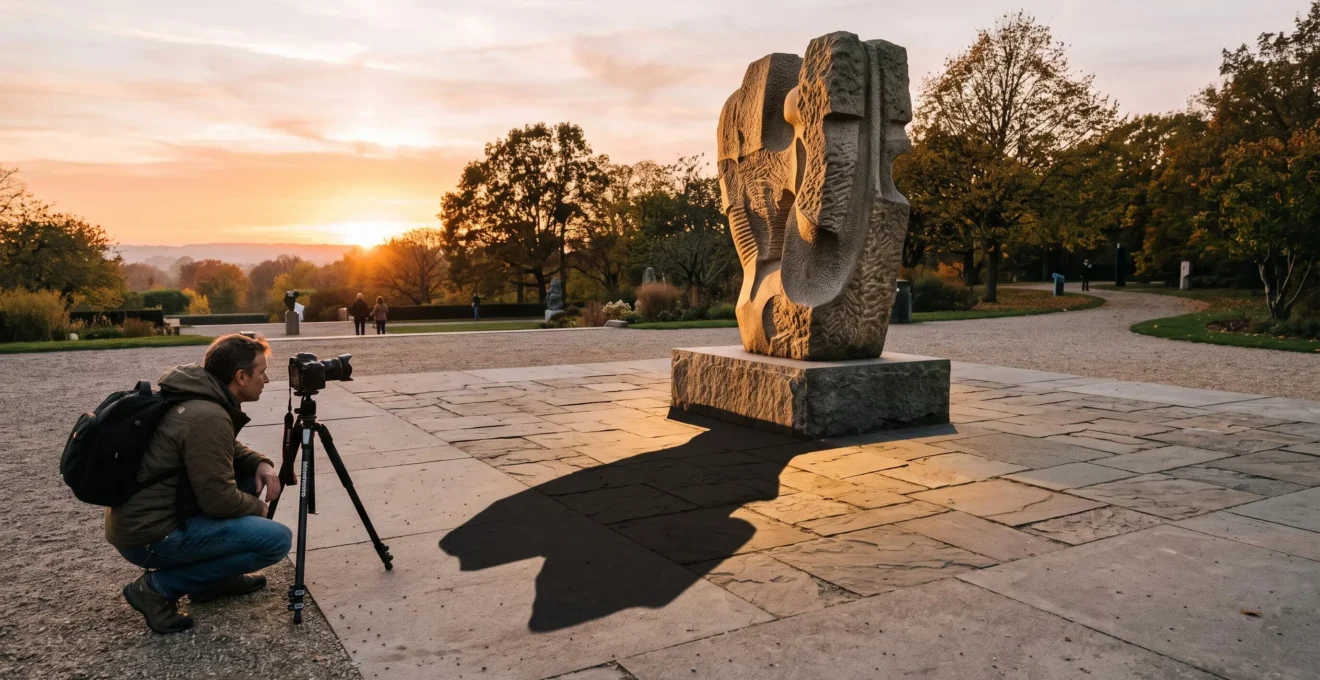
A sculpture does not have to move physically to appear different from one moment to the next. By changing the direction, intensity or position of its illumination, artists can transform its silhouette, expose hidden surface details and project new shapes onto surrounding walls and floors. The resulting shadows become an extension of the artwork rather than a secondary lighting effect.
For sculptors and exhibition designers, this approach offers a way to introduce movement, temporal variation and visitor participation without relying on large-scale projections or complex digital systems. A single directional light can reveal a carved surface, while a slowly rotating spotlight can make an otherwise static object appear to evolve continuously.
The most effective installations treat light, sculpture, shadow and viewing position as parts of one composition. Their success depends on understanding solar geometry, controlling contrast, choosing appropriate light sources and designing transitions that preserve the visitor’s attention. Dynamic shadows can therefore function as both an artistic medium and a practical exhibition-design strategy.
Dynamic Shadows in Sculptural Art: Key Principles
- Moving light changes the apparent silhouette, depth and texture of a sculpture, creating visual transformations without physically altering the object.
- Directional illumination produces more defined shadows, while diffused light softens contrast and improves the readability of overall form.
- Successful installations balance light movement, viewing conditions, visitor interaction and technical reliability to create an immersive physical experience.
- Why Do Sculpture Shadows Change Dramatically Near Sunset?
- How to Make a Rotating-Light Shadow Installation With Simple Equipment?
- Hard Light or Diffused Light: Which Reveals Carved Texture Better?
- How Multiple Spotlights Can Hide the Shape of a Sculpture
- When Should Visitors See a Sun-Activated Outdoor Installation?
- Why Does Shallow Relief Look Deeper Under Side Lighting?
- Why Do Abrupt Changes in Sound and Light Break Immersion?
- How to Create an Immersive Art Experience Beyond Large Projections?
Why Do Sculpture Shadows Change Dramatically Near Sunset?
Sculpture shadows become dramatically longer near sunset because sunlight reaches the ground at a much lower angle than it does around midday. For the same object height, a lower solar elevation produces a longer projected shadow, sometimes extending far beyond the sculpture’s immediate surroundings. This geometric transformation combines with changing atmospheric conditions to create a distinctive visual experience.
The relationship can be expressed through a simple geometric principle: for an idealised vertical object on level ground, shadow length increases as solar elevation decreases. The relationship is inversely proportional to the tangent of the Sun’s elevation angle. Consequently, a modest change in solar elevation can produce a substantial change in shadow length when the Sun approaches the horizon.
However, the visual transformation is not purely geometric. Sunset illumination also appears warmer because sunlight travels through a greater thickness of atmosphere, changing the balance of wavelengths reaching the observer. NASA Earth Observatory explains both the atmospheric scattering involved and the elongated shadows associated with low-angle sunlight in its explanation of crepuscular rays and light scattering.
For sculptors and photographers, this creates a limited daily opportunity. The useful window depends on the artwork’s height, orientation, surrounding surfaces, season and geographical latitude. A sculpture with intricate openings may produce particularly interesting projected patterns when the Sun reaches a suitable angle.
Solar planning tools can help identify candidate observation times. The timeanddate.com Sun Calculator provides solar altitude, azimuth, sunrise and sunset information for selected locations and dates. Its Sun Calculator instructions explain how to interpret these measurements. Solar position should then be checked against actual site conditions, including buildings, trees and terrain.
Atmospheric conditions matter just as much. An overcast sky distributes illumination across a broad area, filling shadows and reducing directional contrast. Haze can also soften the projected shape. Therefore, an evening appointment alone does not guarantee dramatic shadow movement: unobstructed direct sunlight is essential for a strongly defined effect.
Shadow length increases as solar elevation decreases
The geometric relationship depends on the object’s height and the Sun’s elevation angle. There is no universal noon-to-sunset multiplier applicable to every location and season.
Geometric principle consistent with the low-angle sunlight phenomena documented by NASA Earth Observatory.
Sunset should therefore be treated as a changing lighting condition rather than a fixed artistic effect. By observing the same sculpture at different solar elevations, designers can identify the precise moment when its shadow becomes an independent visual element.
How to Make a Rotating-Light Shadow Installation With Simple Equipment?
A rotating-light shadow installation can be built with a strong LED spotlight, a stable rotating mount, a freestanding sculpture and a plain projection wall. The light moves around the object, causing its cast shadow to travel across the wall. The result is a changing composition produced by physical illumination rather than digital projection, making it accessible to artists working with relatively simple equipment.
Begin with a sculpture that has a recognisable silhouette and interesting openings, protrusions or irregular contours. Position it between the spotlight and a matte wall. Aim the beam so that the sculpture creates a clearly visible shadow, then mount the lamp on a slow-rotating mechanism such as a motorised turntable, a rotating platform or a suitable motorised tripod head.
The installation should be calibrated before rotation begins. The distance between the lamp, sculpture and wall affects shadow size and sharpness. A relatively small, directional source produces more defined edges, while a broader source softens them. Moving the spotlight around the sculpture also changes the apparent proportions of the projected silhouette.
Rotation speed requires particular attention. If the lamp moves too quickly, the shadow becomes difficult to follow and the installation may feel restless. A slow, continuous movement allows visitors to observe how the projected form changes over time. The objective is not to create an arbitrary mechanical effect but to establish a visual rhythm.
Wall quality is another important consideration. A plain, matte, neutral-coloured surface preserves shadow contrast and avoids reflections that can compete with the projected form. Glossy paint and strongly textured surfaces may introduce unwanted highlights or visual interference.
Technical safety must be integrated into the construction. LED fixtures are often convenient because they generally produce less heat than comparable traditional lamps, but their actual operating temperature still depends on the fixture. Check manufacturer specifications, maintain appropriate clearance from paper and fabric sculptures, secure cables and ensure that the rotating mechanism cannot pull or twist its electrical connections.
An alternative is to keep the light fixed and rotate the sculpture on a turntable. This approach is particularly useful when the object itself has several interesting faces. However, it produces a different visual result: both the object’s visible silhouette and its shadow change together. Rotating only the light preserves the sculpture’s physical orientation while transforming its projected shadow.
A useful experimental sequence is to test the installation with the light stationary, mark the most interesting starting position, introduce slow rotation and compare the projected shapes at several positions. This makes it easier to distinguish an intentional visual transformation from an effect caused by unstable positioning.
Once the mechanical arrangement is stable, the artwork can become the centre of a continuous lighting performance. The simplest installations often provide the clearest results because visitors can immediately understand how a physical change in illumination creates a new shadow.
Hard Light or Diffused Light: Which Reveals Carved Texture Better?
Hard light reveals carved texture more dramatically when the objective is to emphasise grooves, edges and small surface variations. Its directional beam creates distinct shadows inside recessed areas, increasing the apparent depth of the carving. Diffused light, by contrast, reduces harsh contrast and makes the overall sculpture easier to read. The better choice depends on whether the artistic priority is texture definition or visual continuity.
Hard light typically comes from a relatively small apparent source. A distant spotlight or a compact LED fixture can create sharply defined shadows when positioned appropriately. On a carved sculpture, these shadows emphasise the boundaries between raised and recessed surfaces.
Diffused light comes from a larger apparent source or from illumination bounced off another surface. Because light arrives from multiple directions, small recesses receive more illumination and their shadows become softer. This can be beneficial for polished materials, broad sculptural volumes and installations where the viewer needs to understand the entire object without being distracted by every surface irregularity.
The choice is therefore not simply between good and bad lighting. It is a decision about the information that illumination should communicate.
| Lighting approach | Visual result | Most useful application |
|---|---|---|
| Hard directional light | Sharp shadows and pronounced surface contrast | Deep carving, intricate relief and dramatic shadow installations |
| Diffused light | Softer transitions and reduced shadow contrast | Smooth surfaces, polished materials and overall form readability |
| Hard key with soft fill | Defined texture with partially controlled shadows | Complex sculptures combining detailed carving and large volumes |
A practical example comes from conservation photography. The Metropolitan Museum of Art documents the use of directional illumination to emphasise surface topography in its examination of a painting. Its conservation examination of Portrait of a Young Girl illustrates how raking light can reveal raised areas and irregularities that are less apparent under more even illumination. Although the documented object is a painting rather than a sculpture, the underlying lighting principle is relevant to relief surfaces.
Excessive contrast can nevertheless become counterproductive. Very hard light may turn small recesses into dark patches, while polished stone or metal can produce specular reflections that obscure nearby detail. The apparent richness of the texture may increase even as the actual readability of the surface decreases.
For dynamic shadow installations, a combination of one dominant directional source and carefully controlled fill light can preserve texture while keeping the larger sculptural form legible. Moving the key light gradually also allows the audience to see how different surface features become visible or disappear.
Testing several angles before fixing the lighting design is more reliable than choosing maximum contrast by default. The most expressive result usually comes from controlling what the shadows reveal rather than making every surface detail equally prominent.
How Multiple Spotlights Can Hide the Shape of a Sculpture
Multiple spotlights can make a sculpture appear flatter when their beams illuminate it from several directions at similar intensities. Each source creates its own shadow, but the other sources partially fill those shadows. As contrast decreases, the sculpture loses some of the depth cues that help viewers understand its contours. Multiple lights do not automatically improve visibility: their relative intensity and position determine whether the result is coherent or visually confusing.
Consider a sculpture illuminated by one dominant spotlight. Its protrusions and recessed areas produce a relatively consistent pattern of highlights and shadows. The viewer can use this directional information to interpret the object’s depth and surface structure.
When additional spotlights are introduced from opposing directions, previously dark areas begin receiving light. Shadows overlap, become lighter or disappear. The object may remain evenly visible, but its three-dimensional structure can become harder to perceive.
This is particularly noticeable in galleries where several fixtures are installed to provide uniform visibility from different viewing positions. Such arrangements can be appropriate for general exhibition lighting, but they may conflict with an artistic intention based on a strong, singular shadow.
A practical diagnostic is to inspect the walls and floor around the artwork. If the sculpture produces several faint, overlapping shadows rather than one dominant readable shape, the lighting arrangement may be cancelling its own contrast. The usual correction is to establish a dominant key light and reduce the intensity of secondary sources.
However, multiple shadows can also become a deliberate artistic material. The Exploratorium‘s Colored Shadows exhibit demonstrates how red, green and blue spotlights can produce distinct visitor shadows and colour effects. When visitors interrupt different beams, the projected colours change. This is an intentional use of multiple light sources rather than an attempt to preserve a single sculptural silhouette.
The distinction is artistic control. Accidental shadow cancellation makes form ambiguous without a clear visual purpose. Intentional multiplication can create fragmentation, repetition and surreal spatial relationships.
Exhibition designers can also use asymmetric illumination: one strong directional source establishes the main sculptural shape, while weaker secondary lights provide enough visibility for visitors to appreciate the object from different angles. Auxiliary fixtures may also be dimmed during specific moments if the exhibition supports timed lighting changes.
Multiple light sources are therefore neither inherently beneficial nor inherently problematic. Their artistic value depends on whether the resulting shadow structure reinforces the sculpture’s intended appearance.
When Should Visitors See a Sun-Activated Outdoor Installation?
Visitors should see a sun-activated outdoor installation when the Sun reaches the elevation and direction required to produce its intended shadow composition. There is no universal best hour because the result depends on the sculpture’s geometry, orientation, geographical latitude, season and surroundings. The most reliable visiting schedule comes from testing the artwork at the actual site rather than relying on conventional sunrise or sunset times.
A sun-activated sculpture may depend on a specific alignment between the Sun, the object and a receiving surface. A hole in a metal structure might project a recognisable pattern only when sunlight enters from a particular direction. A carved stone form may create a dramatic shadow across the ground only when the solar elevation is sufficiently low.
These conditions can be anticipated using solar-position information. Solar altitude indicates the Sun’s vertical angle above the horizon, while solar azimuth describes its compass direction. Together, these measurements help artists identify candidate viewing periods and understand how the shadow direction will change throughout the day.
However, astronomical calculations are only the starting point. Nearby buildings, trees, terrain and seasonal changes in vegetation can obstruct sunlight. The receiving surface may also be affected by weather, reflected light and changes in the surrounding environment.
Before announcing public opening times, exhibition teams should conduct repeated observations at the intended location. Photographing the shadow at candidate hours across several days makes it possible to compare its length, direction and visual clarity. The resulting evidence can support a realistic visitor schedule.
The schedule should also account for visitor movement. If the installation requires people to stand at a particular viewpoint, signage should identify the appropriate position without unnecessarily revealing every aspect of the visual effect. A guided viewing moment can turn the alignment into an anticipated event rather than an inconvenient restriction.
Seasonal recalibration is equally important. The Sun’s apparent path changes throughout the year, so a time slot that works during one season may become ineffective later. Outdoor venues should maintain a clear-weather contingency plan and communicate when the intended shadow effect cannot be observed.
A Five-Step Planning Checklist for Sun-Activated Sculptures
- Identify the intended solar alignment by recording the sculpture’s orientation, height and receiving surface in a site plan.
- Consult a solar-position tool and save the candidate dates, solar altitude and azimuth in a planning document.
- Photograph the actual shadow at several candidate times and create a dated comparison record.
- Verify that surrounding buildings, vegetation and weather conditions do not consistently obstruct the required illumination.
- Publish a provisional visitor schedule with a clear-weather contingency and a documented seasonal review date.
A well-planned installation can also use time as part of its artistic language. Visitors who arrive just before a shadow completes its intended shape experience the changing alignment as an unfolding event. The waiting period becomes part of the encounter.
Ultimately, the ideal visiting window is the one demonstrated by the artwork itself. Direct observation, solar calculations and clear communication make the difference between a theoretically attractive installation and a consistently meaningful public experience.
Why Does Shallow Relief Look Deeper Under Side Lighting?
Shallow relief looks deeper under side lighting because a low-angle beam turns small differences in surface height into visible shadows. Recesses appear darker, raised areas catch more illumination and the resulting contrast makes the carving seem more pronounced. The actual physical depth remains unchanged, but the visual system interprets the pattern of shading as evidence of a more complex three-dimensional surface.
This technique is commonly described as raking light or grazing illumination. Rather than directing light towards the surface from the front, the designer positions the source at a low angle relative to the relief. Even a small raised feature can then cast a comparatively long shadow across the adjacent surface.
The geometric relationship is straightforward. For a fixed height difference, the projected shadow becomes longer as the angle of illumination approaches the surface. This explains why a relatively modest change in lamp position can dramatically alter the appearance of a low-relief sculpture.
The effect also depends on visual perception. Human observers interpret gradients, highlights and shadow boundaries as clues about shape. When the illumination creates consistent directional shading, shallow variations become easier to recognise as raised or recessed features.
There is, however, a trade-off. Raking light reveals surface irregularities that frontal or diffused illumination might conceal. Dust, small scratches, tool marks and accidental imperfections become more conspicuous. This can be desirable when the sculptor wants to communicate the process of carving, but problematic when the intention is to present a perfectly smooth surface.
Conservation specialists use directional lighting for a related reason: it makes surface topography easier to examine. The same principle can therefore serve both artistic presentation and technical inspection, although the purpose of the lighting differs.
For sculpture, a useful approach is to test the same relief under several conditions: frontal illumination for overall readability, low-angle side lighting for texture and a softer source for comparing the visual impact of the two. A movable lamp makes these differences immediately apparent without requiring permanent installation changes.
Dynamic illumination is particularly effective for shallow relief because small variations in the light angle can produce substantial changes in the visible shadow pattern. A surface that appears almost flat under even illumination can become visually sculptural as the light moves across it.
Shallow relief is therefore not necessarily a limitation in sculptural design. With carefully positioned directional light, it can offer an unusually responsive surface whose apparent depth evolves throughout the viewing experience.
Key Takeaways Before Designing an Immersive Installation
- Shadow movement should follow an intentional rhythm, with lighting and sound transitions designed as parts of the same experience.
- Visitor movement can become an active component of the artwork, but interaction must remain intuitive and spatially safe.
- Physical light installations require early consideration of room darkness, reflective surfaces, equipment reliability and maintenance.
Why Do Abrupt Changes in Sound and Light Break Immersion?
Abrupt changes in sound and light can break immersion because they redirect the visitor’s attention from the artwork towards the unexpected event itself. A sudden brightness change, loud mechanical noise or unexpected flicker can interrupt the continuity of an installation. The issue is not change itself: carefully timed transitions can strengthen an artwork, but changes that feel disconnected from its established rhythm can undermine the experience.
When visitors become absorbed in a sculptural environment, they gradually adapt to its visual and acoustic conditions. Their attention moves towards the relationships between the object, its shadows and the surrounding space. An unexpected stimulus can trigger an orienting response, drawing attention back to the environment and making the technical source of the interruption noticeable.
This distinction matters for installations built around moving illumination. A slow transition in which a shadow gradually crosses a wall can communicate transformation without forcing the viewer to reconsider the entire scene. An abrupt switch from darkness to full brightness may instead feel like a technical interruption.
Designed surprise is not necessarily disruptive. A sudden change can be meaningful when it follows an established visual or narrative logic. The important question is whether visitors can understand the change as part of the artwork, even if they did not anticipate it.
One practical method is to overlap transitions. A sound layer can gradually emerge before a light movement becomes visible, or the lighting can dim progressively rather than switching off immediately. These overlapping cues help the visitor perceive continuity between different stages of the experience.
Timing should also be tested from the visitor’s perspective. A transition that appears smooth when observed by a stationary designer may feel abrupt to someone entering the room, walking around the sculpture or changing their viewing position. Rehearsals should therefore reproduce realistic visitor movement.
Technical maintenance is another important factor. Failing lamps, unstable LED drivers, drifting timers, loose connections and unexpected mechanical noises can create changes that resemble intentional artistic gestures. HVAC systems and doors can also introduce distracting sound into an otherwise controlled environment.
A pre-opening technical rehearsal should evaluate the complete installation rather than checking each component in isolation. The aim is to identify moments when lighting, sound and mechanical movement become perceptually disconnected.
Immersion is not the absence of change. It is the visitor’s ability to remain connected to the artistic logic of the changes taking place. When transitions are intentional and technically reliable, movement becomes part of the experience rather than an interruption.
How to Create an Immersive Art Experience Beyond Large Projections?
An immersive art experience does not require a large projection system. Moving light on sculptural forms can transform walls, floors and even visitors’ own silhouettes into changing display surfaces. By coordinating illumination, physical objects, spatial movement and subtle sensory cues, exhibition designers can create an experience that engages visitors through their presence in the room rather than through a screen alone.
Dynamic shadows offer a particularly effective starting point because they connect the artwork directly to its surroundings. A sculpture illuminated from different angles produces changing silhouettes that extend beyond its physical boundaries. As the light moves, the entire room becomes part of the composition.
The visitor can also become part of the installation. When someone walks between a spotlight and a wall, their shadow may intersect with the sculpture’s projected silhouette. This creates an immediate relationship between human movement and the visual behaviour of the artwork.
The principle can be extended through a coordinated sensory design. A subtle sound layer may reinforce the rhythm of moving light, while changes in floor texture or carefully controlled environmental cues can strengthen the sense of place. These elements should support one another rather than compete for attention.
A useful orchestration strategy is to give each sensory channel a distinct role. Light can establish the primary visual transformation, sound can provide continuity and spatial texture, and the physical environment can encourage exploration. The installation becomes more coherent when these elements follow a shared theme and an intentional sequence.
Visitor agency is another important design consideration. An installation becomes more participatory when people can influence its appearance through movement, positioning or interaction with the environment. A visitor who discovers that their silhouette completes a projected shape may develop a stronger connection to the artwork than someone who only watches a predetermined lighting sequence.
The interaction should remain discoverable without requiring extensive instructions. Positioning the sculpture and light so that movement naturally changes the shadow can encourage exploration. The audience should be able to understand the relationship between their actions and the visual result through observation.
Physical installations also introduce constraints that large digital projections can sometimes avoid. Ambient light may weaken shadow contrast, reflective surfaces can introduce unwanted highlights and dim spaces require careful attention to visitor safety. Moving fixtures, electrical connections and rotating components must remain accessible for inspection and maintenance.
Accessibility should be considered from the beginning. Walking routes need to remain clear, changes in illumination should not create unexpected obstacles and the installation should remain understandable to visitors who cannot occupy every intended viewing position. A strong artistic effect should not depend on compromising safe movement through the space.
Maintenance is part of the experience’s long-term design. Lamps, drivers, rotating mechanisms and sound equipment require regular inspection. The installation should be tested under actual operating conditions so that its visual rhythm remains consistent throughout the exhibition period.
For sculptors and exhibition designers, the opportunity lies in treating illumination as a material in its own right. A carefully controlled beam can reveal a hidden surface, reshape a familiar silhouette and invite visitors to participate in the artwork. Rather than asking how large a projection needs to be, the more productive question is how light can make a physical space respond to the sculpture within it. Testing one directional source, one carefully chosen viewing surface and one gradual movement is a practical starting point for developing that experience.
What type of light creates the sharpest sculpture shadows?
A relatively small, directional light source generally produces sharper shadow edges than a large diffused source. A compact spotlight positioned appropriately can create strong silhouettes and emphasise carved details. The final result also depends on the distance between the light, sculpture and receiving surface, as well as the surrounding ambient illumination.
Can dynamic shadows work in a small exhibition space?
Yes. A small room can accommodate a shadow installation using a sculpture, a directional LED fixture and a plain wall. The designer needs to control ambient light, allow sufficient space for the projected shadow and keep visitor circulation clear. A rotating mount is optional because moving the light manually or rotating the sculpture can also create changing silhouettes.
How can sculptors make shadows part of the artwork rather than a secondary effect?
Sculptors can design openings, recesses, protrusions and irregular contours that generate distinctive projected shapes. The lighting direction and receiving surface should be considered during the sculptural design process. Testing the object under different light angles helps identify which shadow patterns contribute most effectively to the intended composition.
Does natural sunlight work better than artificial lighting for outdoor shadow installations?
Neither is universally better. Natural sunlight offers changing solar angles and seasonal variation, creating effects that evolve throughout the day and year. Artificial lighting offers greater control over direction, intensity and timing. The choice depends on whether the artwork is intended to respond to natural conditions or provide a repeatable lighting experience.
How can visitors interact with a shadow-based sculpture installation?
Visitors can influence the projected composition by changing their position between the light source and the receiving surface, walking around the sculpture or observing how their own silhouettes overlap with its shadow. Multiple coloured light sources can also create interactive shadow effects, as demonstrated by the Exploratorium’s Colored Shadows exhibit.