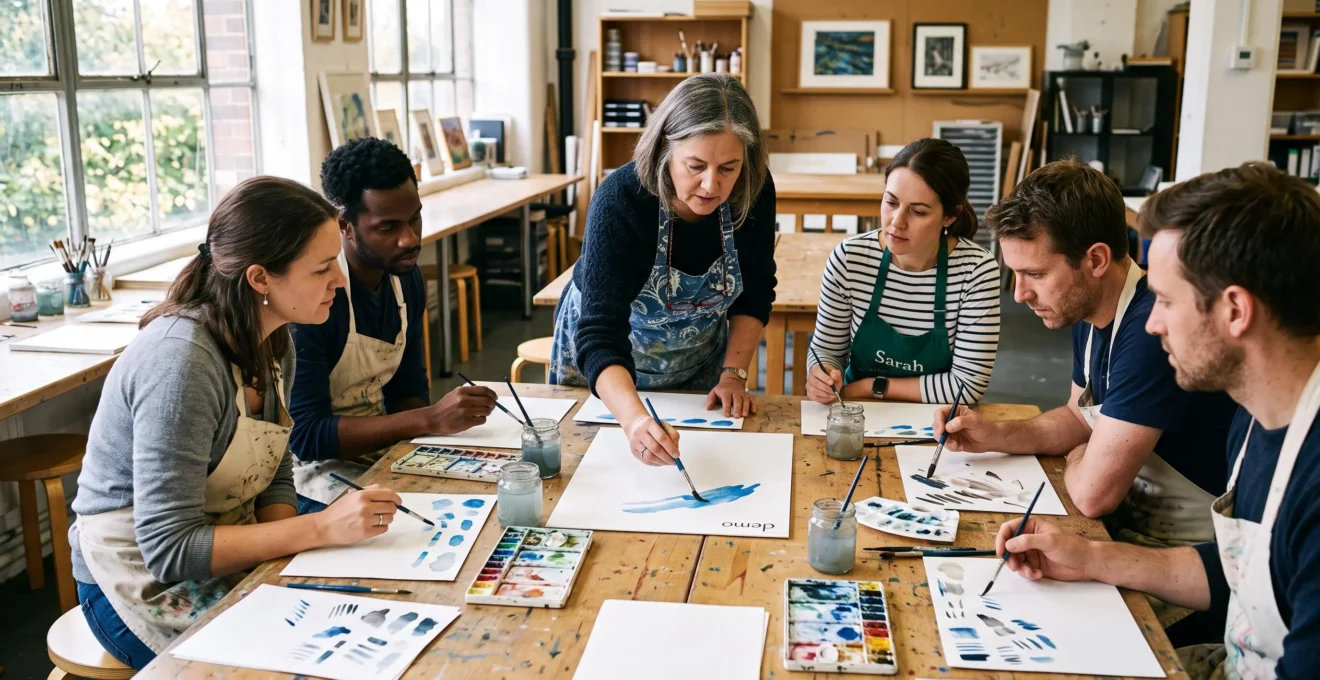
Beginner art workshops become more effective when participants spend less time waiting for instruction and more time making, testing and adjusting their own work. A well-designed session combines focused demonstrations, manageable practical challenges, opportunities for peer learning and feedback delivered at the moment it can make a difference.
The central objective is not simply to help participants complete an attractive painting, drawing or sculpture. It is to develop enough technical understanding and confidence for them to repeat a process without constant instructor assistance.
Achieving that outcome requires deliberate decisions about how workshop time is allocated. A demonstration can explain a difficult movement, but participants still need to perform it. Group activities can encourage experimentation, but only when different ability levels receive appropriate support. Feedback can correct mistakes, but poorly timed intervention may interrupt concentration.
The following methods provide practical ways to structure beginner art workshops while adapting instruction to different materials, abilities and community settings.
Effective beginner art workshop methods at a glance
- Use brief, focused demonstrations followed immediately by practical attempts, rather than explaining an entire process before participants begin.
- Organise manageable technique stations and differentiated challenges so beginners can practise independently while receiving appropriate support.
- Review progress at natural transition points and evaluate learning through observable skills, experimentation and independent re-attempts.
- Why Do Long Art Demonstrations Reduce Hands-On Learning Time?
- How to Organise Three Technique Stations in a Beginner Art Workshop?
- Demonstration or Discovery-Based Learning for Adult Art Beginners?
- Why Mixed-Skill Art Workshops Can Leave Beginners Behind
- When Should an Art Instructor Review Participants’ Progress?
- How to Evaluate What Worked After a Practical Art Experiment?
- How to Run an Intergenerational Art Workshop in a Community Centre?
- How Does Hands-On Experimentation Improve Artistic Skills?
Why Do Long Art Demonstrations Reduce Hands-On Learning Time?
Long art demonstrations reduce hands-on learning opportunities because they occupy the same limited session time participants need to practise new movements. They can also overwhelm beginners with unfamiliar instructions before those instructions are applied. Short demonstrations followed by immediate practice make it easier to connect observation with action while preserving time for experimentation and feedback.
The issue is not that demonstrations are ineffective. Observing an experienced artist can clarify tool handling, material behaviour and the sequence of a technique. The problem arises when an instructor attempts to cover every detail before learners have made their first mark.
Consider a hypothetical 90-minute watercolour workshop. A 30-minute demonstration leaves 60 minutes for everything else, including practice, questions, setup and cleanup. Replacing that initial presentation with several shorter demonstrations does not automatically improve learning, but it allows participants to practise each technique while the explanation remains relevant.
Working memory also matters. The scientific review of cognitive load theory in professional education by Jeroen J. G. van Merriënboer and John Sweller explains why instructional complexity must be managed according to learners’ prior knowledge. Although the review concerns health professional education, its principles provide a useful rationale for simplifying initial art instruction.
A beginner learning watercolour washes might first watch how to load a brush, practise that movement, then observe how to distribute pigment across damp paper. This just-in-time demonstration approach contrasts with a complete demonstration that introduces loading, blending, layering and correction before anyone begins.
Extended demonstrations may also create an unintended expectation that participants should reproduce the instructor’s artwork precisely. That can discourage independent decisions, particularly among learners already uncertain about their abilities.
The next challenge is ensuring that participants can continue practising without waiting for further instructions. Well-organised technique stations offer one practical solution.
How to Organise Three Technique Stations in a Beginner Art Workshop?
Organise three technique stations by assigning each one a clear learning objective, preparing the necessary materials and establishing a predictable rotation system. Begin with accessible tasks, allow enough time for meaningful practice and place instructor-intensive activities where additional support is available. Three stations are a practical option, not a universal requirement for successful workshops.
Before selecting the number of stations, estimate how much usable activity time remains after orientation, transitions and cleanup. Divide that time into practice periods long enough for participants to attempt a technique, notice the result and make an adjustment. If the activities are complex or the workshop is short, two stations may be more effective than three.
In a hypothetical beginner mixed-media session, the stations could be arranged as follows:
| Station | Practical activity | Learning objective | Instructor involvement |
|---|---|---|---|
| 1. Mark-making | Experiment with pencil pressure and line variation. | Recognise how pressure affects visual marks. | Minimal after introduction. |
| 2. Colour application | Compare brush loads and colour intensity. | Control material distribution. | Occasional troubleshooting. |
| 3. Layering | Combine marks and colour in a small composition. | Apply techniques together. | Targeted guidance on sequencing and materials. |
This progression moves from relatively independent tasks towards an activity that may generate more questions. If stations contain techniques that can be completed in any order, groups can rotate freely. Where one technique depends on another, arrange the sequence accordingly or provide an introductory activity that establishes the prerequisite skill.
Set up complete material kits before participants arrive. Provide a clear instruction card at each table, preferably with one central action and a visible example of the intended experiment. Use an agreed signal for rotation and tell participants where their work should remain when they move.
Station groups can also become opportunities for peer learning. CAST guidelines on collaboration and collective learning recommend clear group roles, shared goals and structured peer support. In an art workshop, these principles can be applied by asking participants to discuss materials, compare outcomes and help one another solve straightforward problems.
Mixing confidence levels may be useful when responsibilities remain balanced. An experienced participant should not automatically become the group’s permanent instructor, and every participant needs access to the tools and a genuine opportunity to attempt the technique.
Five steps to prepare a technique-station workshop
- Define the learning outcome. Write one observable skill objective for each station on a planning sheet.
- Allocate practical time. Produce a session timetable showing demonstrations, rotations, practice periods and cleanup.
- Prepare equivalent material access. Complete a station inventory confirming that every participant can use the required tools.
- Create independent instructions. Place one clear activity card and an appropriate example at each station.
- Test the rotation. Walk through the participant route and document the movement signal, group assignments and any accessibility adjustments.
Stations make learning more independent, but their effectiveness still depends on the instructional approach used within each activity. Some techniques require guidance before exploration begins.
Demonstration or Discovery-Based Learning for Adult Art Beginners?
Adult art beginners generally benefit from a combination of demonstration and discovery-based learning. Demonstrations are especially useful when correct tool handling, safety or material preparation matters. Discovery is more suitable for expressive decisions and techniques with multiple acceptable outcomes. A practical hybrid begins with focused guidance, followed by an independent attempt and controlled experimentation.
The choice should depend on the learning task rather than an instructor’s preference for a particular teaching philosophy.
For example, demonstrating safe cutting techniques or the correct handling of unfamiliar equipment helps establish necessary boundaries. By contrast, selecting colours, arranging shapes or developing expressive textures leaves room for personal discovery.
The following decision grid helps distinguish the two approaches.
| Decision criterion | Demonstration first | Discovery first |
|---|---|---|
| Safety | Incorrect handling could cause harm. | Experimentation presents minimal foreseeable risk. |
| Material cost | Incorrect preparation could waste expensive materials. | Materials are reusable or inexpensive to test. |
| Learning objective | Acquire a specific handling technique. | Explore composition, texture or expressive choices. |
| Participant confidence | Beginners need an initial model to start. | Participants can make an attempt without detailed guidance. |
| Successful outcome | A particular process needs to be performed reliably. | Multiple approaches can produce worthwhile results. |
A practical hybrid sequence for teaching brush control might begin with a short explanation of why pressure changes mark width. Participants then reproduce the movement once before exploring alternative pressures, speeds or angles.
Explaining why a technique works can be especially useful when adult learners bring previous experiences, established habits or clear personal goals. However, instructors should not assume that every adult needs more explanation than a child. Prior experience, task complexity and confidence are more useful guides than age alone.
Pure demonstration can produce careful copies without helping participants decide what to do independently. Pure discovery, meanwhile, can leave inexperienced adults uncertain about where to begin. Public failure may feel uncomfortable when a participant believes everyone else understands the task.
The practical test is straightforward: if a mistake would be dangerous or waste valuable materials, demonstrate the essential process first. If the likely consequence is simply an unexpected artistic result, make room for exploration.
Neither method works equally well for everyone in a mixed group. Once the instructional approach is chosen, instructors must ensure that more experienced participants do not unintentionally determine the pace for beginners.
Why Mixed-Skill Art Workshops Can Leave Beginners Behind
Mixed-skill art workshops can disadvantage beginners when instruction, group pace and feedback become dominated by participants with greater experience. Beginners may stop asking questions, imitate more confident artists or disengage without attracting attention. Differentiated challenges, accessible starting tasks and discreet instructor check-ins help maintain meaningful participation across ability levels.
The problem often develops gradually. An experienced participant asks about an advanced blending technique, and the instructor offers a detailed explanation. Other experienced participants join the conversation while newcomers remain focused on understanding the first step.
Without deliberate adjustment, the workshop can become an informal advanced class even though everyone registered for the same beginner-friendly activity.
Faster participants may also influence the social environment. Someone who finishes early might occupy shared equipment, offer unsolicited corrections or become an intimidating comparison point. These behaviours are not inevitable, but they are worth anticipating when planning group activities.
Tiered tasks provide a practical response. Rather than assigning different subjects to different ability groups, give participants the same central theme with progressively greater technical demands.
For a botanical drawing workshop, for instance, everyone could draw the same plant. Beginners might focus on observing basic shapes and line direction, while more experienced participants explore overlapping forms, shading and tonal transitions.
Before the session, ask neutral questions such as « Have you used this medium before? » and « Would you prefer to practise the fundamentals or explore an additional challenge? » These questions help instructors prepare support without publicly labelling anyone as less capable.
Initial warm-ups should also allow everyone to start without requiring specialist knowledge. Free mark-making, texture exploration or drawing with an unfamiliar tool can temporarily reduce the advantage of prior experience.
During practical work, watch for quieter indicators of difficulty:
- A participant repeatedly copies a neighbour rather than continuing their own experiment.
- Someone erases the same area without attempting an alternative approach.
- A beginner stops handling materials while others continue working.
- A participant begins packing away well before the activity ends.
These behaviours are possible signals, not reliable diagnoses. A private question such as « Which part of the technique would you like to try differently? » is more informative than publicly announcing that someone needs help.
Pairing can support learners when both participants retain an active role. Short exchanges between people with different experience levels are preferable to arrangements where the confident participant performs the task for the beginner.
Once differentiated tasks are in place, progress reviews become the main way to detect whether learners are developing confidence or encountering obstacles that require intervention.
When Should an Art Instructor Review Participants’ Progress?
Art instructors should review progress shortly after a beginner’s first practical attempt and at natural transitions between activities. Early checks can identify incorrect tool handling before it becomes habitual, while later reviews can focus on creative decisions and independence. Feedback is most useful when it responds to a clear learning need without unnecessarily interrupting concentration.
A fixed schedule of constant corrections is rarely appropriate for every participant. Someone experimenting thoughtfully with several brush movements may benefit from uninterrupted practice. Another learner who repeatedly freezes or erases the same area may need immediate assistance.
The distinction is between productive struggle and unproductive struggle.
Productive struggle involves deliberate attempts, visible variations and continuing attention to the task. The participant may not be satisfied with the result, but they are still generating information through practice.
Unproductive struggle is more likely when attempts stop producing new approaches. Repeatedly restarting without changing technique, abandoning materials or waiting indefinitely for reassurance suggests that a brief check-in may help.
Instructors can use three natural review moments:
- After the first attempt: check basic grip, material handling and understanding of the objective.
- At a station rotation or technique transition: ask what changed, what worked and what participants want to test next.
- Before independent completion: shift attention towards artistic intention, decision-making and the ability to continue without guidance.
These are flexible checkpoints, not mandatory interruptions. A participant deeply engaged in an effective experiment may need no immediate intervention.
Feedback should describe an observable action rather than judge the participant’s ability. For example, « The brush released more water when you increased pressure » gives the learner information they can test. « Your technique is wrong » offers little guidance about how to improve.
Mid-session public critiques can increase comparison and discourage quieter participants from discussing unfinished work. Individual feedback is generally more suitable for early technical difficulties.
When a group review is valuable, focus on observations instead of rankings. Ask « What happened when you changed the amount of water? » or « Which mark would you like to investigate further? » This encourages reflection without requiring participants to defend the quality of their artwork.
Feedback becomes more valuable when its effects are documented. Reviewing the workshop afterwards helps identify which interventions supported genuine learning and which simply made the session feel well organised.
How to Evaluate What Worked After a Practical Art Experiment?
Evaluate a practical art experiment by examining what participants attempted, what they learned and what they would change. Combine their reflections with observable evidence of independent technique use. A successful workshop should develop skills that participants can apply again, not merely produce attractive artwork or receive positive satisfaction ratings.
A useful evaluation begins with three questions asked in a consistent order:
- What did participants actually do? Record the techniques attempted, opportunities for practice and whether learners worked independently.
- What did participants produce or notice? Identify visible changes in technique, observations about materials and decisions made during experimentation.
- What would participants change? Ask about confusing instructions, insufficient practice, unhelpful group arrangements or techniques worth exploring again.
Beginning with actions helps distinguish what happened from what participants intended to do. Examining outcomes then connects practice to learning. The final question turns feedback into a practical source of improvements for the next session.
Finished artworks provide only partial evidence. A participant may complete an impressive piece after receiving continuous instructor assistance but remain unable to begin a similar task alone.
A simple independent re-attempt offers a more informative check. At the beginning of a subsequent session, invite participants to repeat a previously introduced technique without a fresh demonstration. Alternatively, offer a voluntary take-home activity that asks them to recreate a process from memory.
Record whether they can select materials, begin the movement and adjust the result without step-by-step guidance. This is a practical workshop assessment, not a validated standardised test.
Enjoyment should still be considered, particularly because positive experiences may encourage continued attendance. However, satisfaction and technical progress measure different things. A workshop can be enjoyable while leaving participants with limited independent practice, just as a demanding session can produce worthwhile learning without universal satisfaction.
Pair participant feedback with a simple observational indicator, such as the approximate amount of active practice per learner or the number of self-initiated technique attempts. Avoid interpreting either measure as a complete account of learning.
Finally, make evaluation actionable. If participants spent too long waiting, simplify demonstrations or redistribute materials. If beginners struggled at one station, revise its instructions or assign additional support. If confidence declined in mixed groups, change the task levels or collaboration arrangements.
This feedback loop becomes particularly important when workshops bring together participants with different ages, physical needs and expectations of collaborative learning.
How to Run an Intergenerational Art Workshop in a Community Centre?
Run an intergenerational art workshop around a shared creative goal, accessible materials and balanced opportunities for participation. Rather than assigning older participants teaching roles and younger participants learning roles, structure activities so everyone contributes ideas and practical work. Adjust seating, tools, pacing and feedback to accommodate different needs without making age the measure of ability.
Intergenerational groups can bring together participants with different experiences, motivations and expectations. Some may value social connection or shared creativity, while others prioritise learning an unfamiliar medium. These preferences should be explored rather than assumed from age.
Introduce the workshop as a collaborative activity in which participants learn through exchanging perspectives. A shared drawing, community mural or collective printmaking project can provide a common purpose without requiring everyone to perform identical technical tasks.
A systematic review of intergenerational programmes by Caroline Giraudeau and Nathalie Bailly examined 11 studies, including three involving artistic activities. Some programmes reported benefits for younger or older participants, but positive outcomes were not systematic. The review supports paying attention to meaningful activities and programme organisation rather than assuming that mixing generations automatically creates positive results.
Rotating collaborative roles is one practical way to encourage balanced involvement. In a paired drawing activity, one participant might select the composition while the other develops initial marks. During the next stage, they exchange responsibilities. Both should also have opportunities to contribute directly to the artwork.
Community centre accessibility should shape activity selection from the beginning. Consider adjustable or suitable table heights, stable seating, unobstructed movement routes and sufficient lighting. Larger drawing tools, adaptable grips and easy-to-handle materials can support participants with different levels of dexterity.
Ask participants about their practical needs rather than assigning adaptations automatically based on age. A younger participant may need accessible tools, while an older participant may have extensive technical experience and no additional physical requirements.
Station rotations may need additional transition time when movement is difficult. Bringing materials to seated groups can sometimes be preferable to asking every participant to move between tables.
Progress reviews should also reflect the collaborative task. Ask each partner what they contributed, what they noticed and what they would like to try next, rather than evaluating whether one generation taught the other successfully.
These adjustments reinforce a wider principle: effective workshop design should maximise opportunities to act, observe and make choices. That principle explains why practical experimentation is central to artistic skill development.
Key takeaways for workshop design
- Judge activities by whether participants can make useful decisions without continuous instructor direction, not only by the appearance of completed work.
- Protect opportunities to adjust technique after observing results; mistakes can provide information when participants have room to respond.
- Design an achievable early experiment that gives each beginner a meaningful experience of producing something independently.
How Does Hands-On Experimentation Improve Artistic Skills?
Hands-on experimentation improves artistic skills by allowing learners to connect physical movements with visible and sensory results. Each attempt produces information about tool pressure, material behaviour, timing or composition. When beginners deliberately vary their approach and observe what changes, they develop more adaptable skills than they would through observation or mechanical repetition alone.
Many artistic techniques involve procedural learning: developing the ability to perform an action rather than simply describe it. Knowing that brush pressure affects line width is different from controlling that pressure consistently while painting.
A scientific review of motor skill learning and performance by Gabriele Wulf, Charles Shea and Rebecca Lewthwaite discusses observational practice, attentional focus, feedback and learner control as influences on motor learning. Its findings suggest that observing a movement and physically practising it can complement one another.
The review is not a controlled comparison of visual-art workshops, and it does not prescribe a particular number of practice attempts or demonstration length. Nevertheless, its principles help explain the instructional value of combining guidance with opportunities for independent physical practice.
Consider a beginner learning to paint a controlled brush stroke. Repeating an identical movement can help establish familiarity. However, deliberate variation reveals how the technique responds to different conditions.
Instead of asking participants to produce one perfect stroke, an instructor could give them a simple experiment:
- Make a stroke using light brush pressure.
- Repeat the movement with greater pressure.
- Change the speed while keeping the brush load similar.
- Compare the marks and describe what changed.
- Choose a variation and apply it independently to a small composition.
This exercise is a suggested teaching activity, not a research-validated protocol. Its purpose is to make the relationship between action and outcome visible.
Deliberate experimentation differs from random repetition because each variation answers a question. Participants are not simply making more marks; they are discovering which adjustments produce particular effects.
That process also explains the value of the earlier workshop methods. Short demonstrations provide enough initial guidance to begin. Technique stations create structured opportunities to compare approaches. Well-timed feedback helps learners interpret difficulties without replacing their own decisions.
Early independent success can have an important motivational role. A beginner who discovers how to create a desired texture or control a line has experienced a specific capability they can practise again. Instructors can encourage this by setting an achievable opening task without demanding a polished result.
Over time, the meaningful outcome is not simply completing more workshops. It is becoming increasingly able to select a technique, test an approach, identify an unexpected result and decide what to change.
For the next workshop, select one technique and design a short demonstration followed by three purposeful variations and a brief independent re-attempt. Observe what participants can accomplish without further instructions, then use those observations to refine the following session.
How much of a beginner art workshop should involve practical activities?
There is no universally established percentage of workshop time that should be devoted to practical work. Allocate sufficient time for participants to attempt each technique, observe the result and make adjustments. Keep demonstrations proportionate to task complexity, safety requirements and participants’ existing skills. Record actual practice time during early sessions and adjust the format based on what learners accomplish.
What materials are suitable for a first beginner art workshop?
Choose materials that are safe for the intended participants, manageable to prepare and suitable for repeated experimentation. Pencils, paper, water-based paints and simple mark-making tools can support introductory exercises when appropriate to the setting. Consider cost, cleanup, accessibility and any relevant product safety instructions. The best choice is the material that allows learners to explore the intended skill without unnecessary logistical or technical barriers.
Should beginners be allowed to choose their own artistic projects?
Participant choice can support autonomy when essential techniques and safety requirements remain clear. Offer a common starting exercise followed by limited creative options, such as choosing a subject, colour palette or texture. Beginners who need more direction can follow an example, while others explore alternatives. The amount of choice should reflect the learner’s confidence and the complexity of the task.
How can instructors assess artistic progress without grading finished artwork?
Observe whether participants can prepare materials, attempt a technique, recognise its effects and make an informed adjustment. Compare their initial and later attempts against the same learning objective rather than against other participants’ work. A brief independent task can reveal whether a learner understands the process without relying on a fresh demonstration.
What should an instructor do when a participant finishes much earlier than everyone else?
Offer an optional extension that deepens the same learning objective instead of introducing an unrelated activity. For example, a participant who has completed a basic shading exercise could investigate a different light direction or surface texture. Avoid automatically assigning early finishers to teach their peers. Peer assistance should be invited, clearly defined and balanced with each participant’s own opportunity to learn.