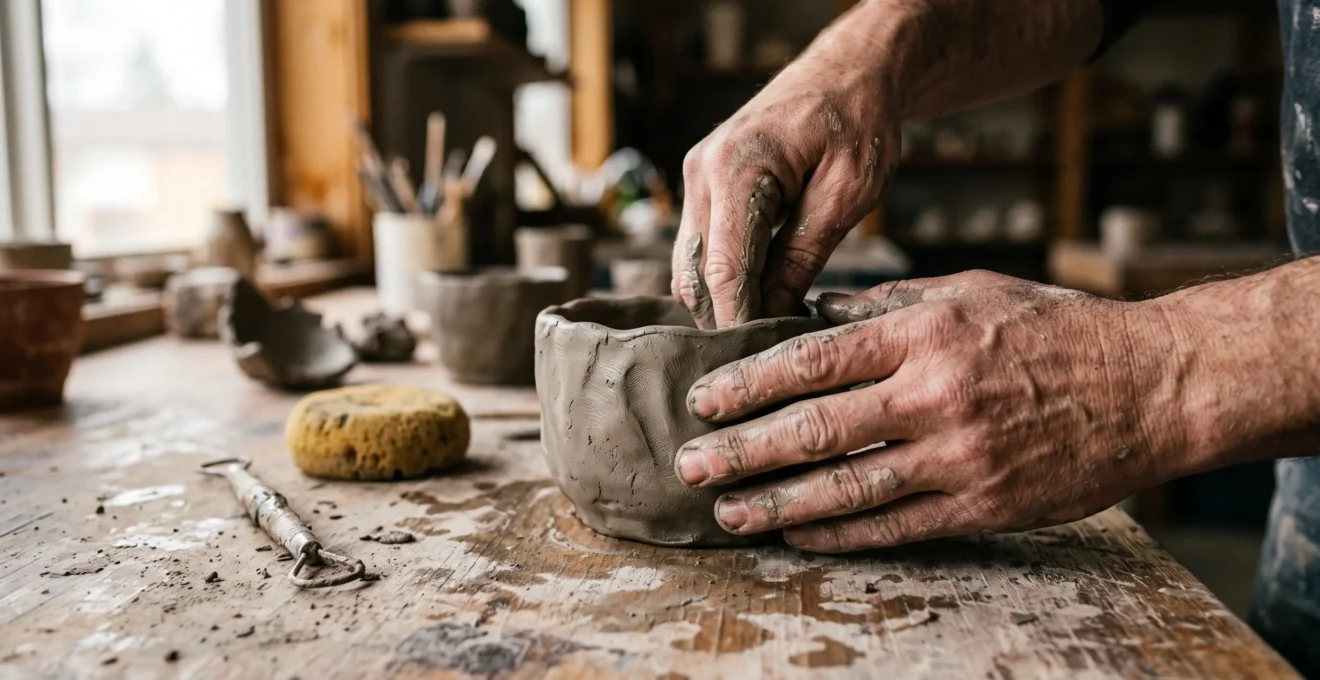
Artistic ability develops through more than observation and instruction. It grows when learners make decisions, handle materials, encounter unexpected results and adjust their approach. Hands-on experimentation turns artistic ideas into practical experiences, helping beginners understand not only how an artwork is made but also why particular techniques work.
For art beginners and hobbyists, this process offers a practical route towards creative confidence. Shaping clay, constructing recycled cardboard sculptures or testing different drawing techniques provides immediate feedback that cannot always be obtained by watching demonstrations or reading instructions. Each attempt reveals something about materials, proportions, structure and personal preferences.
The key is to treat experimentation as a learning process rather than a performance. A collapsed sculpture or an uneven shape can provide useful information when the learner identifies what happened and decides what to change. With appropriately challenging exercises, regular feedback and reflection, practical discovery becomes a foundation for more independent artistic decisions.
Hands-On Experimentation: The Essential Takeaways
- Direct contact with artistic materials develops practical awareness of texture, resistance, structure and physical properties.
- Accessible materials such as clay, cardboard and paper make it easier to experiment without worrying about wasting expensive supplies.
- Combining short demonstrations, guided exercises, independent exploration and reflection helps beginners build confidence progressively.
- Why Does Working Directly With Clay Improve Material Awareness?
- How to Explore Sculpture With Recycled Cardboard and Paper?
- Guided Tasks or Free Exploration for First-Time Art Learners?
- Why Difficult First Projects Can Discourage New Art Learners
- How to Evaluate What Worked After a Practical Art Experiment?
- Demonstration or Discovery-Based Learning for Adult Art Beginners?
- Why Long Art Demonstrations Reduce Hands-On Learning Time
- Which Traditional Art Skills Are Still Valuable for Modern Artists?
Why Does Working Directly With Clay Improve Material Awareness?
Working directly with clay improves material awareness because the hands receive continuous physical feedback about resistance, moisture, weight and shape. As beginners press, stretch and reshape the material, they learn to recognise how their actions affect its behaviour. This sensory information helps develop practical judgment that visual observation or theoretical instruction alone cannot provide.
Clay is particularly useful because its properties change visibly in response to relatively small adjustments. Press too hard and a thin wall may collapse. Add too much water and a previously stable form may become difficult to support. Work with insufficient moisture and the surface may crack during shaping or drying.
These experiences reveal the difference between knowing about a material and knowing how to work with it. Reading that clay responds to moisture provides information, but discovering how a specific mixture behaves under the fingers develops a more practical understanding.
Direct experimentation also makes artistic decisions more deliberate. Instead of following a memorised sequence, learners begin recognising when to apply pressure, when to support a structure and when to stop manipulating a fragile surface.
Material awareness can inform other creative activities, although improvement does not transfer automatically between disciplines. The sensitivity developed through clay handling may encourage more thoughtful decisions about pressure, structure and surface when drawing, painting or designing. Each medium still requires its own practice.
A simple first-session exercise can make this discovery manageable:
- Choose one small form, such as a simple bowl or rounded vessel.
- Limit the session to three tools, such as a shaping tool, a sponge and a small cutting tool.
- Make the same basic shape three times.
- Notice differences in pressure, moisture, thickness and stability.
- Compare the attempts to identify what changed and why.
The objective is not to produce three attractive objects. It is to observe how the material responds to repeated actions. Keeping the shape relatively constant makes it easier to notice the influence of individual adjustments.
Once learners become comfortable exploring a material’s physical behaviour, they can apply the same experimental mindset to other accessible media. Recycled cardboard and paper offer a different set of structural challenges without requiring specialist equipment.
How to Explore Sculpture With Recycled Cardboard and Paper?
Recycled cardboard and paper provide an accessible way to explore sculpture because they allow beginners to build three-dimensional forms using inexpensive, readily available materials. Cutting, folding, bending and joining sheets teaches structural thinking through immediate physical results. These materials are particularly useful for learning how flat surfaces become volumes and how connections influence stability.
Unlike clay, which can be shaped continuously, cardboard introduces a more geometric approach to making. A flat sheet must be transformed through deliberate cuts, folds and connections. This encourages learners to think about dimensions, angles, balance and the relationship between individual components.
It also reduces the psychological pressure associated with experimentation. When working with discarded packaging, unsuccessful attempts can usually be recycled or reused. This makes it easier to test unconventional ideas without worrying about wasting expensive materials.
The best approach is to introduce structural concepts progressively rather than attempting a complex sculpture immediately.
Start with flat constructions. Cut simple geometric shapes and arrange them into a composition. This develops cutting precision and encourages attention to proportion.
Introduce folds and tabs. Fold cardboard along selected lines and use tabs to connect individual pieces. Learners begin understanding how a flat surface gains volume and how folds influence rigidity.
Explore load-bearing joints. Create simple supports using slots, interlocking sections or folded connections. Observe which arrangements remain upright and which deform under their own weight.
This progression isolates different challenges. Beginners can concentrate on cutting accuracy before introducing more complicated connections or balancing problems.
Cardboard also teaches skills that clay does not emphasise in the same way. These include planar thinking, cutting accuracy, joint construction and the translation of two-dimensional surfaces into three-dimensional objects. Such abilities are relevant to model-making, product design, architectural exploration and other creative disciplines.
Documentation is another important part of the exercise. Before dismantling or recycling an unsuccessful construction, photograph it from several angles. Capture the front, side and top whenever these views reveal useful structural information. The photographs preserve evidence of the process even when the physical sculpture no longer exists.
A useful experiment might involve building three small structures from the same cardboard supply, changing only the joining method. The comparison can reveal how different connections influence stability without introducing too many variables at once.
Material choice alone, however, does not determine how effectively beginners learn. The amount of guidance provided during an exercise also influences whether experimentation feels manageable or overwhelming.
Guided Tasks or Free Exploration for First-Time Art Learners?
Guided tasks and free exploration can both help first-time art learners develop artistic skills, but they serve different purposes. Guided exercises provide structure and reduce uncertainty, while independent exploration encourages personal decisions and creative ownership. A combination of the two is often a practical starting point because beginners can develop confidence before gradually taking greater control of their work.
Guided learning is especially helpful when a learner does not know where to begin. A task such as creating a small clay form using a single shaping technique establishes a clear objective. The learner can concentrate on understanding the material instead of making numerous decisions simultaneously.
However, relying exclusively on instructions has a potential disadvantage. Beginners may become comfortable reproducing demonstrated results without learning how to adapt techniques when materials or circumstances change.
Free exploration presents the opposite challenge. Learners can choose their own forms, methods and materials, which encourages experimentation and personal expression. Yet someone facing an unfamiliar material without any reference point may struggle to identify what to try first.
The educational framework discussed in the National Research Council‘s chapter on learning environments highlights the importance of considering learner needs, subject knowledge and assessment together. It also cautions against assuming that one instructional approach works equally well for every learning objective.
A practical solution is to introduce autonomy gradually.
- Begin with one constraint: select a single material and one technique.
- Complete a guided attempt: follow a simple instruction to understand the basic process.
- Repeat with one change: modify the shape, pressure or construction method.
- Introduce a personal decision: let the learner choose one aspect of the next attempt.
- Review the result: identify which decisions produced useful discoveries.
This approach creates a bridge between instruction and independent artistic judgment.
Beginners can also use their own reactions to identify the most appropriate starting point. Someone who freezes when facing a blank page may benefit from a guided exercise with a clearly defined first step. Someone who becomes frustrated by rigid instructions may prefer an open task with just one constraint, such as using only recycled paper.
The distinction matters because early difficulties are not necessarily evidence of insufficient talent. Without reference points, beginners may interpret normal technical problems as personal shortcomings. Small guided exercises provide opportunities to recognise progress and understand that mistakes are part of learning.
At the same time, guidance should not eliminate every uncertainty. Artistic development requires opportunities to make choices, test alternatives and discover individual preferences.
Choosing the right learning method is only part of the process. The difficulty of the project itself must also match the learner’s current abilities, particularly during the first experiences with an unfamiliar medium.
Why Difficult First Projects Can Discourage New Art Learners
Difficult first projects can discourage new art learners because ambitious expectations often exceed their current technical abilities. When the finished object looks very different from the intended result, beginners may interpret the gap as a lack of artistic talent. A smaller project with a manageable challenge makes it easier to recognise progress and treat mistakes as useful information.
One common problem is choosing a first project based on a polished image found online. A complex ceramic sculpture, detailed illustration or elaborate recycled-material installation may appear straightforward when viewed as a finished object. However, the image hides the accumulated experience, planning and unsuccessful attempts behind its creation.
The National Research Council’s discussion of learning and transfer in its chapter on learning and transfer explains that challenges need to be appropriately matched to learners’ abilities. Tasks that are excessively easy can become boring, while tasks that are too difficult can produce frustration.
This principle offers a useful foundation for selecting beginner art projects. The goal is not to remove difficulty but to make the challenge productive.
A suitable first project should generally meet three practical conditions:
- Manageable duration: it should be possible to complete a basic version within one session.
- Limited technical uncertainty: it should introduce one unfamiliar technique rather than several demanding processes simultaneously.
- Low-stakes outcome: the materials and expectations should make experimentation comfortable, even when the result is imperfect.
For example, a beginner interested in sculpture might start with a small clay vessel rather than a highly detailed figurative sculpture. Someone exploring paper construction could begin with a folded geometric form instead of a complex architectural model.
The National Research Council also distinguishes between learners who focus on developing their abilities and those who are primarily concerned with demonstrating performance. For beginners, this distinction is useful: a project should encourage learning rather than turn every attempt into a judgment of artistic competence.
When a project has already gone wrong, continuing to repair it is not always the most productive decision. A better response is to pause, identify one specific observation and restart with a smaller version.
Consider a hypothetical beginner whose cardboard sculpture repeatedly falls over. Rather than rebuilding the entire object, the learner might observe that one connection bends under the structure’s weight. The next attempt can focus exclusively on improving that connection. The failed construction has then provided a concrete starting point for another experiment.
The same principle applies to painting, drawing and clay work. An unexpected result becomes useful when it reveals something about pressure, proportions, material behaviour or technique.
After choosing an appropriately sized project, the next step is learning how to interpret the experience. Without reflection, beginners may complete several exercises without recognising what has actually improved.
How to Evaluate What Worked After a Practical Art Experiment?
Evaluating a practical art experiment means examining the decisions, material responses and adjustments made during the session rather than judging the finished object alone. Beginners can develop this habit by asking what behaved unexpectedly, what they changed instinctively and what they would modify next time. This creates a clearer understanding of progress and makes subsequent experiments more purposeful.
A finished artwork provides only part of the information needed to understand an experiment. An uneven clay vessel, for example, may still represent valuable progress if the learner has discovered how pressure affects its walls. Similarly, an unstable cardboard construction may reveal which connection needs additional support.
Process evaluation makes these discoveries visible. Instead of asking only whether the result looks attractive, learners examine how the result was produced and what can be learned from it.
A simple three-question review can be completed immediately after each session:
- What did the material do that I did not expect? Record an observation about texture, resistance, stability, moisture or another physical property.
- What did my hands adjust without thinking? Identify an instinctive change in pressure, movement, positioning or technique.
- What single variable would I change next time? Choose one adjustment that can be tested in the next experiment.
These questions encourage specific observations rather than general judgments such as being good or bad at art.
The National Research Council’s research synthesis on learning and transfer emphasises the importance of practice combined with progress monitoring and feedback. It also explains why simply spending time on an activity does not guarantee effective learning. The practical implication is that repetition becomes more informative when learners notice what happens and adjust their approach.
A short experiment log can help turn these reflections into a cumulative record. Use one line for each session and include four elements:
- Material: what was used, such as air-dry clay, cardboard or charcoal.
- Constraint: the technique or limitation that structured the exercise.
- Surprise: an unexpected result or observation.
- Next adjustment: one change to test in the next session.
Photographs can complement these notes, especially when the work is temporary or made from recyclable materials. Comparing images over several sessions may reveal changes in construction, proportions or technical control that are difficult to remember accurately.
To make the reflection process more concrete, use the following five-action checklist after a practical art session.
A Five-Step Art Experiment Review
- Record the material and technique used, producing a dated session entry.
- Photograph the finished or unfinished work from multiple angles, creating a visual record of the attempt.
- Write down one unexpected material response, producing a specific observation rather than a general opinion.
- Identify one decision or adjustment made during the session, documenting how the process evolved.
- Choose one variable to test next time, creating a clear objective for the next experiment.
Two evaluation habits should be avoided. The first is comparing beginner work directly with professional artworks, which ignores differences in experience and accumulated practice. The second is failing to evaluate anything at all, allowing the same comfortable exercise to be repeated without testing new possibilities.
Once learners understand how to review their own work, they can make better decisions about the resources that support their development. Demonstrations are particularly useful when they provide a reference without replacing the opportunity to practise.
Key Takeaways Before Choosing Your Learning Method
- Practical discovery develops through repeated attempts, but the difficulty of each exercise should remain appropriate to the learner’s experience.
- Guidance is useful when it clarifies an unfamiliar technique, while independent experimentation allows learners to develop personal judgment.
- Demonstrations are most valuable when learners actively apply the techniques they observe rather than treating watching as a complete learning activity.
Demonstration or Discovery-Based Learning for Adult Art Beginners?
Demonstration-based learning and discovery-based learning offer complementary benefits for adult art beginners. Demonstrations make unfamiliar techniques easier to understand by showing practical examples, while discovery-based learning develops independent judgment through direct experimentation. Combining a short demonstration with an immediate hands-on attempt allows beginners to use instruction as a reference rather than simply copying a finished result.
A demonstration can compress information that might otherwise take several unsuccessful attempts to discover. Watching someone shape clay, prepare a drawing surface or construct a cardboard joint reveals useful movements, sequences and technical possibilities.
However, observing a technique is not the same as being able to perform it. Beginners may understand the general explanation but struggle when their own materials respond differently or when a small practical problem appears.
Discovery-based learning addresses this gap by requiring learners to make decisions themselves. They experiment with pressure, proportions, construction methods and alternative solutions. This can make the activity more personally meaningful, although unrestricted exploration may take longer and become frustrating when learners have no starting reference.
Adult beginners may recognise another difficulty: watching feels productive because it provides clear information without the awkwardness of an imperfect first attempt. This can encourage excessive preparation before practical work begins. However, understanding a technique requires more than recognising the steps in a demonstration.
The distinction between expert and novice knowledge helps explain this challenge. In its chapter on how experts differ from novices, the National Research Council describes how experienced practitioners recognise meaningful patterns that beginners may overlook. An expert demonstration can therefore contain decisions that are difficult for a new learner to recognise without explanation.
A useful combined method follows three stages:
- Observe: watch a short demonstration to understand the basic technique and see what is possible.
- Attempt: reproduce the essential movement or construction using the learner’s own materials.
- Explore: modify one aspect of the exercise and observe how the result changes.
For example, someone learning basic clay shaping might first observe how a demonstrator supports the walls of a small vessel. The learner then attempts the same process before experimenting with different wall thicknesses or shapes.
A practical time-allocation principle is to give the hands-on attempt at least as much time as the demonstration itself. This is an editorial guideline, not a scientifically established universal ratio. The appropriate balance depends on the complexity of the technique and the learner’s experience.
The purpose is to ensure that viewing remains connected to action. Demonstrations should provide enough information to begin, while practical experimentation reveals the questions that instruction alone cannot answer.
This balance becomes particularly important when learners use lengthy online tutorials. Without an active practice strategy, watching an entire demonstration can consume the time that should be dedicated to developing practical skills.
Why Long Art Demonstrations Reduce Hands-On Learning Time
Long art demonstrations can reduce hands-on learning time when learners spend most of a session watching instead of applying techniques. Extended viewing may provide useful context, but it can also encourage passive consumption and make it harder to connect individual instructions with the practical problems they are intended to solve. Short, purposeful viewing intervals help keep attention on the making process.
One difficulty is that beginners often attempt to memorise an entire sequence before starting. A lengthy tutorial might demonstrate material preparation, shaping, corrections and finishing in one continuous presentation. For someone unfamiliar with the technique, retaining every detail before attempting the first step can be unnecessarily demanding.
There is also a difference between understanding an explanation and recognising when to apply it. A particular instruction may only become meaningful when the learner encounters the corresponding problem with their own materials.
For instance, a demonstration of clay shaping may explain how to support a thin wall. That information becomes more relevant when the learner notices their own vessel beginning to deform. At that moment, the learner has a specific practical question to connect with the explanation.
A segmented viewing method makes this relationship easier to manage:
- Watch until the next important decision point or unfamiliar technique.
- Pause the demonstration.
- Attempt the corresponding action with the actual material.
- Observe the result and identify any difficulty.
- Resume the demonstration when additional guidance becomes necessary.
This creates a repeated cycle of observation, action and adjustment. It also makes tutorials easier to revisit because learners can focus on the specific technique they need rather than repeatedly watching the entire presentation.
Long demonstrations are not inherently ineffective. Some subjects require extended explanations, particularly when a technique involves several interdependent stages or important safety considerations. The problem arises when viewing becomes a substitute for practice rather than a preparation for it.
Another important consideration is the uncomfortable early stage of practical learning. Initial attempts often look awkward, feel unfamiliar and require repeated corrections. Spending excessive time watching polished demonstrations can postpone this experience, even though working through it is an essential part of becoming more comfortable with a medium.
Beginners should therefore evaluate tutorials according to their practical usefulness. A good demonstration answers a specific question, clarifies a technique or reveals a decision that the learner can test. Its value is not determined simply by its length or visual quality.
For example, someone learning cardboard construction might watch a short explanation of slot joints, pause to create a test connection, and return to the tutorial only if the joint does not hold. This makes the instructional content directly relevant to an observable result.
As practical experience grows, beginners can also explore which established artistic techniques deserve continued attention. Some traditional skills remain useful precisely because they develop forms of observation and judgment that are relevant beyond their original medium.
Which Traditional Art Skills Are Still Valuable for Modern Artists?
Traditional art skills remain valuable for modern artists when they develop transferable abilities such as observation, composition, spatial understanding and material awareness. Drawing, painting and sculpture are not compulsory paths for every digital creator, but they can strengthen the judgment needed to make deliberate creative decisions. Their value lies less in preserving old techniques than in understanding what those techniques teach.
One of the most transferable traditional skills is observational drawing. Studying proportions, negative space, perspective and relationships between shapes trains the ability to analyse visual information. These skills can inform digital illustration, graphic design, animation, photography and other creative disciplines.
Compositional judgment is equally relevant. Understanding visual balance, contrast, hierarchy and spatial relationships helps artists organise information regardless of whether they work on paper, canvas or a digital screen.
Material sensitivity also deserves attention. Handling charcoal, paint, paper, wood or clay provides physical feedback about texture, pressure, resistance and weight. These experiences reveal aspects of making that a digital interface may represent differently or simplify.
Traditional media also introduce a useful relationship with mistakes. In many physical processes, corrections require additional material, time or changes to the object itself. Digital software often offers reversible editing, layers and undo functions. Neither approach is inherently superior, but working with less reversible materials can encourage more deliberate decisions before an action is taken.
This does not mean that artists should avoid digital flexibility. Rather, alternating between physical and digital processes can help learners understand the advantages and limitations of each environment.
The most useful traditional skills are those that provide feedback relevant to a learner’s creative goals.
| Traditional skill | What it develops | Modern creative application |
|---|---|---|
| Observational drawing | Proportion, visual analysis and attention to detail | Digital illustration, character design and visual communication |
| Composition | Balance, contrast and visual hierarchy | Graphic design, photography and interface design |
| Sculpture and modelling | Spatial awareness, volume and structural judgment | 3D modelling, product design and visual prototyping |
| Painting and colour studies | Colour relationships, layering and surface awareness | Digital painting, visual identity and art direction |
| Printmaking and material experiments | Process awareness, repetition and physical problem-solving | Mixed-media work, creative production and experimental design |
These connections should be understood as opportunities for transfer rather than guaranteed outcomes. Developing a traditional skill does not automatically produce competence in a different medium. Learners still need to practise the specific techniques and decisions required by their chosen discipline.
Traditional foundations can also support more intentional use of contemporary creative technologies, including artificial intelligence tools. A person who understands composition, proportion, colour and visual direction is better positioned to assess whether a generated image meets a creative objective. Technology can accelerate production and offer alternatives, but meaningful selection still depends on human judgment.
For busy learners, the most effective approach is to prioritise traditional exercises that offer feedback unavailable or less apparent on a screen. Drawing from observation, building a simple physical model or experimenting with clay can reveal practical relationships that are easier to understand through direct contact.
There is no need to master every traditional discipline. A beginner interested in digital illustration may benefit most from observational drawing and composition, while someone exploring product design may find cardboard modelling and sculpture more relevant.
Ultimately, building artistic skills is less about choosing between traditional and modern methods than about learning to observe, test, evaluate and make increasingly informed creative decisions. Start with an accessible material, choose a manageable challenge and allow each practical experiment to provide the information needed for the next one.
How often should beginners practise hands-on art experimentation?
Beginners should practise regularly enough to maintain familiarity with their materials and observe changes between attempts. Consistency matters more than following an arbitrary schedule. Even relatively short sessions can be useful when they include a clear objective, direct experimentation and a brief review of what happened. The appropriate frequency depends on personal availability, learning goals and the complexity of the medium.
What are the best materials for learning art through experimentation?
Clay, recycled cardboard, paper, charcoal and inexpensive drawing materials are useful starting points. Clay develops tactile awareness and an understanding of physical form, while cardboard introduces cutting, folding, structural thinking and three-dimensional construction. Paper and charcoal offer accessible ways to explore composition, marks and contrast. The best material is one that allows beginners to test ideas without unnecessary financial or technical pressure.
Can hands-on experimentation improve artistic creativity?
Hands-on experimentation can support creative development by exposing learners to alternative methods, unexpected material responses and new ways of solving artistic problems. It creates opportunities to move beyond familiar approaches and make independent decisions. However, experimentation alone does not guarantee creative improvement. Reflection, feedback, technical learning and repeated practice help turn discoveries into more developed artistic abilities.
Should beginners follow art tutorials or experiment independently?
Both approaches are useful at different stages of learning. Tutorials can clarify unfamiliar techniques and provide a starting reference, while independent experimentation helps learners adapt what they have observed. A practical approach is to watch a short demonstration, attempt the technique and then change one aspect of the exercise. This develops technical understanding without making beginners dependent on step-by-step instructions.
How can beginners overcome the fear of making bad art?
Start with small projects, use accessible materials and define success through learning rather than appearance. A first attempt does not need to resemble a professional artwork. Instead, identify one thing the material revealed, one technique that became clearer or one adjustment worth testing. Keeping photographs and short experiment notes also makes progress easier to recognise and helps unsuccessful attempts become useful parts of the learning process.